




























































































The Language of Type 1 Diabetes: Why Words Matter
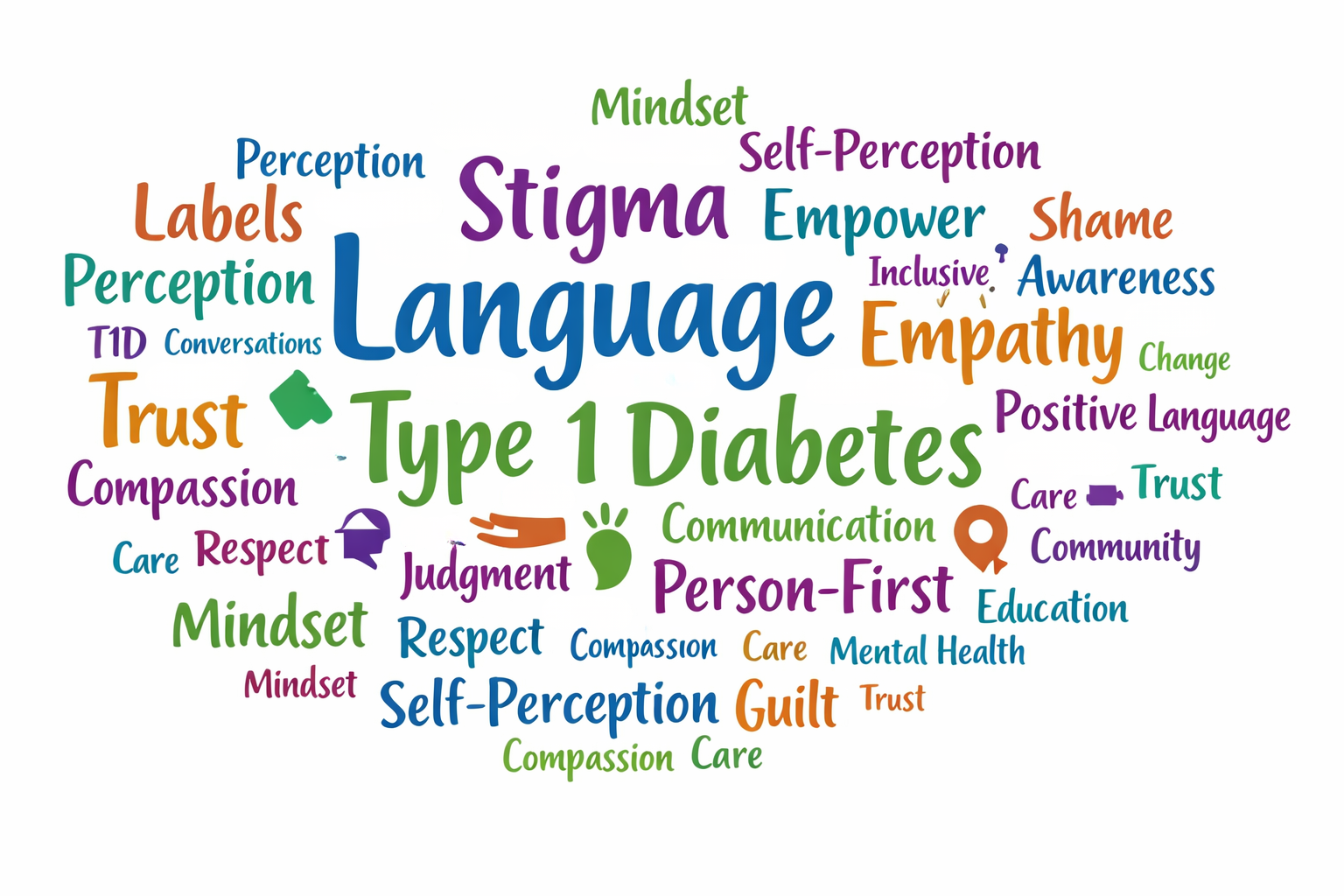


Language doesn’t just tell a story — it shapes how we think, what we believe, and how we feel about ourselves and the world around us. This is especially true in healthcare, where word choices can reinforce stigma and misconceptions or foster empathy, understanding, and empowerment.
For those living with type 1 diabetes (T1D), language isn’t just background noise. It’s woven into everyday conversations with family and friends, in classrooms and medical settings, and even in how people think about themselves. Yet it remains an often-overlooked part of life with T1D.
The words we use to talk about T1D do more than define it — they shape how it’s understood. In turn, influencing perceptions, impacting support, and even affecting how people with T1D view themselves.
Life with T1D isn’t just about medications, devices, and glucose values — it’s also about the words used to explain and interpret them. That’s why it’s worth asking: How does language shape the way we see — and live with — type 1 diabetes?
Can small changes in language make a difference for people with T1D? Experts believe they can. Let’s explore what they have to say.
When words stick
Every phrase, question, or comment can empower — or frustrate and isolate. The language surrounding T1D shapes perceptions, reinforces stereotypes, and influences how people think about and manage their health. For many, constantly correcting misconceptions is exhausting.
“The words that I keep seeing and hearing, despite the work so many people are doing, are ‘control’ and ‘compliance or adherence,'” said Jane K. Dickinson, RN, PhD, Program Director and Senior Lecturer at Teachers College, Columbia University.
“While there are certainly many others, these send messages of ‘you’re doing it wrong’ or ‘just do what I tell you,’ and leave people feeling guilty, ashamed, and confused. This can erode trust in health professionals and diminish self-management behaviors.”
Susan Guzman, PhD, Director of Clinical Education at the Behavioral Diabetes Institute, agrees.
“I strongly believe that the word — and the larger concept of ‘control’ — is the most damaging to people with diabetes,” she said. “It sets an unachievable expectation and is laden with blame and judgment.”
“You can’t ‘control’ diabetes when all the factors that impact blood glucose aren’t fully within a person’s awareness or influence,” she said. “People manage diabetes by constantly making decisions — they don’t ‘control’ it. And, when a person is not ‘in control,’ what does that imply about them?
“I have heard far too many people struggling to reach glucose targets say they’re a ‘bad diabetic.’” But here’s the thing: “Elevated glucose is not a character flaw.”
What does the research say?
A study by Dickinson, Guzman, and colleagues explored how negative language affects people with diabetes. About half of those who participated live with T1D, and the other half with type 2 diabetes (T2D). Researchers discovered that respondents experienced strong negative emotions in response to words and phrases they viewed as “judgmental and unhelpful.”
They reported feeling blamed, misunderstood, hopeless, judged, not motivated, not trusting and not understood in response to the following words and phrases.
- Noncompliant
- Unmotivated
- In denial
- Preventable
- Failed
- Should
- Uncontrolled
- What did you do wrong
- You could end up blind or on dialysis
These findings confirm that negative language carries emotional consequences and highlights the need for more intentional, nonjudgmental communication.
Who can benefit from thoughtful language?
The short answer: everyone.
Thoughtful, intentional language benefits people with T1D, their family and friends, healthcare providers, educators, and the broader community. The words we use shape understanding, expectations, and support at every level.
Public understanding starts with how diabetes is talked about
Public narratives around diabetes are powerful. They can blame and shame — or reflect on the reality of managing a complex, ever-changing autoimmune disease. When language acknowledges the daily burden, risks, and need for systemic support, it helps to replace oversimplifications with informed understanding.
Language awareness helps break stigma and blame
Many diabetes-related terms carry moral judgment — even when it’s not the intent. Shifting toward neutral, descriptive language can help interrupt cycles of blame and shame. Small changes can have a big impact.
 Control →
  Manage
Out of control → Out of target range
Words affect mental health and self-perception
Language doesn’t just inform — it’s internalized, often unconsciously. Ongoing exposure to shaming language may increase diabetes distress, shame, and disengagement from care.
Thoughtful language creates space for understanding
Diabetes numbers are not a moral reflection of a person. They are fluctuating data points, not evidence of “good” or “bad” behaviors. Rather than being seen as a personal failure, trends may signal a need for adjustments in care.
“Good” or “Bad” glucose → “High,” “Low,” or “Out of Range” glucose
If labels are part of the problem, what is the alternative? One approach that’s gained support is shifting away from judgmental language and toward the person behind the lifelong condition.
What is person-first language?
“Person-first language literally puts the person first,” explained Dickinson.
“So often in diabetes care, the person gets lost in all the numbers and words. When we put the person first in our messages, we are forced to remember that it’s a person we are working with or talking about — a person who happens to have diabetes.”
“Putting the person first helps health professionals address the emotional side of diabetes, which is so often overlooked, and humanizes the experience of living with and managing the disease.”
Dickinson knows this first-hand as an educator, a person living with T1D, and as the lead author of The Use of Language in Diabetes Care and Education, co-authored with Susan Guzman and integrated into the American Diabetes Association’s Standards of Care in Diabetes.
At its core, this approach emphasizes neutral, nonjudgmental, person-first language that reduces shame and fear. But it’s about more than swapping words.
“Person-first language is meant to recognize that no one is a disease or condition,” she said. It recognizes that no one is defined by their diagnosis, “their numbers, glucose outcomes, presence or absence of complications, or a treatment plan,” she explained.
Understanding person-first language is one thing. Putting it into practice — especially when it comes to labels — is where real change begins. How can we promote person-first language?
A good place to start is to model it and speak up when we hear someone being defined by labels or misconceptions, said Guzman.
Small changes that make a big difference
What can people do in everyday conversations?
“A small change that can make a big difference is to stop labeling people with diabetes,” said Dickinson. Labels, she explained, are harmful because they communicate stigmatizing messages and can lead others — including health professionals — to form negative assumptions.
“Labels include ‘diabetic,’ ‘uncontrolled,’ ‘well controlled,’ ‘noncompliant,’ ‘adherent,’ and many more,” she added. “A good starting point is to simply stop using them.”
At the same time, the issue isn’t always straightforward. “Many with diabetes still describe themselves as ‘diabetic’ and are not bothered or offended by it,” said Guzman, while others strongly prefer not to. That said, not being bothered by a label doesn’t mean person-first language doesn’t matter.
“People with diabetes have spent decades being called ‘diabetic,’ and are simply used to it,” said Dickinson. “Some may think of it as a badge of honor — many others don’t identify with the label or are even offended by it. Often, people aren’t aware of the stigma attached to the word ‘diabetic,’ and keep using it.”
“At the very least,” she added, “health professionals can lead by example and use person-first terms, which are not offensive or stigmatizing.”
But labels aren’t the whole story. Confusion between T1D and T2D also fuels stigma, Guzman said.
“A common misconception around T1D results from confusion with T2D,” she said. “The stigma applied to all types of diabetes results from myths and misinformation,” such as the idea that diabetes is the result of personal failure.
This can lead to resentment and blame, even among people with T1D. As Guzman emphasized, “Nobody chooses diabetes.”
The solution isn’t found in shaming those with T2D, she said. “Appreciating the complexities of both diseases, challenging myths and stereotypes about all types of diabetes, and modeling respectful and factual descriptions is empowering to everyone.”
Wrapping it up
At T1D Exchange, we believe the words we choose matter deeply. Using clear, inclusive language breaks down barriers, reduces stigma, and opens the door to better health outcomes. Most importantly, it welcomes more people into a thoughtful, supportive conversation about type 1 diabetes.
As you reflect on your own experiences, consider: How has T1D-related language shaped your experience? How could choosing more thoughtful language reshape the way you see life with type 1 — and how others see you?
The post The Language of Type 1 Diabetes: Why Words Matter appeared first on T1D Exchange.
What's Your Reaction?
 Like
0
Like
0
 Dislike
0
Dislike
0
 Agree
0
Agree
0
 Disagree
0
Disagree
0
 Excellent
0
Excellent
0
 Useful
0
Useful
0
 Great
0
Great
0