
































%20and%20Batch%20Production%20Records%20(BPR).png)













How patient education drives lasting behavior change
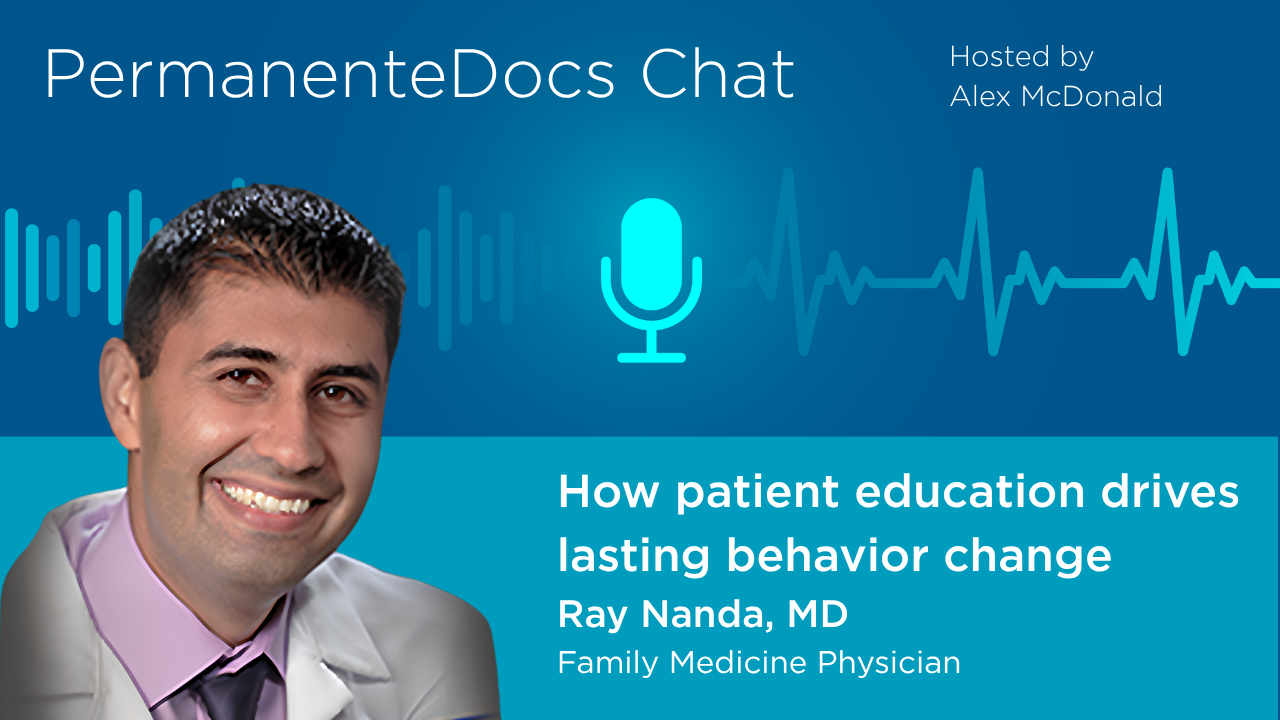



While access to quality health care is essential, an estimated 80% of health outcomes are driven by factors outside the health care system, such as socioeconomic conditions and patient behavior. That makes patient education and lasting behavior change vital to helping physicians improve long-term health.
In the latest episode of PermanenteDocs Chat, Ray Nanda, MD, a family medicine physician with the Southern California Permanente Medical Group, and regional physician lead at the Center for Healthy Living, talked to host Alex McDonald, MD, about how lasting behavior change is a journey that requires the right set of circumstances to create healthy habits.
What is the role of physicians — and AI — in behavior change
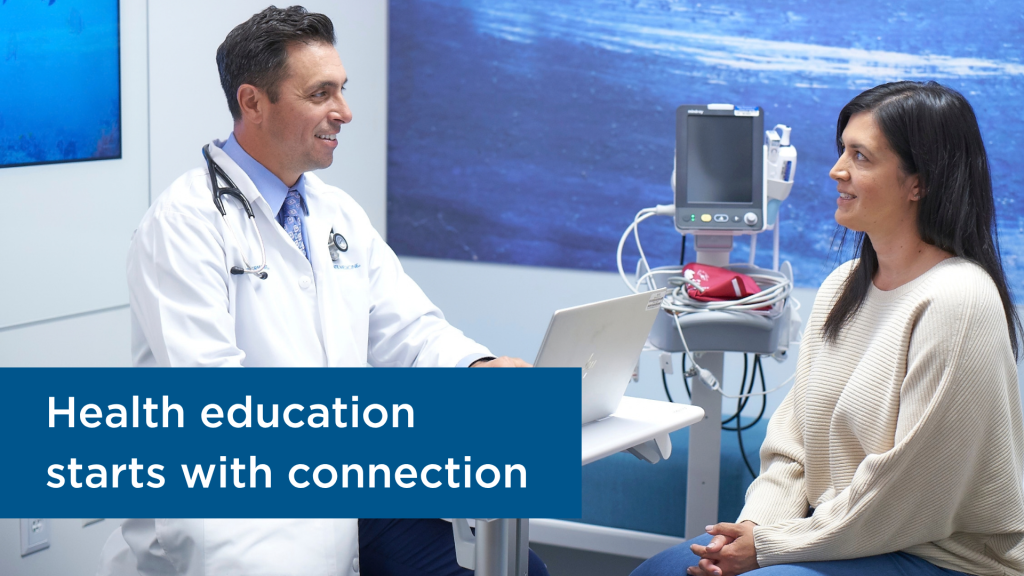
In their discussion, Dr. Nanda and Dr. McDonald explored strategic ways to communicate with and educate patients. They highlight the importance of building trust and establishing a successful partnership, which will create more alignment and engagement on the part of patients.
An example motivational technique Dr. Nanda raised is drawing ideas for change directly from patients, who are experts on themselves, while physicians, as experts in medicine, can turn evidence-based health education and tools into successful patient action.
When asked about the role of AI in behavior change, Dr. Nanda warned that current technology has not matched the human function of physicians maintaining the relationships needed to make behavior change last over time, like quitting vaping and getting exercise.
Watch this episode of PermanenteDocs Chat to learn more.
Podcast transcript
Transcript is autogenerated. Although edited for clarity, it should not be considered an exact replication of the podcast and may also be updated as needed.
Alex McDonald, MD: Welcome everyone to today’s PermanenteDocs Chat. I am your host, as always, Alex McDonald. And today we are talking about health education, patient education, and how we can help frame health education as an actual intervention as opposed to an afterthought. We are joined by my good friend and colleague, Dr. Ray Nanda, who is the director of the Kaiser Permanente Center for Health Education here in Southern California. So Dr. Nanda, welcome and thanks for joining us. Dr. Nanda, tell us who you are and what you do for those two people out there who don’t know who you are.
Ray Nanda: I am the physician lead for something we call the Center for Healthy Living. You have some sort of analog, most likely if you’re in Permanente. If you’re not in Permanente, we have a recruiting website and we would love to have you come on, come on in. And so what is that? The Center for Healthy Living is the evolution of health education, Dr. McDonald, as you know very, very well. And you’ve got the gamut of patients out there in the San Bernardino County area, from super wealthy living on the hill to people just struggling to figure out “How am I going to make rent this week?”
And health really is something that impacts everybody in a very personal way, in a very meaningful way in terms of their happiness. So we start with evidence-based. We look at that. And then what we’ll do is we’ll shift into something called human-centered design, which is not the old way of “we will build it and you will come.” But it is “you are the target person we want to help. Let’s build it with you. Tell us how we should build this so that we put up an evidence-based construct in a way that you would take advantage of because we really want to be your partner in health.” So in a nutshell, that’s really what Center for Healthy Living is modeling with those two facets. And there is an analog of that, I think, throughout the Permanente’s and I’m super proud of the work everybody’s doing in health education and the Center for Healthy Living.
AM: We’ll get into lots of details here, but I want to even take a step back at this point. And when people think of medicine health care, they think of pills and procedures and diagnosis and treatments. But we know 80 to 90% of what actually shapes a person’s health happens outside of the four walls of an office visit or a hospital visit. And how do you think about the relationship between medical care and personal behavior and how do you define the physician’s role within that context?
RN: That is an excellent question. There is no answer to this on the outside and I wish that there was, but we have invested lots and lots of resources into how we help our patients live healthier lives. Dr. McDonald knows how to prescribe metformin. Dr. McDonald knows who needs an MRI. But what Dr. McDonald may not be an expert is, is that person going back to work their second job? Is that person taking two buses to get to him and that kind of thing that will impact what the patients are able to do with our counsel. So the way I frame it to my docs is “you’re an expert in what you are an expert in and the patient is an expert in themselves.” And when you partner, the opportunity is incredible to move patients forward in terms of their health and move health outcomes and provide this value-based care that we’re the best at.
And there’s also a desynchrony when sometimes we just assume things about our patients that they are capable of doing and then we backtrack because we find out along the way that sometimes it’s not so easy to do the things that we’re asking them to do.
How to create lasting healthy habits in patients
AM: Absolutely. I can think of a patient. I saw a patient last week actually, a middle-aged gentleman struggling with obesity and diabetes. And this man was prescribed probably 15 different medications for diabetes and people just kept throwing more and more medications at him. And when I met with him and I sat down, he couldn’t afford his medications. He wasn’t taking half the medications. And so being a family doctor, I had a relationship with this gentleman. I knew him better. And rather than just doing some of these patchwork pieces of throwing medicines here and throwing medicines there, we could actually sit down and you want to talk about the root cause of a disease or root cause of a problem when you can’t afford your medications, that makes it hard when people just keep throwing medications at you. So I think that’s what we do so well as family doctors and just partnering with our patients when it comes to behavior change and understanding all the different things beyond all the things in our toolbox besides medications.
So again, when we’re talking about behavior change and partnering with our patients, why is behavior change so difficult and what is that? How can we help patients? How can we guide patients through making real and lasting changes to their health and their diet and their physical activity, which we know are true underutilized drivers of health?
RN: So just to tie together the last conversation into this conversation, the last conversation is that we have an enormous system around our physicians. We have an organic practice. So when you do your doctoring and you know that a patient needs help with medical financial assistance, they need help with where do I find affordable, healthy foods, they need transportation assistance. The Center for Healthy Living is one of the constructs that helps support the patients getting their best ability to activate these resources that Kaiser Permanente in aggregate supports our members with. And that’s how we’re so different than every other organization. We really are and we’re blessed to be that way. But you asked me a very loaded question about why behavior changes so hard, didn’t you, Dr. McDonald?
AM: I was hoping you wouldn’t notice.
RN: Any good guest is going to turn it right back around to the host. So let me ask you a question, Dr. McDonald, and let me ask you, podcast land. Think about your New Year’s resolutions for 2026, everybody. I’m not asking you to share because I know that they may be extraordinarily personal. So Dr. McDonald, in all honesty, it’s end of May on this podcast. Have you accomplished all of your New Year’s resolutions that you set out for 2026?
AM: No, I’m going to go with no.
RN: Are you stupid? Are you non-compliant? Are you patient refuses treatment? Do those things apply to you?
AM: Well, I should ask my doctor actually, maybe. I’m not sure. I like to think not, but it’s certainly possible.
RN: They don’t. So again, sometimes we get in this mindset of we can tell somebody to do something and they’re just going to come back 30 days later with some miraculous ability to do that. If you look at our own personal behaviors and the goals we set for ourselves, these are journeys. These are longitudinal journeys that require time, they require assistance, they require creating the right set of circumstances to live well, to be well. And again, as we brought up the example of New Year’s resolutions. So another question back to the host, how many days does it take to make a habit, Dr. McDonald?
AM: Well, I feel like I should know the answer to this. I want to say three months.
RN: Okay. So I think what you were trying to say is 21 days.
AM: Sure. Three weeks. Sorry, I meant three weeks. Did I say three months? It was my mistake.
RN: Well, because every industry is 21 days to financial freedom, 21 days to six-pack abs, 21 days to becoming a better golfer. So where did that 21 days of habit formation mindset get created? Got created in plastic surgery. You know what? It takes 21 days for a patient who’s had a facelift to get used to that new face in the mirror for the brain to get used to it. That has nothing to do with behavior change, that has nothing to do with health behavior change. So if you challenge me and you say, did you take your boards? Yes. How long does it take on average to institute a health behavior change that sticks not just for the weekend, but that sticks longitudinally? The answer is on average 66 days, so you were very close, but it can go up to 253 days. So if you allow for that and you embrace that, that is the cycle of behavior change.
And some folks it’s long and some folks is a little shorter and there’s always relapse. Then you can understand why behavior change on a long-term basis is so very challenging because there are a lot of things that we need to lock into to make things become a habit. And I know you have plenty of podcasts that bring up ways to form healthy habits, and I love those. I love those.
AM: I think that’s the piece is helping how do we partner with our patients to make those behavioral changes. And again, we can sit there and talk till we’re blue in the face, but again, knowledge is power and how can we give our patients the knowledge and give our patients the power so that then they can then go make those behavior changes, which we know are evidence-based, which we know are going to actually move the ball down the field when it comes to keeping them healthier or preventing reversing illnesses and diseases.
How to motivate patients and create alignment between patient and physician
RN: So remember back to what’s on both ends of this. This device that was invented in Dr. McDonald knows probably 1693 by a barber bloodletter and surgeon on both ends of this is trust. So if the person on the bell side trusts me and I on the earbud side trust them, if we have that confidence in each other, that alignment, we’ll call it alignment, we can get anything done. If we don’t start there, we’ll never wind up there, frankly, that’s kind of the way it is. So a lot of what goes wrong. So if you think about the last time you had that sick feeling in your stomach because you had a disagreement with a loved one and we know it can’t be Dr. McDonald and his lovely wife, who is my favorite person on the planet because they’re both perfect human beings, but you don’t have a cool side of the pillow because you’re tossing and turning about something you’re not … It’s almost always due to non-alignment.
So when we talk about aligning, it’s much … And we talk about joy in medicine. Alignment and joy in medicine go hand in hand. And what does that mean? When we get frustrated, when we get angry, when we are really kind of fuming that our patients are not following through on the plans that they agreed to, that we told them that was going to be get better outcomes and healthier lives, then it goes sideways. However, when you yourself are not taking on the responsibility of creating the solution sets, especially around behavior change, but what you’re doing is you’re asking open-ended questions, you’re giving advice, you’re assessing confidence and readiness for change, you are assisting people by pulling out their intrinsic motivation versus what, Dr. McDonald? What’s the other kind?
AM: Intrinsic and the extrinsic motivation.
RN: And which one lasts longer?
AM: I’m going to go with the intrinsic.
RN: That’s exactly right. Intrinsic motivation. So when you’re able to pull out with these open-ended questions, the patient’s ideas for change, the patient’s solutions for change, the patient’s reasons for change instead of you giving all of that to them, then what you do is you unburden yourself. So if that patient still continues to struggle, you are not going to be super frustrated and actually you’ll be more successful because they came up with things that would actually work for them, not put the statin by your toothbrush and that’s everybody’s solution to statin adherence. And you could think about vaping and tell somebody all you want to that they’re going to get lung injury from vaping. But then if you say it like, what do your kids think of your vaping? Oh God, that’s like a gut punch for so many people. And then they wind up thinking about their reason for why they may want to change and it goes on and on in terms of what would help you be successful.
Can I share some things that have been successful for other people and how might that work for you? So as opposed to directing, I think the strategy is, and the joy comes from bringing out the ideas from our patients at the end of the day, those are the visits that wind up in a hug.
And at the end of the day, the other kind of visits are the ones we go home and fume to our spouses about so-and-so didn’t do this and I’m so bad and I keep telling them the right thing to do. But we can break that cycle if we just embrace a little bit of a different approach with those people who are struggling with those people.
AM: And you talk about trust and you talk about partnering with your patients and helping patients engage where they feel like they have some autonomy and they have some ability to make a difference as opposed to just being told what to do. And I think again, to bring this back a little bit to the Center for Healthy Living, I think that’s what’s so valuable is I as a physician can say, “Hey, you know what? We have 15 minutes together. We can talk about X, Y, and Z, but I’m going to then pass you on to this amazing resource where you can learn more. And by building that trust and having that little bit of relationship, even in a short period of time, the physician recommendation to then go move forwards with this other program where they can delve deeper into their own education and their own aspects to make these changes, that’s I think an amazing resource and so incredibly valuable.
RN: That is the power of Permanente Medicine. That is the power of the physician. That is the role of the physician. You’re not there to be their dietician, their social worker, their exercise counselor. No offense to my sports medicine boarded colleague, you are there to provide expertise and backtracking into the earlier conversation. The patient is there to provide the expertise on what on themselves. And when you partner, your days fly by and they’re so joyous and the opposite is also true.
AM: Well, and I think that says so much about the building that relationship between the patient and the physician, that trust, which helps fulfill us as physicians and makes us more sustainable in our own practice and our own professional wellness, but also ultimately helps the patients achieve their goals better and stay healthier also.
RN: And so you might ask, “well, that sounds good on a podcast, but does it work in reality?” And you said you’re going to start with the evidence-based and do this awesome human-centered design and life is going to be like puppy dogs and rainbows if I use some of these little tips to engage with a patient. And so if you are the kind of person that is driven by outcomes, are you, Dr. McDonald?
AM: I am highly motivated by outcomes. I will not lie.
RN: Got it. So when we embrace the very techniques you and I are talking about us using here and we apply them to these constructs and it’s different in every region, but when you apply this construct to a group education type of class, it’s no longer a class, it’s a workshop, workshops and life change and the power and the technique that I’m kind of dancing around is called motivational interviewing, but I was trying to say before that. Out saying it. But what we have done is we have proven. And when I say we, it’s not us. We don’t study our own data, but when we go to the evidence, we build it with folks and then we use motivational interviewing, those three constructs alone. We can drop a patient’s A1c by 1%, which is as much as metformin or more in those patients who are 9, 10, 11 A1Cs in just two sessions.
We can drop body weight of 5%, which approximates some of the weight loss medications out there just through a 16-week lifestyle-based program. So we chase outcomes and we chase things that are meaningful. We don’t chase information. Why, Dr. McDonald? Where can you get information these days?
AM: Everywhere?
RN: Everywhere. So your and my practice used to be, “I Googled this, doc” and now it’s, “I ChatGPT’d this and here’s what ChatGPT says is wrong with me, and here’s what ChatGPT says I should do about that. So I need you to prescribe this because that’s the information that I got.” So information is just a commodity, but real expertise in helping people change their behaviors long-term, that still is a human function. I know everybody wants to AI, AI, AI everything. And by the way, I loved podcast number 36 with Dr. Khang Nguyen, the AI king. And the future is absolutely there to incorporate AI into a lot of this. And there is still something about that relationship that some of these skills AI is really not close to being able to deliver upon that again. I think that we are lucky to be on the human side of the robot wars because there’s still some things that we do a hell of a lot better than AI. Not that I’m against AI. Let that AI agent make my appointment.
AM: Well, and everything you’re talking about here is how do we help activate a patient? We can counsel a patient, but then how do we activate a patient? And those are different things. So tell us, again, for the physicians listening out there who have been used to that motivational interviewing and counseling a patient, what is the difference between that versus activating a patient to then go on and use all these other resources?
RN: So again, what I’m going to do is I’m going to boil this down into five As. We’ll give you the five A’s, ask, advice, assess, assist, arrange. And all of these things are along the spirit of respecting that patient’s autonomy. You made the magic A word, autonomy. So when the patient says, when you ask them, “is it okay if we talk about your weight today?” If they say yes, then they have embraced the autonomy to give you the permission to go into that space. They’re much more receptive to what you have to say. When you ask them, “would it be okay if I shared with you some things that we know about make up the condition, diabetes or hypertension and that kind of a thing?” “Yes, you may.” That again is autonomy. It’s not any different than the information you were going to give them anyway, is it? Except you’ve asked for that space and that permission and therefore respected them.
And then your job is always to not be judgmental but to assess. So is this person going to walk out of this office with a greater than five to six out of 10 chance of activating through what they said were good ideas that they had come up with or less? And if it’s less, be honest and be realistic and say that sometimes behavior change, like our New Year’s resolutions, takes time and don’t get frustrated. And then they’re always asking for our assistance in terms of, well, they will ask you for expertise and don’t fall into just the information trap always. It’s not always the driver of health behavior change, but we are tasked with delivering information. It’s just open that space for autonomy, respect their opinions about things. Don’t make anybody feel stupid or belittle. “How could you think that the vaccine for flu causes the flu itself? Don’t you know we have all these studies?” Don’t be like that. Just respect the fact that that’s where they’re coming from and then share your expertise. And then lastly, the last A is arrange. You really want to set up these smart goals with your patients. You don’t want to let them off the hook and say, “I’ll be better. I’ll see you at next year’s physical. My triglycerides will be down from 450 because I’ll stop drinking,” and that kind of a thing. What you want to do is you want to set up these SMART goals to hold them accountable both in a time fashion, but also in a medically appropriate expertise glide path.
AM: I think that makes perfect sense. I love how I think you and I are obviously a cut from the same cloth. We both love the Center for Healthy Living because it’s not just support, it’s an actual intervention. I use this example all the time. I talk about diet, I talk about exercise, talk about sleep,
But how often do I say, “I want you to walk 30 minutes, five days a week.” How often do we say, “Here’s some metformin, you should take something.” That’s what we do a lot of times in these exam rooms. We tell patients, just using exercise as an example, “You should exercise more.” And we don’t make it a SMART goal. We’re not specific or targeted about what it is. And that’s one thing that I try to do is think about these lifestyle interventions as an actual intervention and not just sort of an afterthought or a support tool. So for those out there who maybe are not as familiar with it, how do you think about the Center for Healthy Living as an actual clinical intervention as opposed to just extra help?
RN: This is great. And by the way, if you’re like me and you’ve screwed this up 10,000 times a day in your career and you’re sitting there thinking like, “Oh my God, all I ever do is tell people what to do and what am I doing?” That’s okay. That’s been my journey. That’s been Dr. McDonald’s journey, and there’s a better place to land. So definitely that’s one of the reasons we got together today to hopefully lift all boats, help people in what you really want to achieve, which is what drives you is seeing your patients thrive. So I think we’ll go back to one thing you had mentioned is what the role of the physician is. Did you know that the most important driver of a patient coming into health education or a Center for Healthy Living, depending upon what you have is the physician referring them?
Why in the world would that be? Wouldn’t the patients just, “Give me a diabetes program, give me a weight loss, give me this, give me that.” Wouldn’t the patients be safe? But actually what we find is that the highest rate of attendance, the most activated patients are the ones that have this really respectful collegial conversation with their physician and that sticks and that’s worth your time. So that’s number one. Number two, if our assessment and plan doesn’t always have a space, I don’t care if you’re using Abridge like I am to save my life or you’re using something else, if your assessment and plan doesn’t have a space or a line for how the patient’s going to help themselves, how our system is going to help the patient help themselves — and again, this can go back to lifestyle, it can go back to financially, it can go back to housing insecure, how the patient is going to help themselves in a way to help them be healthier — then we are missing something because that you said it, only 10% of what’s going to happen with that patient’s health is doctoring. The other 90% is going to come from somewhere else. So imagine what is your percent assessment and plan look like? Is it 90% something else and 10% doctoring? Probably not. Mine’s not.
But even a line or two in there concretizing the formal thinking from you to yourself and now with open notes, patients reading their own notes in addition to you doing the prompt in your system of care to getting the patient the right help that they need, this is really what we’re talking about. It just belongs on that line with metformin and left-knee MRI and all those things.
The role of AI in behavior change
AM: I completely agree. This is great. We could probably go on for years, although we got to keep this somewhat wrapped up. I want to ask you one brief question that you touched on earlier about AI and how you see AI shaping health education and does it create new challenges and new opportunities as we enter this post Google world, so to speak?
RN: So I am giving myself permission that the answer I give you on May 29th, 2026 would be very different than three months from now, a year from now and three years from now. Okay? Fair
AM: Point, fair point.
RN: Right now at this particular moment, no, the agentic or other form of AI has really not delivered that kind of capacity to be able to help the patient so far yet with behavior change. It’s great for information. It is absolutely perfect for information. However, being able to unravel what’s underneath the surface, this is what AI is not super good at this point in the lifecycle of this technology. I think there will be a day where 50% of lifestyle intervention is going to be delivered AI and 50% is going to be delivered by a human being. Yes, I do. And will that leverage our system, preserve our resources, offer things to people who are really driven in that motivation and in that kind of platform? Yes, but we have to build it correctly and it has to have physician oversight, it has to have the right expertise because like you brought up, are there unintended consequences of AI?
And unfortunately we’re reading about those every day that people start to go in there and get bad things and the AI just wants to serve. It’s where you and I always start every conversation — how can we not harm this patient and then let’s move into the space of how we’re going to help them. So yes, the potential for the technology is there. No, it is not a one-size-fits-all solution for everybody. I apologize to Dr. Khang Nguyen for saying that.
AM: Well, it’ll be interesting too, because I think your point of we need to make sure that we have physicians involved on the ground floor as we continue to build these tools and not placate their responsibility or shift that responsibility to someone else and coders and designers, which are great, but we have to make sure it’s patient-centered and it’s based on evidence and that it helps serve both the patient and the physician trying to help do that work also.
RN: And then you said, “Hey, as a physician, I’m motivated when I see your diabetic outcomes — your A1C drop of 1% or more.” I think we have to hold AI to the same standard because if it can’t deliver on the same health outcomes, I understand that everybody thinks it’s cheaper. Actually, some of the studies coming out show that in some things AI is not cheaper, believe it or not. And if it can’t measure up to at least our standard of evidence-based and our standard of delivering value-based outcome-based care, then I would say that it’s inferior technology. And again, I don’t want to make a blanket statement. I’m just saying that we need to hold it to the same accountability we hold our human lovable human beings like you and me too as well.
AM: Well, and I’d love to see AI do cartwheels in the hallway like I do when my patient’s A1C drops by two or three points, but we digress.
RN: We have your video on YouTube of you doing that. I can’t remember if you ran up a flight of stairs and then did the cartwheel or if you just did the cartwheel up the stairs. Do you remember?
AM: I don’t remember. It’s all right. We’ll find the video. So awesome. Great conversation. One last question, my favorite question of the whole podcast, what makes you most proud to be a Permanente physician?
RN: That I think has 13,000 answers. I think a lot of them are very, very similar with all of our colleagues across the country. It’s our ability to be the leader in value-based, quality-based care because what we do is we give people birthdays. We give people anniversaries. We give people graduations way more than any other system on the planet does because of the incredible care. I don’t care if it’s cancer care we’re talking about. I don’t care if it’s diabetes care or cardiac care that we provide. I am so incredibly proud of this being a physician-run organization. In this day and age, frankly, that is a dinosaur and very hard to find and we stand on top of that world. The reason our patients do so well is because this place is physician run. Please everybody out there never, ever forget that when you have a really tough day, we still call the shots and that is really what our secret sauce is and why we have an competitive advantage all over the place.
It doesn’t matter if it’s Center for Healthy Living, Dr. McDonald’s, young athletes in college, the sports teams type of clinic. We run this in a way that always has the patients at the center and that is why I’m so damn proud to be here. We have this big controversy in some of our regions about retirement age and things like that. Guess what? You will have to drag me kicking and screaming out of this place when I’m 65 if they haven’t changed that by then because I love what I do. I love what Dr. McDonald does. I love what you do and I can stand behind that for our 13 million patients that we take care of. And we’re an amazing, amazing group. So thank you for your time and having me on and for your attention on your drive home or whatever it is.
AM: Amazing. So well said. I really appreciate you taking the time and sharing your thoughts and your expertise with us and all the listeners out there.
AM: And thanks for all of you out there listening. Please make sure you like, subscribe and stay tuned for all of our multitude of Permanente Docs Chats and Permanente Medicine podcasts.
RN: Live long and prosper, everybody.
The post How patient education drives lasting behavior change appeared first on Permanente Medicine.
Apa Reaksi Anda?
 Suka
0
Suka
0
 Kurang Suka
0
Kurang Suka
0
 Setuju
0
Setuju
0
 Tidak Setuju
0
Tidak Setuju
0
 Bagus
0
Bagus
0
 Berguna
0
Berguna
0
 Hebat
0
Hebat
0