

















































%20and%20Batch%20Production%20Records%20(BPR).png)














Podcast: Designing care that delivers quality, access, and affordability
Designing care that delivers quality, access, and affordability: A conversation with Ameya Kulkarni, MD



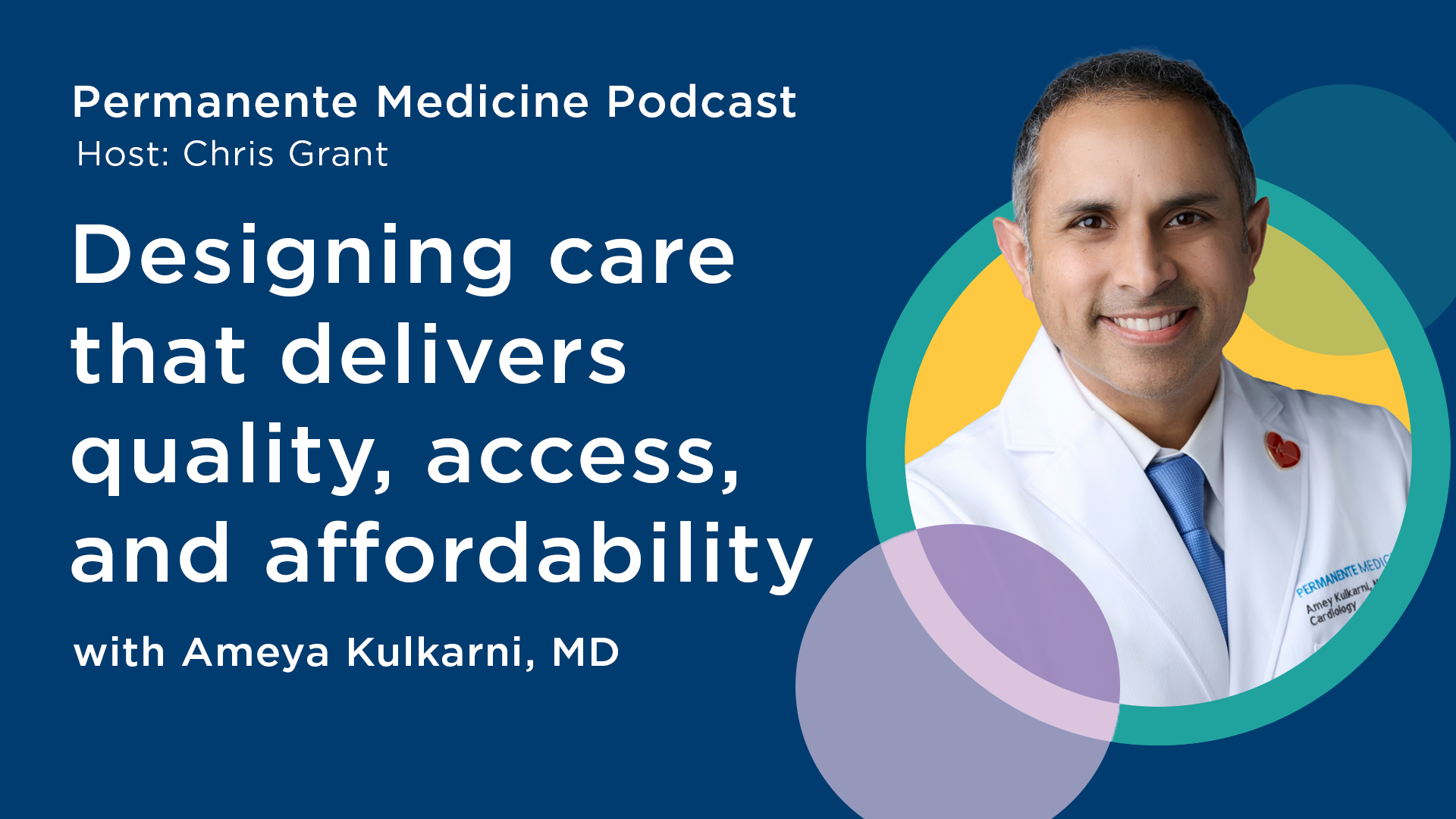
In this episode of the Permanente Medicine Podcast, Chris Grant speaks with Ameya Kulkarni, MD, executive medical director of the Mid-Atlantic Permanente Medical Group, about the future of physician-led, value-based care.
Dr. Kulkarni shares how integrated care models can improve access, affordability, and quality while reducing friction for both patients and physicians. The conversation also explores physician well-being, the importance of meaningful work in medicine, and how Permanente Medicine supports clinicians through community and purpose-driven leadership.
Dr. Kulkarni also discusses why trust between patients and physicians may be one of the most critical factors shaping the future of health care. From preventive care to innovation and leadership, this episode highlights how value-based care can create better outcomes for patients and care teams alike.
Watch the full episode on YouTube:
Connect with Chris Grant by following him on X at @cmgrant or LinkedIn.
Follow us: Subscribe to the Permanente Medicine Podcast on your favorite streaming platform.
Podcast transcript
Transcript is autogenerated. Although edited for clarity, it should not be considered an exact replication of the podcast and may also be updated as needed.
Ameya Kulkarni, MD: Everyone is obsessed with longevity now. You hear about it every day, but what are the best biohacks you have? It’s vaccines, it’s cancer screening, diabetes control, hypertension, and cholesterol control. If you do those 5 things well, you’ll live 6, 8, 10 years longer. And we know that because if you’re a Kaiser Permanente patient, you do.
Chris Grant: Welcome to the Permanente Medicine Podcast. I’m your host, Chris Grant, the chief operating officer at Kaiser Permanente, The Permanente Federation. Today I’m joined by Dr. Ameya Kulkarni, executive medical director of the Mid-Atlantic Permanente Medical Group. In this role, Dr. Kulkarni oversees more than 1,800 physicians caring for more than 740,000 members in Kaiser Permanente’s Mid-Atlantic States. As such, Dr. Kulkarni is responsible not only for clinical excellence, but for advancing access, affordability, and sustainable growth within an integrated value-based care model. As the health care landscape grows more complex for patients, physicians, and communities alike, the question on the minds of many isn’t just about how we ensure people get the care they need, but how we can do it responsibly. This means making care easier to get, delivering measurable value, and creating an environment where clinicians can lead and excel. Today, we’ll explore what that looks like in practice from integration and access to affordability, culture, and leadership in a rapidly evolving environment.
Dr. Kulkarni, welcome. We’re so happy to have you on the podcast.
AK: Oh, thank you so much for having me. I’m excited to talk medicine with you.
CG: Before we get into the conversation, I thought let’s let our audience hear a bit about your journey into medicine and what ultimately drew you into the medical leadership role that you’re in.
AK: When I was a kid, I wanted to be president of the United States. When I was five years old, that’s what I wanted to be. And then when I was about 7, I had typhoid fever and I was actually in the hospital for 18 days. And I went into the hospital, wanted to be president of the United States and I came out wanting to be a doctor. And so that’s my formation story, if you will. And it’s interesting because I was sort of going through the course of undergrad and med school. I’m probably the one Indian kid whose parents didn’t want them to be a doctor. My dad wanted to be an entrepreneur, so I went to business school as an undergrad and I always liked the sort of 2 sides of medicine, the chance to care for patients at the bedside and really make an impact on an individual patient.
And then the chance to influence how health care looks in America and the world. I always thought that physician leadership was critical if you wanted good health care. And so when I got out of training, I started looking for places where the physician voice mattered a lot and I found Permanente [Medical Groups]. And the rest is history. I started solving problems early in my career for the medical group. And if you solve one problem, people ask you to solve more and I found myself doing more and more. And now since January, I’m in this role.
CG: Let’s continue down that leadership pathway. You’ve stepped into a significant and important role. Kaiser Permanente has been caring for people in the Mid-Atlantic region since 1984, over 40 years. From your perspective, what has contributed to the staying power of Kaiser Permanente and what will help you not just continue to lead in that region, a critical region of the United States, but grow?
AK: I actually think the staying power of Kaiser Permanente in the Mid-Atlantic States is the same staying power in California or Oregon or Washington, anywhere else we are. Because when it comes down to it, patients want simple things. They want a doctor they trust to help them guide them through their care journey. They want care to be easy. It shouldn’t be that hard to get. They want it to be affordable and they want to know they’re getting really good care, high-quality care. And so if you put that equation together, it’s high-quality, high-service, trusted care led by physicians that’s affordable; that’s us. And so I think that patients who choose us see that and they stick with us. And the reason for that is that if you’re a Kaiser [Permanente] baby and you grow up, you realize just how wonderful it is to have a trusted physician backed by this incredible system offering high-quality care at a good price.
And how we’re going to grow is just letting the world know that’s what we do. I think you and Chris, you and I talk about this all the time, the outside world is so fragmented. Patients are so frustrated by all of the opposites of what I just said. They’re not sure if the quality of care they’re getting is great. Their doctors don’t talk to each other. It’s either unaffordable or they don’t know how much things cost because pricing is not transparent and it’s the opposite of who we are. And so patients are looking for us. And so I think if we get the message out in the Mid-Atlantic, they’ll come.
CG: I think that’s a great point. And we all hear horror stories from family members, relatives, neighbors about navigating the health care system and the health care environment. And to your point, trying to figure out what is the right doctor to see or getting a surprise bill that they didn’t expect. In Kaiser Permanente, we solve for those things. And your description, Dr. Kulkarni is so spot on of really it’s high-quality care that you can just be assured that it’s the greatest quality, but it’s also in the hands of doctors in a partnership decision between the patients and the physicians. Like all Permanente executive medical directors, you lead within a value-based system and what you’re describing is a value-based system. Practically speaking, what does that mean for physicians and patients and what role does integration of care and services play?
AK: So I’ll start with what it means for a physician. I think for physicians, it means that you get to hone your craft with minimal interruption. But when we’re doing it right, physicians get to care for patients and they have to worry about very little else. They don’t have to worry about prior authorization because we’re an integrated system. We don’t have to worry about which medications are on the patient’s formulary because our clinical leaders have those conversations ahead of time. We agree ahead of time to say, this is the clinically indicated path for medications. You don’t have to worry about how I’m going to get my patient to a specialist on time or whether I’m going to hear what happened at specialists because we’re in a single integrated electronic medical record [system]. And so I think that for physicians, you get to practice medicine. I call it like the village doctors for the 21st century.
We get to practice the best version of that Andy Warhol painting of the classic doctor, but with all the 21st century tools. That’s for the physician. And for the patient, it means care that’s simple and easy to access that doesn’t have to be that hard and that’s super high quality. And what’s super interesting is that we often talk about quality and we don’t always put a fine point on it, but you think about what quality of care means. Quality of care to me at a system level means that we are continuously monitoring the things that drive longevity. Everyone is obsessed with longevity now, like you hear about it every day, but what are the best biohacks you have? It’s vaccines, it’s cancer screening, diabetes control, hypertension, and cholesterol control. If you do those 5 things well, you’ll live 6, 8, 10 years longer. And we know that because if you’re a Kaiser Permanente patient, you do.
CG: You’re so spot on and there’s a lot of very strong proof points and defensible data around the risk of mortality from heart attacks or cancer externally versus compared to within Kaiser Permanente and demonstrably greater longevity and reduced late-stage cancer diagnosis or cardiovascular risk. So everything you described is spot on.
AK: It’s so funny, every time I see a headline or read an article about what’s wrong with American health care, and there’s one every day, I always think, look, we solved that problem already. And we’ve been thinking about that for 40 or in some cases 80 years and prior auth, we’ve solved that problem already. We know how to do it because if you have smart, thoughtful clinicians who have a conversation with our colleagues on the payer side upfront and have the real conversation about what’s the right thing to do for patients, then you get a formulary that works for physicians, for patients, and for a system. That’s how you keep care affordable and high quality.
CG: I’m going to continue on this thread. One of the things you sometimes hear from patients is that health care feels really complicated. How are you thinking about simplifying it? How do you define access beyond just an appointment availability?
AK: I’ve been thinking a lot about this concept called minimally disruptive medicine. The idea is that when a patient is seeking care or going through a condition treatment journey, that they have a certain amount of capacity to apply effort to their care and that capacity has to be deployed to the work of getting their care, making the appointments, doing the follow-up, getting all the information, understanding the information, then the actual illness recovery and then all the emotional and mental weight with their family. So those 3 things, they have to have the capacity to manage all of those. And if we ask patients to invest all of their capacity on just getting the care that they need, that they have nothing left in the tank to make sure that they’re having a salad every day so that they reduce their A1C or make sure that they’re going to the caregiver meetings.
And so how I think about access is really about minimally disruptive medicine. And so then what does that mean practically? So obviously access to appointments is really important, but it can’t just be that you get an appointment very quickly. It has to be easy to get the appointment. When you get the appointment, it has to be easy to do the next thing like if you need testing, getting the testing done quickly. If you have to go to the hospital, it should be a quick process for the hospital. You should be reconnected to your health care system afterwards. All those things contribute to access. My favorite example of this is, so about a decade ago we started our transcatheter aortic valve program. I’m an interventional cardiologist by practice and we started our transcatheter aortic valve program, our TAVR program. And at the time it took an average of 12 weeks for a patient to get all the testing they needed.
They had to see a bunch of different physicians or a bunch of requirements. And so we decided that when we launched our TAVR program, we were going to make the attempt to make it a one-day TAVR evaluation because the majority of patients undergoing TAVR are in their 80s or 90s or in their hundreds and they have a caregiver most of the time. So we said, if we can make it one day, even if it’s a hard day, that one day of getting all the testing you need done is the right way to offer access to care. That integration and coordination effort, to me, that’s what access is, that you’re thinking about how much disruption to the patient and their family’s life is required to get the care they need.
CG: I love it because you’re really thinking about the whole individual, the physical ailment or challenge or diagnosis, but also emotionally, mentally and their family. And how do we organize care in a way that really is seamless and frictionless for them that can just change not only that patient’s life in a profound way, but also affect their families.
AK: I want to just say it again. The time that a patient waits to hear an important diagnosis, whatever the diagnosis is, the days in between when they think they may have something and they found out they have something, those days are the hardest days of their life. The faster we can get them to diagnosis, to treatment, back to their lives, that’s part of healing.
CG: Let’s continue down this kind of consumer-patient centricity. Affordability is also top of mind for patients and health care delivery system leaders. How do you balance delivering high-quality care, that care that you just described, including all the elements of access and experience with being financially responsible within the health care system on behalf of the communities we serve?
AK: Yeah. I think this is the biggest secret of Permanente Medicine is that high-quality care is affordable. I think that it’s worth saying twice, that high-quality care is affordable. Let’s talk about cancer diagnoses. Early detection of cancer is not only better for the patient, it’s going to make them live longer. It’s also cheaper. And again, cardiologists, managing diabetes and hypertension, we always joke that a cardiologist’s job is to make your job irrelevant. That’s what I hope long-term. And so primary prevention is so powerful as a tool of cost control and also the way we think about access is different. The rest of the world is thinking about access in terms of how many appointments can I maximize because that’s their sort of stream of revenue. It’s not that they’re bad doctors or bad at their job, but think differently, but they’re just incentivized to have more appointments.
We’re incentivized to care for the patient holistically because that’s how our payment model is. And so what that means for us is that we think about access in terms of affordability naturally. And so if there’s a conversation that can be had in person in an appointment, or I can just pick up the phone and call you now rather than having you wait 2 weeks for the appointment, that’s better for you and that’s a more affordable way to deploy access. Now there’s times when they’re in conflict and this is where physician leadership is really important because the number one goal that we have is to offer high-quality care. And sometimes that care is more expensive, it’s still the right thing to do and we have to be okay saying that. And you know who’s really good at saying that? It’s doctors. Physician leaders are really good at advocating for patients in those moments where there’s a tension between the cost of care and the quality of care. We adjudicate that very well.
CG: That’s one of the nice things about the system is that the end decision around clinical care is really in the hands of the doctor. There’s not an administrative review or approval or denial. When talking with you, Dr. Kulkarni, I feel this excitement and this real true love of medicine and joy. So let’s talk about that for a minute. The environment clinicians work in, what does it take to create a culture where physicians and care teams can find meaning in practicing medicine?
AK: Good question. Yeah. It’s funny because I think that there was a time where the primary marker of this was joy, like happiness in medicine. The reality is that our jobs are hard. We care for patients at their most vulnerable moments and we carry a lot of burdens with us. And so I think singular joy is not always possible, which is why I love you asked the question about how do we create meaning in medicine, which is actually what people want. And so in our practice, we have a strategy for how we think about building meaning in medicine and it consists of 3 elements. So the first element is minimizing the friction of giving care, because if your job is harder than it needs to be, then no matter how fulfilling it is, it’s not fulfilling for a long time. And so we have a committee that’s dedicated to minimizing the friction of giving care.
And sometimes they’re big things, like how do you do message management or how do you make sure that patient phone calls are answered on time in a way that doesn’t tax physicians, how do you minimize pajama time. But some things are small little pebbles in shoes that irritate the way that a physician goes through their day that we can solve pretty quickly. The second part is building community. It’s funny in another life, I ran one of our wellness teams and I wrote an essay that actually ended up in the New England Journal [of Medicine] about the loneliness epidemic in medicine. And in that article, I talked about how like when you’re a resident, you have a doctor’s lunch. The doctor’s lounge is like your place of solace at the community. So we are spending a lot of time thinking about all the different ways in which people build community in our practice and how can we make that easier for physicians and staff and how can we maximize it?
So I’ll give you an example. I love community service. It’s just something that my family and I really like doing. We do it often. And so this year we’re doing volunteer with me. So 3 sessions over the course of the year and 3 of our geographies where our physicians can come and work at a food bank with us and that’s a way of building community. I’m also a runner. I run marathons and we have a running club. So ways to build community and the things you care about. The third thing that’s really important in meaning in medicine for me is purpose, because I think what happens in medicine is when you start as a resident, you have a lot of sense of purpose. And then over the course of the years, the actual day-to-day eats away at that purpose a little bit.
So we’ve developed these sort of clinical pathways, first we call them Permanente Pathways because we love alliteration. And they’re about if you’re interested in being a lobbyist, a physician lobbyist, we’re actually working with [The Permanente] Federation on a program on that. If you’re interested in media, we have a vehicle for you to get in front of media. If you’re interested in research, we have programs. So all of the things that satisfy physicians that are physician-practice adjacent, but that fill your cup when clinical practice may not, that we want to create opportunities for that. And then for those for whom clinical practice is the thing that fills their cup, we want them to be the sort of folks who teach us, who show us the new technologies and help us decide what the right thing to do is in terms of guidelines and practice.
So I think that’s how those sort of 3 phases, reducing the friction, really thinking about community and building purpose. I think that’s how you get to the meaning. So that was a long answer, but you can tell I care a lot about it.
CG: I like how you’ve reworded meaning in practicing medicine versus kind of the more code word joy of medicine. I often use the same language that you do that it might have been a difficult week, it might’ve been a complex kind of set of factors that we were dealing with, but was it purposeful? Did you get to the end of the week, the end of the month, and was the work that you did purposeful? Did it have meaning? Did it pull at your heartstrings? And the environment that you just described, Dr. Kulkarni, to me, if I’m a resident or a fellow listening to this podcast, I would be saying, “That’s what I’m looking for. Looking for great environment.”
AK: I think all the Permanente [Medical Groups] are recruiting…
CG: You just described the environment that we work every day to try to maintain and even make better. It’s not perfect all the time, but as you, in your leadership role and all of your peer executive medical directors work every day to really make this the best place to practice
AK: And it’s amazing, I think you have commented on this before, just how similar the medical groups are to each other. There’s a Permanente physician archetype and I think you could drop one of us in any of the Permanente Medical Groups. And it’s because again, we go back to the thing we talked about at the beginning is we had the same sort of set of values that we believe in that we share together around physician leadership, around high-quality, affordable care, about thinking about service to patients beyond just service to appointments. And I think that those are shared across from [Washington,] D.C. to Hawaii and everywhere in between.
CG: We often think about some of these geographies as so unique and different and they are, right? There’s local cultures, there’s local customs, there’s things that are certainly different in Washington, D.C. than they might be on the west side of Maui, but the care needs and the diagnosis and the application of technology and applying the best quality is identical and we can learn from each other.
All right, I want you to pull out that crystal ball of yours. And looking into that crystal ball, what is going to be most important to delivering great care of the future?
AK: So I’m going to go a little counterculture here and I’m not going to say AI, because everyone says AI.
So I actually think the most important thing to delivery of care in the future is going to be trust actually. I think over the last 10 years, I think COVID accelerated it, but even before then there has been this erosion of trust between the doctor and the patient. And so I think no matter how good your technology is or no matter how good the AI is at diagnosing a condition, when it comes down to it, a patient has to make a decision on a treatment plan. I have to make a decision every day about the things, whether they’re going to do their 10,000 steps and whether they’re going to manage their diabetes or take their pills. All those things are not dependent on any technology, they’re dependent on trust. And so I actually think the most important factor in whether health care is going to be good or not in the next 5 or 10 years is how good a health system is at strategically investing in building trust between their physicians and their patients.
And I’ll tell you, in our practice at MAPMG on my executive team, I have a chief trust officer because I actually believe so much that this is important to the future of medicine that I’ve appointed a physician executive to build our strategy around how we are going to invest in restoring trust between patients and physicians, between physicians and each other, between physicians and the community. I think there’s so many opportunities. And it’s interesting is that if you look on the trust spectrum, Permanente physicians are on the high end, but there’s still opportunities for us to invest in that. So that’s where I think our worthy investments are.
CG: Wow. A CTO with a whole new meeting, chief trust officer. I really like that because you’re right, physicians from a profession and a societal perspective, they do tend to be among the most listened to and appreciated and trusted, but often when you take things for granted, they erode and certainly there’s lots of things, lots of environmental factors in health care right now and through the pandemic and COVID that risk the trust between patients and clinicians and physicians. So the fact that you see this as essential, the most essential important factor in the future of care, I think is brilliant because I agree with you. I think maintaining that incredibly trusting relationship between the patient and the physician is everything. The ability to have the dialogue that’s needed to convey and motivate a patient, it has to start with trust. So kudos to you.
Dr. Kulkarni, as we wrap up, for me, it’s clear that delivering high-quality affordable care isn’t about one solution. In listening to you, it’s about bringing together the right model, the right culture, and the right leadership to meet the moment. I want to thank you for sharing your perspectives and for your work and your team’s work to make care in our communities in the Mid-Atlantic States so amazing.
And I want to thank all of our listeners to the Permanente Medicine Podcast. If you enjoyed this episode, be sure to subscribe, share it with your colleagues and stay tuned for more conversations with great physician leaders like [Dr.] Ameya Kulkarni, who will share their insight into the future of care delivery. Until next time, I’m Chris Grant. Thanks for listening.
The opinions expressed on this podcast are those of the speakers and are not necessarily the views of Kaiser Permanente, the Permanente Medical Groups, or The Permanente Federation.
The post Podcast: Designing care that delivers quality, access, and affordability appeared first on Permanente Medicine.
Apa Reaksi Anda?
 Suka
0
Suka
0
 Kurang Suka
0
Kurang Suka
0
 Setuju
0
Setuju
0
 Tidak Setuju
0
Tidak Setuju
0
 Bagus
0
Bagus
0
 Berguna
0
Berguna
0
 Hebat
0
Hebat
0