













































%20and%20Batch%20Production%20Records%20(BPR).png)

















How Long After Surgery Can You Drive?

Our orthopedic experts answer questions about surgery, driving, medications, and more.
Driving is an activity that gives many of us a sense of independence. It’s how we get to school, travel to see friends and family, and see the world. But if you have an upcoming orthopedic surgery, you might be wondering how long after surgery you can get back in the driver’s seat. We get that question a lot—you’re not alone in wondering! Let’s talk about it.
How long after surgery can you drive?
When looking at returning to driving after surgery, there are several factors to consider. For minor surgeries, you need to ensure anesthesia has worn off, and that takes at least 24 to 48 hours. For more involved procedures, it really varies based on the kind of surgery you have.
Does the type of surgery impact how long you need to wait before driving?
Yes, the type and location of your procedure can influence how long you need to wait before getting behind the wheel. Some surgeries are more intensive than others, and procedures for a lower-extremity fracture (leg bones, knee, hip, or ankle) might mean you’ll be in a cast, boot, or brace, making driving more difficult while you’re healing.
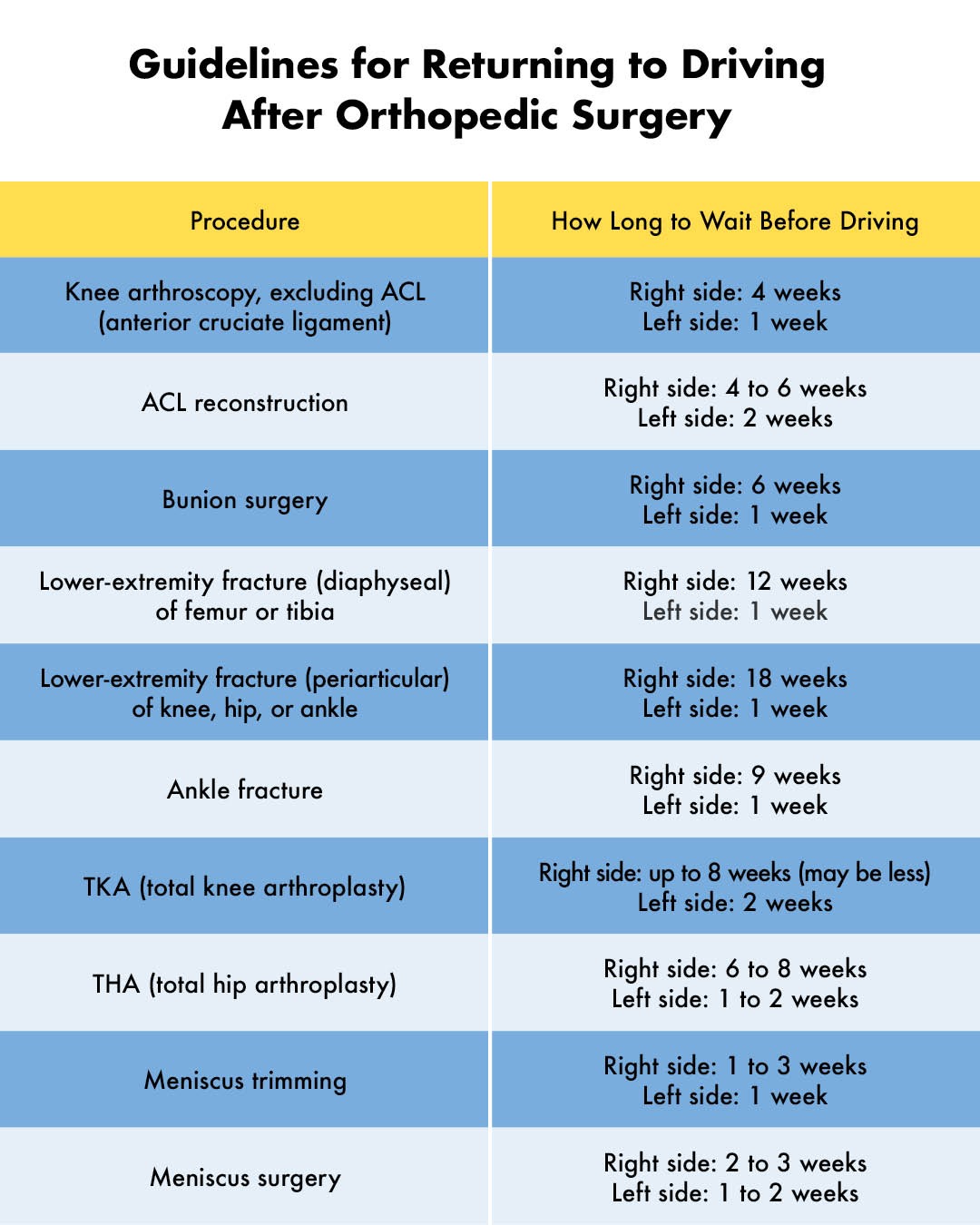
A note on left vs. right side injuries
The chart above lists guidelines for returning to driving based on the assumption that you drive a vehicle with an automatic transmission, which relies solely on the function of the right side of your body.
However, if you drive a vehicle with a manual transmission, your left side may need to be more engaged to drive safely. Manual transmission drivers, you will need to talk to your doctor to get a more accurate recovery timeline.
Why is it a bad idea to drive after surgery?
As we discussed above, it takes a while for anesthesia and any surgical pain medications to wear off (24–48 hours). While those substances are still in your system, they can influence your reaction time and decision-making. You may also have limited strength or range of motion, which can make it harder to operate a car safely. Pain can play a role, too. If discomfort causes you to hesitate, guard your movements, or avoid reacting quickly, driving can be dangerous.
How long after surgery are you at risk for blood clots?
Blood clots can occur after surgery for a couple of reasons, including patients having reduced mobility and damage happening to blood vessels during surgery. When a blood clot forms, it can block blood flow to essential tissues and organs, causing health emergencies.
After surgery, blood clots may form within days or weeks. Luckily, there are ways to prevent blood clots from forming after surgery, including:
- Wearing compression stockings, especially if you are going to be going on a long car, bus, or plane ride
- Taking low dose aspirin or, if prescribed by a doctor, blood thinners
- Starting to walk again when you’re able to safely
What kind of driving restrictions are there when you’re taking post-surgery medications?
When it comes to post-surgery medications and driving, it all depends on the patient and what they have been prescribed. Some medications, like pain relievers and muscle relaxers, may make it unsafe to drive. It’s important to talk to the healthcare provider who prescribed your medication about how it may affect your ability to drive.
At OSMS, we encourage patients to also explore alternative or supplementary pain management techniques. Ice, elevation, rest, and gentle movement can all help. There’s a lot to be said about the power of finding a distraction, too, whether it’s talking to a friend or watching your favorite TV show.
How can I get around if I can’t drive?
Luckily, most communities offer public transit like buses and ridesharing. Green Bay Metro, for instance, offers affordable, efficient, and convenient shared rides near residential neighborhoods. Valley Transit has similar options for Appleton, Kaukauna, Menasha, Neenah, and more. Plus, ride apps like Uber also have ride sharing options, making it more cost-effective to get where you need to go.
Final Thoughts
In Wisconsin and around the country, drivers are responsible for making sure they can operate a vehicle safely before getting behind the wheel. While your doctor can offer guidance, there is no official medical clearance that removes a driver’s personal responsibility in the event of an accident. Ultimately, the decision to return to driving should be made carefully and based on your comfort, mobility, state of mind, medication use, and capacity to react safely.
About the Author
Dr. Joseph McCormick is a board-certified orthopedic surgeon. He is currently seeing patients in Chilton and the Fox Valley. Schedule an appointment with him here.
This blog was originally written in February 2020. It was updated in June 2026.
The post How Long After Surgery Can You Drive? appeared first on Orthopedic Sports Medicine Specialists (OSMS).
Apa Reaksi Anda?
 Suka
0
Suka
0
 Kurang Suka
0
Kurang Suka
0
 Setuju
0
Setuju
0
 Tidak Setuju
0
Tidak Setuju
0
 Bagus
0
Bagus
0
 Berguna
0
Berguna
0
 Hebat
0
Hebat
0