























































%20and%20Batch%20Production%20Records%20(BPR).png)
















The winds reshaping Indian pharma supply chains

For years, Indian pharma has been preparing to build walls against uncertainty. But as global winds continue to shift, the industry is now realising that it may need to learn to build windmills instead. Pharma supply chains, once backstage operational functions, are now at centre stage, forcing companies to rethink continuity, sourcing, inventory, and resilience in a world where disruption is no longer occasional, but constant.
Against this backdrop, the conversation is no longer only about whether supply chains are prepared to tackle these pressures, but how quickly and effectively they can be re-engineered for it. What is emerging is less a question of readiness in isolation, and more a reading of how the sector is already adapting in real time. Perhaps the answer lies in the current temperature of the sector itself.
Gauging the industry’s pulse
The current pressure on pharma supply chains is no longer theoretical. The industry is already beginning to feel the impact operationally. According to trade data highlighted by FinTrekk Capital, India’s drug exports in March 2026 declined 23 per cent year-on-year to $2.83 billion, marking the steepest drop in over five years, largely driven by transit disruptions rather than weakening demand. Rerouting around the Red Sea and Strait of Hormuz has extended delivery timelines by up to two weeks, while rising dependence on air freight has significantly inflated logistics costs.
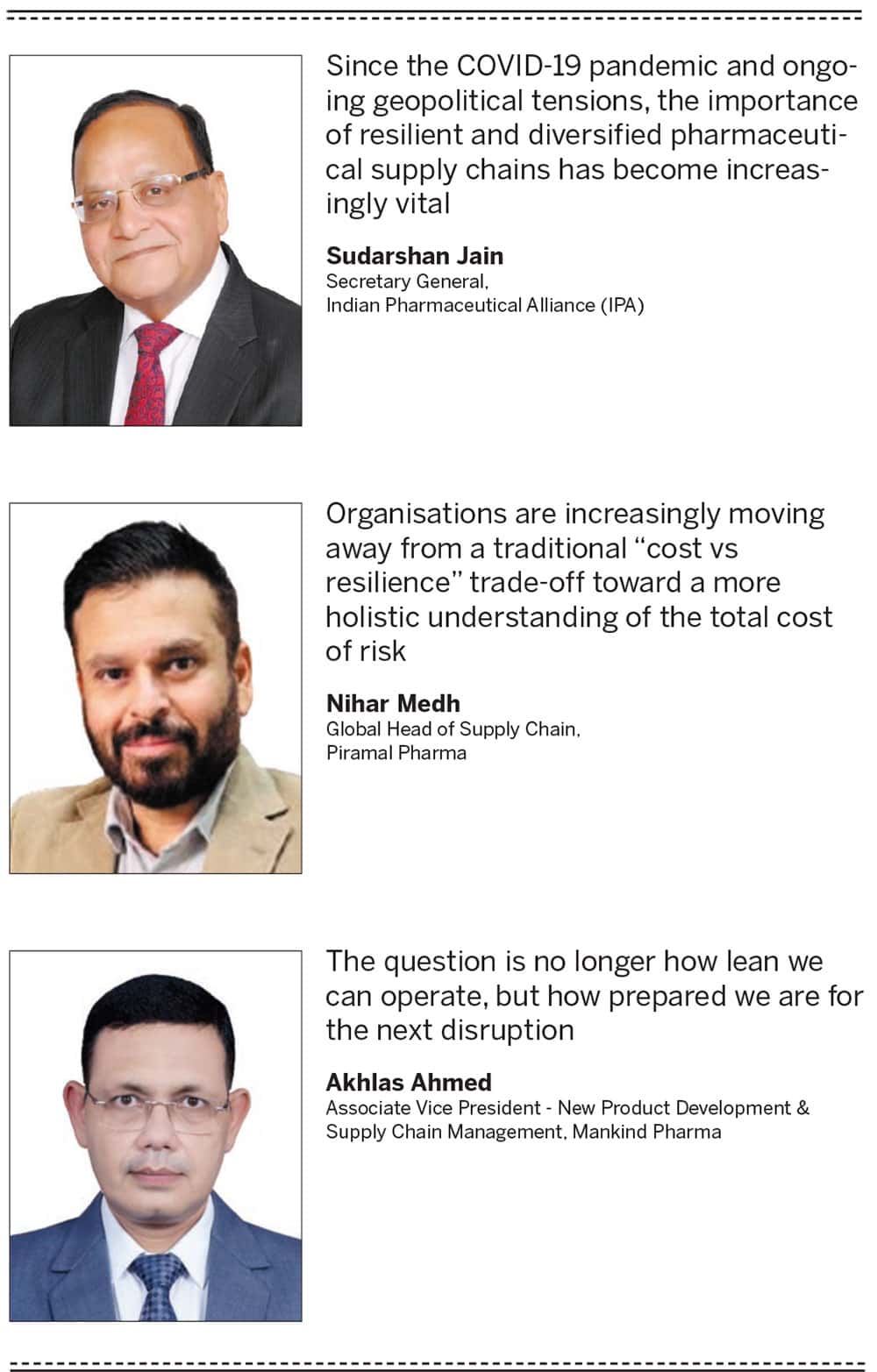
Yet, despite these disruptions, the broader sentiment across the industry is not one of panic, but recalibration. “While global demand for Indian medicines remains strong, geopolitical tensions have introduced greater complexity and cost into supply chain operations through rising input costs, freight costs, insurance premiums, and transit uncertainties. However, the Indian pharmaceutical export ecosystem remains stable and resilient,” says Sudarshan Jain, Secretary General, Indian Pharmaceutical Alliance (IPA).
What appears to be changing more fundamentally is the industry’s approach towards supply chain risk itself. “The industry has moved beyond ‘lowest cost’ optimisation to a more balanced approach where supply continuity, resilience, and predictability carry equal weight alongside efficiency,” explains Nihar Medh Global Head of Supply Chain, Piramal Pharma. Companies are increasingly reassessing dependencies across APIs, key starting materials, and logistics routes while simultaneously reducing concentration risks and diversifying sourcing models.
A similar shift is also becoming visible at the operational level. “The question is no longer how lean we can operate, but how prepared we are for the next disruption,” notes Akhlas Ahmed, Associate Vice President – New Product Development & Supply Chain Management, Mankind Pharma adding that successive geopolitical shocks and trade restrictions have exposed deep structural dependencies across the pharma supply ecosystem. The response, increasingly, is centred around agility, supply buffers, and building resilience into the network itself rather than treating disruptions as temporary events.
Where the cracks are beginning to show
If the current disruptions have exposed anything, it is that the vulnerability of pharma supply chains extends far beyond manufacturing floors.
One of the key concerns that continues to remain under discussion is import dependence, particularly in critical APIs, intermediates, and fermentationbased key starting materials. According to MedPharma Global data, India imported nearly $4.35 billion worth of APIs, bulk drugs, and drug intermediates in FY 2024–25, with China accounting for close to 74 per cent of these imports.
At the same time, India’s growing trade footprint has also increased its dependence on global maritime routes that facilitate the procurement of raw materials and movement of finished formulations. According to a research paper published by the Indian Institute of Strategy, Policy and Public Research (IISPPR), nearly 95 per cent of India’s trade by volume moves through maritime routes. This places greater strategic importance on chokepoints such as the Strait of Hormuz, the Red Sea corridor, the Bab-el-Mandeb Strait, the Suez Canal, the Strait of Malacca, and the Panama Canal for exports to the US market.
With geopolitical tensions continuing to rise across regions, these chokepoints can no longer be seen as distant geopolitical flashpoints. The Strait of Hormuz remains central to global energy flows, directly influencing fuel and freight costs. The Bab-el-Mandeb Strait and the Suez Canal continue to act as key trade corridors linking Indian exports to Europe and North America, where even small disruptions can stretch transit timelines by days or weeks. The Strait of Malacca, meanwhile, remains critical for the movement of APIs and intermediates from East Asia into India. Any prolonged disruption across these routes now risks cascading effects across sourcing, production schedules, inventory cycles, and export commitments all at once.
“Recent global events have demonstrated how disruptions in shipping routes or energy flows can quickly translate into extended lead times, capacity constraints, and elevated cost structures, even when manufacturing operations remain stable,” states Medh. The focus, he notes, is increasingly shifting from pure production efficiency towards building systems capable of absorbing volatility.
For many companies, the Red Sea crisis became one such inflection point. “Rerouting added 10–14 extra days to Europe-Asia shipping routes and sharply increased freight costs. Temperature control, shelf-life compliance, and documentation timelines also came under pressure simultaneously. These are patient safety issues, not just logistics issues,” says Ahmed. He adds that concentration risk remains another major challenge, particularly when critical APIs or intermediates depend heavily on limited suppliers or geographies.
Industry leaders, however, remain cautiously optimistic that the sector is gradually moving towards stronger resilience-building through domestic capacity expansion, supplier diversification, and long-term localisation efforts. “Since the COVID-19 pandemic and ongoing geopolitical tensions, the importance of resilient and diversified pharmaceutical supply chains has become increasingly vital,” says Jain. While acknowledging that import dependence still exists across certain critical segments, he points towards growing domestic API capabilities, supported by the Government’s PLI scheme and new manufacturing capacities coming online. “The broader direction is toward building a more diversified, resilient, and self-reliant pharma supply ecosystem in India,” he adds. As a result, supplier diversification, alternate logistics routes, regional buffer stocks, and stronger end-to-end visibility are increasingly being viewed less as contingency measures and more as long-term operating necessities.
The recalibration has already begun
Companies appear to be recalibrating the very framework through which supply chains are designed and evaluated. The earlier dominance of cost efficiency and lean inventory models is gradually giving way to a more layered approach where risk, continuity, and predictability are becoming equally central to decision-making.
“The post-pandemic period marked a fundamental shift in mindset, from prioritising efficiency through just-in-time models to building resilience through just-in-case preparedness,” says Jain. He notes that companies are now carrying higher inventory buffers, often three to four months for critical APIs and raw materials, alongside multi-source procurement strategies and greater use of digital tools to strengthen visibility and forecasting. “Supply chain resilience is no longer viewed as a contingency measure; it has become a strategic business imperative,” he adds.
This shift is also reflected in how organisations are approaching trade-offs that were earlier treated as straightforward cost decisions. “Organisations are increasingly moving away from a traditional ‘cost vs resilience’ trade-off toward a more holistic understanding of the total cost of risk,” explains Medh. According to him, companies are now selectively building redundancy in high-criticality areas such as APIs and key intermediates, while also investing in multi-regional supply networks that reduce exposure to concentrated geographies.
At the same time, this transition is not uniform across the value chain. While resilience is becoming a strategic priority, companies continue to operate within regulatory, cost, and capacity constraints, which prevent a complete structural overhaul. As a result, the shift appears less like a replacement of the existing model and more like an additional resilience layer built over efficiency-driven systems.
This balancing act is also being reinforced by regulatory tightening. As Ahmed points out, upcoming IP amendments expected to come into effect in July 2026 will require stricter quality systems and deeper supplier oversight.
He notes that for companies with large, multi-layered networks across formulations, APIs, and packaging, this is not just a compliance update but a structural push to strengthen systems that can audit, track, and manage suppliers more rigorously across the value chain.
“For a company with Mankind’s large network across formulations, APIs, and packaging, this is not just a routine compliance update. It requires stronger systems to audit, track, and manage the wider supplier network.” adds Ahmed.
From cost optimisation to continuity planning
As this strategic shift begins to take shape, its impact is also becoming visible in day-to-day supply chain design. What was earlier treated primarily as a cost optimisation function is now increasingly being reframed as a continuity and risk management exercise, where sourcing, logistics, and planning decisions are evaluated through disruption readiness.
“Definitely, and this shift is long-term and structural, not temporary,” says Ahmed. He explains that supply chain decisions are now carrying geopolitical weight, with procurement moving beyond pricebased evaluation to include supplier concentration risk, route stability, and regulatory exposure. According to him, companies are actively investing in supplier diversification, regional hubs, and flexible manufacturing setups, even when these come at higher short-term costs. “Earlier, supply chain performance was mainly measured through cost per unit and delivery speed. Today, continuity has become equally important,” he adds.
A parallel shift is also underway in how visibility and control are being strengthened across networks. “Real-time visibility has moved from a capability to a necessity,” he notes, highlighting how disruptions in freight routes, policy changes, or energy shocks can quickly cascade into shortages if not detected early. Companies are increasingly building digital systems that track shipments, supplier health, compliance status, and cost volatility across multiple tiers of the supply chain, enabling faster course correction when disruptions emerge.
Beyond internal restructuring, organisations are also focusing on deeper ecosystem coordination. “Enhanced end-toend visibility, faster tech transfers, and deeper ecosystem collaboration will be critical going forward,” says Medh. He points to a growing emphasis on shared risk frameworks across suppliers, logistics partners, and manufacturers, where resilience is being built not just within companies but across interconnected networks.
Companies are also increasingly exploring more distributed and geographically balanced sourcing models. “At the same time, friend-shoring and crossregional collaboration models are gaining traction—enabling companies to leverage the strengths of different geographies while maintaining regulatory alignment and market proximity,” notes Medh. He adds that this is enabling organisations with integrated, multi-region capabilities to better combine resilience with efficiency, positioning them to respond more effectively to volatility without compromising competitiveness.
This structural recalibration is also reflected in how supply chain decision-making itself is evolving within organisations. Ahmed explains that supply chain performance is no longer defined purely by cost efficiency metrics such as per-unit cost or delivery speed, but increasingly by geopolitical exposure, network resilience, and continuity planning.
According to him, procurement has now become a strategic function where decisions around suppliers, logistics, and inventory carry long-term business implications. “The industry is now moving away from purely cost-focused models towards resilience-led planning,” he notes, adding that this includes supplier diversification, flexible manufacturing models, and stronger network visibility, even where short-term costs may be higher. He also points to regulatory tightening, including upcoming IP amendments, as further reinforcing the need for stronger supplier governance systems and long-term planning frameworks.
Resilience as the new measure of leadership
The focus is no longer only on managing the next shock, but on building systems that can continuously absorb, adapt, and recover without breaking the flow of medicines across markets.
“Looking ahead, three priorities will be critical in building stronger and more resilient pharma supply networks,” says Medh. He highlights faster and more predictable tech transfers and regulatory pathways to enable redundancy across sites, enhanced end-to-end visibility through digitised supply ecosystems for earlier disruption detection, and deeper ecosystem collaboration across suppliers, logistics partners, and customers built on shared risk frameworks. He adds that capability alone is no longer sufficient, with execution speed, regulatory predictability, and trust emerging as decisive factors in how supply chains perform under stress.
He further notes that resilience is no longer a defensive construct but a competitive advantage, with organisations that embed it structurally into their operating models increasingly emerging as partners of choice in an uncertain global environment.
This redefinition of competitiveness is echoed across industry leadership. “I believe resilience and supply continuity are becoming just as important as scale and cost competitiveness in defining global pharma leadership,” says Ahmed. He points to repeated global disruptions—from the pandemic to geopolitical conflicts and trade restrictions—as evidence that scale alone is no longer sufficient to ensure continuity or credibility in global supply chains.
He adds that expectations from regulators, governments, and healthcare systems have also evolved significantly, with frameworks such as the US FDA’s drug shortage mechanisms, the EU’s Critical Medicines Act, and India’s PLI-driven API push reflecting a stronger emphasis on supply security and local manufacturing capability. According to him, future pharma leadership will be defined across three dimensions: reliability of supply, cost competitiveness, and strategic agility. While efficiency and scale will remain important, he notes that the real differentiator will be the ability to withstand disruption, reroute supply quickly, and maintain continuity under pressure.
For companies like Mankind Pharma, he adds, this shift represents both responsibility and opportunity—particularly for organisations with large and diversified supplier networks, where resilience is no longer a parallel goal but an embedded part of long-term ecosystem design.
What does the future hold?
Overall, what is becoming increasingly visible is that the era of hyper-globalised supply chains built purely around cost efficiency may slowly be giving way to a more regionalised and strategically balanced model. India’s long-standing positioning as a trusted global partner, backed by strategic relationships across regions, may place it in a stronger position to build more resilient, diversified, and trusted pharma supply networks in the years ahead. Perhaps the larger opportunity now lies in how effectively the industry can absorb and adapt these situations.
References
https://www.bakerinstitute.org/si tes/default/files/202603/20260316Maritime%20Chokepoints.pdf https://www.crisil.com/content/d am/crisil/ouranalysis/reports/Research/documents/2024/02/sectoral-impactof-red-sea-trade-disruptions/sect oral-impact-of-red-sea-trade-disruptions.pdf Ministry of Commerce and Industry – Annual Trade Reports https://www.pib.gov.in/PressReleasePage.aspx?PRID=2222528& reg=3&lang=1 https://www.icra.in/Media/GetNewsFile/24508
neha.aathavale@expressindia.com
nehaaathavale75@gmail.com
The post The winds reshaping Indian pharma supply chains appeared first on Express Pharma.
Apa Reaksi Anda?
 Suka
0
Suka
0
 Kurang Suka
0
Kurang Suka
0
 Setuju
0
Setuju
0
 Tidak Setuju
0
Tidak Setuju
0
 Bagus
0
Bagus
0
 Berguna
0
Berguna
0
 Hebat
0
Hebat
0