














































%20and%20Batch%20Production%20Records%20(BPR).png)














BIO 2026: How biotechs break the $100M barrier in funding rounds

The tap is opening up for venture capital in the biotech industry.
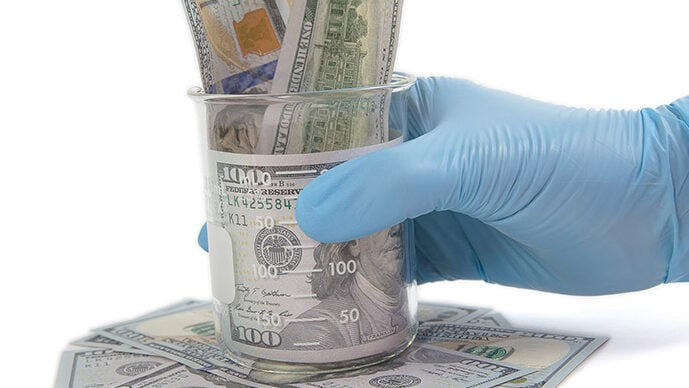
Venture investment in biotech jumped 23% year-over-year in 2025 to $23 billion, according to BIO’s State of Emerging Biotech Report. This amounted to a thaw in a four-year period of stagnation deemed the “biotech winter” by Cognito Therapeutics CFO Steve Worthy, in a June 25 panel at the BIO International Convention. As Endpoints Correspondent Kyle LaHucik told the panel, 40 biotech companies had financing rounds above the $100 million “mega-round” threshold in the first half of 2026, up from 33 in half one last year.
That freer flow of cash has spurred excitement among emerging biotech companies, eager to close an ever-elusive mega-round. But many find it hard to stand out from their competition and make a convincing case for venture funding, said experts in the panel on Breaking the $100M Barrier: How Biotechs Closed Mega-Rounds in a Tough Market.
The panel featured three biotech company representatives, each of whom secured at least one mega-round in venture funding, who shared details on how they broke through to investors. Additionally two investment representatives came to give their side of the story, detailing how they choose which companies are worth backing.
Prioritize the right product
Kenneth Greenberg, co-founder and CEO of SonoThera, admitted that he had to make hard choices in determining which of his firm’s projects are attractive to investors. SonoThera is developing a best-in-class gene therapy for hemophilia A, which Greenberg had originally put forth as his company’s flagship project.
“But the sentiment that we got across the board from venture investors was ‘don’t do it.’ Despite the data looking quite good, the commercial risk of a hemophilia gene therapy product was too insurmountable for investors to build that conviction.”
SonoThera ultimately found success by prioritizing its bubble-based gene delivery system and closing with $125 million in series B funding.
Gather robust clinical data
The market is notoriously fickle, said Cognito CFO Worthy. He offered advice to firms struggling to navigate its peaks and troughs.
Worthy shared how the appetite of Cognito’s prospective investors oscillated wildly between enthusiasm and skepticism over the course of 2025, particularly after April’s Liberation Day tariffs. As such, the milestone the company sought to fulfill in February 2025 took until February 2026 to fulfill.
Cognito’s position was complicated by the company’s specialty in treating Alzheimer’s; “A disease rife with failure,” remarked Worthy, “with billions of dollars burned chasing hypotheses proven to be untrue.”
Worthy recognized that investors in volatile markets in a risky field want proof of viability above anything else. As such, Cognito went all-in on its data gathering, evolving its 74-patient phase 2 case study into a 673-patient phase 3. The increase in study size demonstrated not only that the company was confident in its product, but that it also had the financial competence to responsibly manage its funding. In return, they were rewarded for their meticulousness with $105 million series C funding.
Demonstrate ‘China-like efficiency’
Meanwhile, Enveda raised $550 million of capital due to its commitment to what CEO Viswa Colluru calls “China-like efficiency.” This means streamlining the research to production pipeline as much as possible: Enveda has a team of 200 scientists based in India working in conjunction with its Colorado headquarters to turn its molecules into medicine.
This commitment to efficiency is part of a larger China strategy employed by emergent biotech firms, experts said. It addresses reluctant investors’ fear of heavily backing an American biotech firm’s project, only for one of China’s companies to come out with a product that makes it obsolete.
The investor’s perspective
“Personally, I think these are kind of the golden years for public trading,” said Josh Schimmer, a Biotech Equity Research Analyst at Cantor Fitzgerald. “We’re starting to see the IPO window open back up after four years.”
He said his optimism is emblematic of the mood that seems to be infusing the greater investor community, founded on the strides in efficiency the biotech industry is making.
“This is one of the most exciting times for biotech innovation,” he continued. “We’re seeing a dramatic acceleration, and it is really breathtaking and overwhelmingly super exciting.”
Jakob Dupont, Executive Partner at Sofinnova Investments, speculated that biotech investors are looking for companies that gather all their resources on just a few promising products and backing them with robust clinical data.
Attracting investment is about easing the concerns of investors. Those who successfully close mega-rounds do this more than anyone else.
The post BIO 2026: How biotechs break the $100M barrier in funding rounds appeared first on Bio.News.
Apa Reaksi Anda?
 Suka
0
Suka
0
 Kurang Suka
0
Kurang Suka
0
 Setuju
0
Setuju
0
 Tidak Setuju
0
Tidak Setuju
0
 Bagus
0
Bagus
0
 Berguna
0
Berguna
0
 Hebat
0
Hebat
0