





















































%20and%20Batch%20Production%20Records%20(BPR).png)















Why Digital Infrastructure Deserves a Seat at the Table from Day One
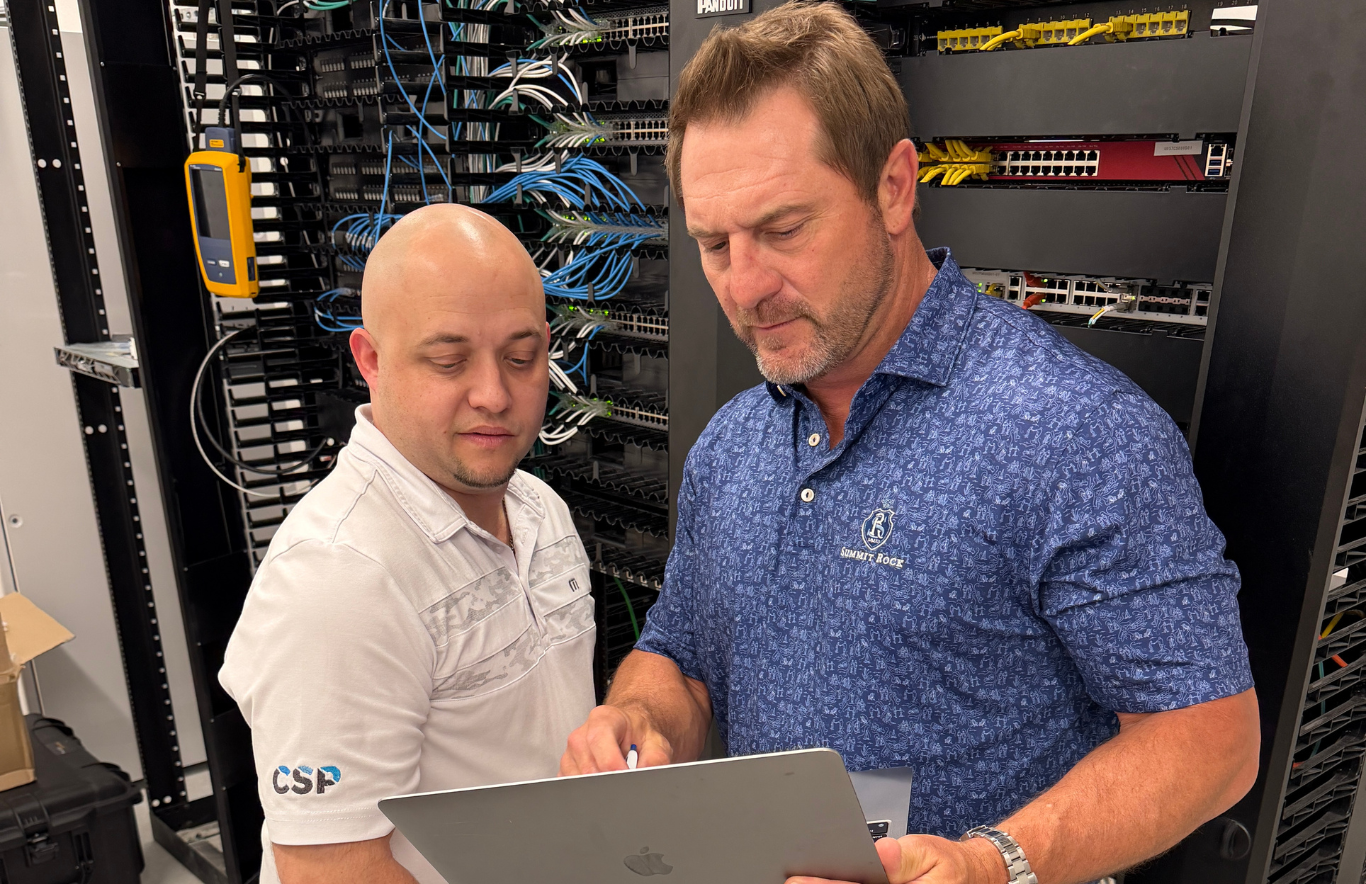
As a building nears completion, owners often discover just how deeply technology infrastructure affects day-to-day operations and the path to a Certificate of Occupancy. | Photo Credit: CSP Consultants Group
By Josh Vickery
A building can be structurally sound, beautifully designed, and delivered on schedule and still fall short on day one. That’s because building performance is no longer defined by the physical structure alone. It also depends on the systems that make the space usable, connected, and secure every day: security, Wi-Fi, AV, and access control. Yet those systems are still too often treated as secondary considerations, brought in after floor plans, room layouts and major design decisions have already been locked in.
The pattern is familiar across the industry. A building is delivered on schedule, the ribbon gets cut and then the real problems begin. Employees can’t connect to the network. Conference rooms are unreliable. Access control is incomplete, creating last-minute scrambles. Wi-Fi is spotty because coverage was never properly accounted for during design. The building may be technically complete, but operationally, it still isn’t ready.
The good news is that this is a process problem and process problems can be fixed.
The Invisible Trade
Low-voltage systems, including structured cabling, Wi-Fi, AV, physical security and access control are the central nervous system of a modern building. Yet most architects and engineers don’t include these systems in their base scopes, so they aren’t considered during initial design. Most companies also fail to involve their IT departments in early project planning, pushing technology requirements to the final weeks of construction, when changes are costly and options are limited.
The result is fragmented technology delivery: multiple vendors working in silos, technology drawings misaligned with architectural drawings, and scopes that fall through the cracks between trades. Here’s what that looks like in practice:
- Missed scope. Cabling and pathways needed to support security, or AV gets left out because vendors weren’t coordinating in real time.
- Costly rework. Once the slab is poured, walls and ceilings are closed, running infrastructure is exponentially more expensive. Systems also compete for space. A server room may not have room for other systems like security panels because nobody accounted for both cabling racks and hardware from the start.
- Day-2 deficiencies. When technology vendors arrive in the final stretch, the bare minimum gets installed to hit the move-in date. The real costs surface in the months after occupancy.
- Schedule drag. Managing multiple vendors across a compressed timeline consumes disproportionate project management resources, and something always falls between the cracks.
While these outcomes are predictable, they’re not inevitable. They follow directly from a process that treats digital infrastructure as a secondary feature.
When Technology Integration Should Actually Start
While earlier is always better, the most impactful entry point is Schematic Design (SD).
Once an architect releases the SD drawing set, the technology team has enough context to communicate major infrastructure requirements like how much square footage is needed for server rooms, whether there are complex AV requirements like video walls, town halls, or boardrooms that require structural or electrical coordination, and which doors need access control. Getting these answers on record at SD matters because Design Development (DD) is the first set of drawings where significant changes begin triggering revision costs and schedule impacts. Technology requirements that miss the SD window tend to show up later as change orders.
An integrated approach engages a single technology partner at SD to ensure all low-voltage requirements are reflected in architectural and engineering drawings from the start. IT stakeholders participate in the design process early, not at move-in. Technology and architectural drawings are coordinated in real time rather than reconciled after the fact. And systems are designed to communicate with each other rather than simply installed in parallel.
That last point is increasingly critical. A decade ago, building management systems, access control, security cameras and intrusion detection were entirely separate platforms. Today those systems are converging, and buildings being designed now need to account for that trajectory.
What Owners Learn Too Late
As a building nears completion, owners often discover just how deeply technology infrastructure affects day-to-day operations and the path to a Certificate of Occupancy. General contractors can’t close out if access control isn’t complete. An entire floor goes without connectivity when cabling hasn’t been properly installed and tested. Conference rooms that weren’t planned around actual business workflows become a source of daily frustration. Spotty Wi-Fi coverage signals a design that was never properly performed in the first place.
Oftentimes, building owners chalk this up to growing pains as they settle into the building. But there doesn’t need to be growing pains. These are simply the standard outcomes when technology gets treated as a commodity line item sorted out at the end of a project.
Designing for What’s Next
Future-proofing a building’s digital infrastructure doesn’t require a complex strategy. It requires the right decisions made during design rather than corrections made after construction. A few principles worth building around:
- Install Cat 6A and 6A Shielded. Category 6A cabling supports the bandwidth demands of current and future wired systems. Wireless bandwidth is a shared, finite resource under constant pressure from growing employee device usage, and hardwired infrastructure remains the reliable backbone for high-demand applications.
- Choose PoE-enabled, cloud-based security systems. Power over Ethernet devices paired with cloud-based management platforms are easier to upgrade and simpler to scale, reducing long-term hardware refresh costs compared to legacy systems.
- Keep AV systems simple. All-in-one videoconference soundbars and straightforward touchscreens consistently outperform complex processor-driven systems in usability and longevity. When technology advances, individual components can be swapped without redesigning the entire room.
- Select systems with open architecture. Most security platforms today operate in their own silo. The expectation going forward is that those same systems will interface with lighting, HVAC and life safety to deliver genuine building intelligence.
The Case for Single-Point Accountability
Consolidating low-voltage responsibility under one integrated partner changes the risk profile of a project in meaningful ways. Cabling doesn’t get missed because it fell between the AV vendor and the security subcontractor. Infrastructure doesn’t get undersized because the IT team was never consulted. Systems don’t conflict because all drawings were coordinated from the start.
For building owners and developers, the timing question has a clear answer. Addressing technology infrastructure before design is locked is far less expensive, far less disruptive and far more likely to produce a building that performs on day one. Waiting until after the ribbon is cut means paying to fix problems that were entirely avoidable.
Changing the sequence and adding IT as a priority in the beginning is all it takes.
Josh Vickery is Chief Executive Officer and Co-Founder of CSP Consultants Group.
The post Why Digital Infrastructure Deserves a Seat at the Table from Day One appeared first on HCO News.
The post Why Digital Infrastructure Deserves a Seat at the Table from Day One appeared first on HCO News.
Apa Reaksi Anda?
 Suka
0
Suka
0
 Kurang Suka
0
Kurang Suka
0
 Setuju
0
Setuju
0
 Tidak Setuju
0
Tidak Setuju
0
 Bagus
0
Bagus
0
 Berguna
0
Berguna
0
 Hebat
0
Hebat
0