



















































%20and%20Batch%20Production%20Records%20(BPR).png)















Diversifying beyond the US market
On July 21, US President Trump unleashed uncertainty on the tariff front once again. Generics exported to the US will have zero tariff until August 1, 2028, after which tariffs are proposed to increase to 100 per cent from August 2028 and 200 per cent from August 2029. However the two year interim period makes it seem like a negotiation tool.
As Bharat Celly, Equity Research Analyst at Equirus Securities points out, the proposal runs counter to the intent of the Hatch-Waxman framework, which was designed to reduce drug prices through greater generic competition. Imposing 100–200 per cent tariffs on imported generics could instead raise the cost of low-priced medicines and, in shortage-prone categories, increase the risk of supply disruptions rather than drive reshoring.
Param Desai, Research analyst – PL Capital points out that President Trump’s term ends in January 2029, while the major tariff impact begins from August 2028, so the eventual implementation remains uncertain if there is a change in administration.
An Ind-Ra analysis believes that the evolving tariff environment could accelerate consolidation across the generic pharma industry, strengthening the market position of larger and better-capitalised companies. As operating challenges increase, small generic companies may find it difficult to remain competitive due to weaker balance sheets, lower pricing flexibility, and limited ability to undertake significant greenfield investments in the US, particularly where investment paybacks remain unattractive.
The Ind-Ra report posits that tariff-driven disruptions could create opportunities for partnerships, acquisitions, and strategic investments. Distressed generic assets may become attractive acquisition targets, while Indian pharma companies could increasingly collaborate with US contract manufacturing organisations to establish domestic manufacturing capabilities in a capital efficient manner and meet local sourcing requirements where necessary.
India has already diversified beyond the US market, through numerous free trade agreements (FTAs). India’s FTA network now includes 15 agreements covering 27 countries, and counting. Though we still haven’t been able to make a trade deal with the US, which is the world’s biggest pharma market, 6Wresearch’s recently released India Export Attractiveness Tracker 2026 makes the point that India’s next export wave will not be won on tariff advantage alone — most of the frictionless doors (Japan, Egypt, Mexico) are already open, and most of the mature markets (US, China, UAE) are now regulatory contests rather than tariff contests.
For instance, the report points out that the US applies 213 regulatory measures whereas China applies 148 measures on medicines. Both large pharma export markets thus come with a dense regulatory architecture.
The playbook is therefore twofold: scale fast in the zero-tariff corridors while capacity is uncontested, and invest early in regulatory and standards compliance in the high-value, high-friction markets — because that is where the next $30.1 billion in untapped potential will actually be won.
According to 6Wresearch’s report, built on UN Comtrade data, generic medicines are the fourth anchor of India’s highest-value future export potential by 2031. Smartphones, polished diamonds, and refined petroleum, lead the list.
Pharma exports currently make up $39.45 billion, of which medicines make up 44.7 per cent. By 2031, the report projects that medicines alone carry export potential of $23.30 billion, led by the US ($8.67 billion), Switzerland ($3.15 billion), China ($1.81 billion), Japan ($1.45 billion) and Canada ($758.62 million). Human vaccines have an export potential of $209 billion. Within the exports to the US, medicines lead with 9.6 per cent share followed by smartphones (8.8 per cent).
The pharma sector could scale this to $66.81 billion, with the US alone accounting for $20.13 billion — nearly a third of the total — followed by China ($ 8.79B), Switzerland ($ 5.68B), Japan ($4.23B) and Brazil ($3.36B).
But the July 21 tariff announcement put this at risk. As the cover story in the August 2026 Express Pharma edition analyses, in a world shaped by geopolitics, economic nationalism and heightened scrutiny on quality and resilience, India’s next phase of growth will depend on trust, innovation and strategic agility. (See story, Power, politics and pharma).
India will have to work on deepening and expanding current FTAs to increase our export competitiveness. A key part of these measures is mutual recognition of standards and regulatory cooperation. The US tariffs could well be a blessing in disguise if we can look beyond the US and achieve these wins.
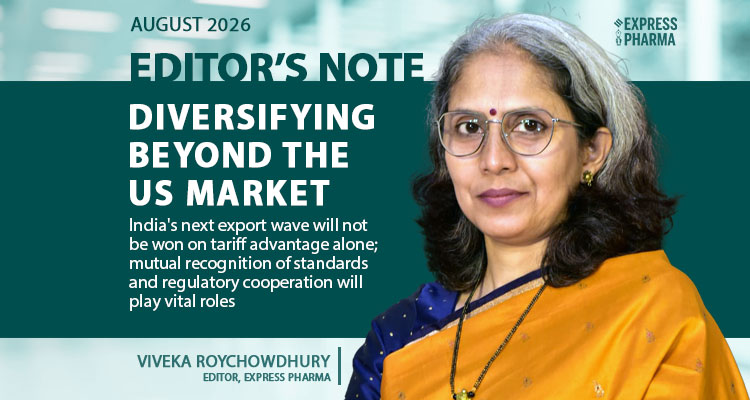
VIVEKA ROYCHOWDHURY, Editor
viveka.r@expressindia.com
viveka.roy3@gmail.com
The post Diversifying beyond the US market appeared first on Express Pharma.
Apa Reaksi Anda?
 Suka
0
Suka
0
 Kurang Suka
0
Kurang Suka
0
 Setuju
0
Setuju
0
 Tidak Setuju
0
Tidak Setuju
0
 Bagus
0
Bagus
0
 Berguna
0
Berguna
0
 Hebat
0
Hebat
0