











































































From USMLE Step 1 to Step 2 CK: What Actually Changes (and What Still Matters)
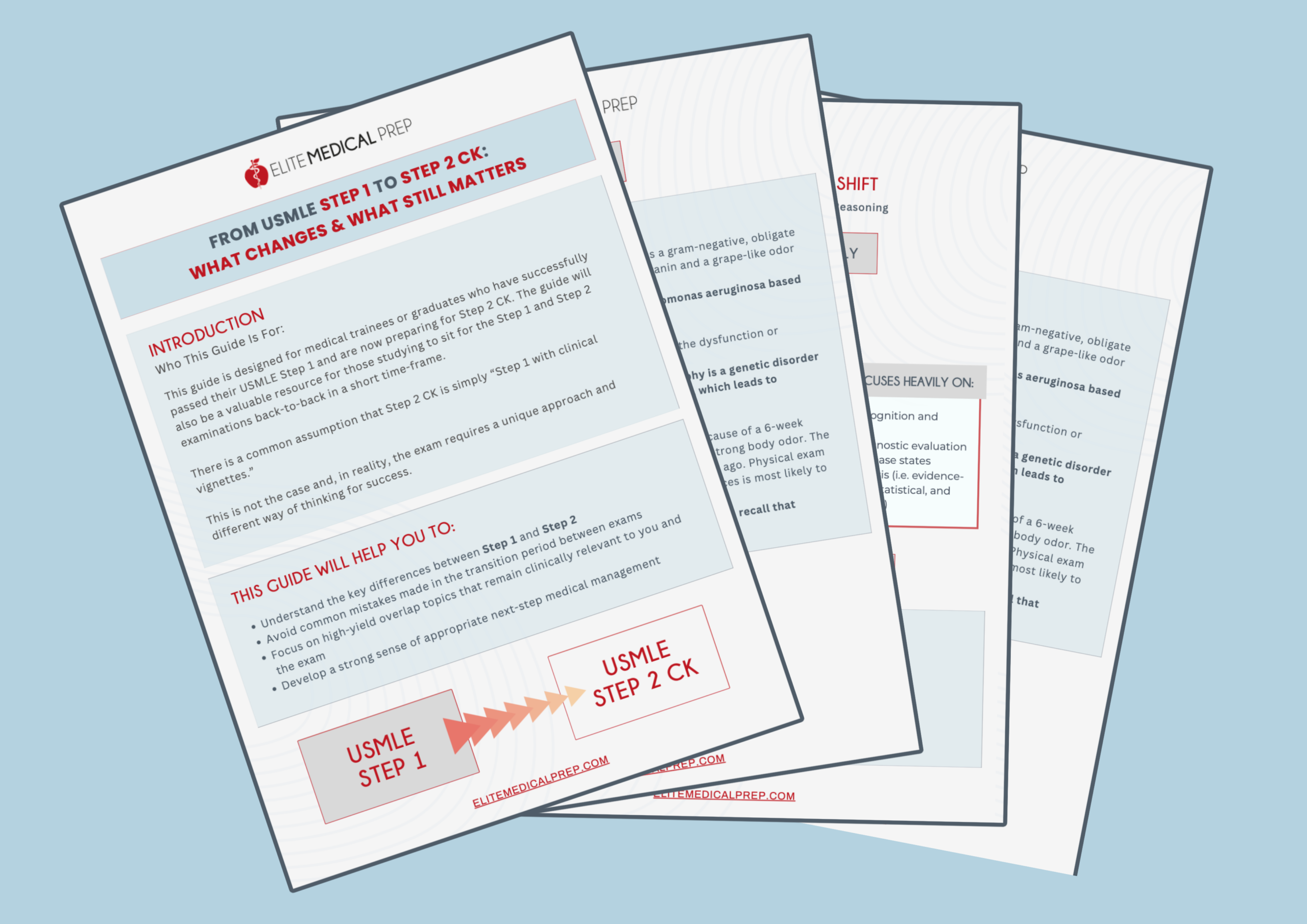
If you’ve recently passed Step 1 or you’re preparing to take Step 1 and Step 2 close together, you’ve probably heard that Step 2 is just Step 1 with longer clinical vignettes. While this is a commonly shared idea, it doesn’t quite hold up. Step 2 isn’t simply a longer or harder version of the same exam. This is a test that actually requires a different way of thinking altogether, and that shift is where many students run into trouble.
Step 1 vs Step 2: What’s the Real Difference?
Step 1 is largely about understanding the basics of how things work. It emphasizes pathophysiology, mechanisms, and disease associations. You spend a lot of time learning how to recognize patterns and connect them to specific diagnoses. Step 2 does build on that foundation but moves in a different direction. Instead of asking “What is this?”, it asks, “What are you going to do about it?” That transition from recognition to action is the core difference between the two exams.
This transition explains why Step 2 questions often feel more challenging, even for strong students. The vignettes tend to be longer and more detailed, and not every detail is relevant to correctly answering the question. Success depends on being able to sort through a lot more information efficiently, identify what matters most, and ignore distractions. One of the most common frustrations is understanding enough to get the diagnosis right but not knowing the piece that is needed to answer the question correctly. In most cases, the issues students face is choosing the wrong next step.
A helpful way to reframe this is to think of Step 1 as a test of identification and Step 2 as a test of decision-making. On Step 1, you might be asked to recognize an infection with Pseudomonas aeruginosa based on classic characteristics of the bacteria, or identify Duchenne muscular dystrophy and its inheritance pattern from a clinical description. On Step 2, the expectation is different: decide what to do next. Should you order a test? Start treatment? Intervene immediately? The diseases are the same, but the skill being tested has changed.
Biggest Challenges
One of the biggest challenges I see from my students during this transition is leaning on their Step 1 habits. There’s often a tendency to maintain the familiar focus on mechanisms, rare associations, or highly specific details that don’t ultimately change management. Step 2 tends to reward practical and often big-picture thinking by understanding standard-of-care medicine and making decisions to impact a patient at a higher level.
Another common issue students run into is missing key clues in the vignette. Vital signs, signs of instability, and patient-specific factors like age, pregnancy status, or comorbidities are key in arriving to the correct answer. If a patient is hypotensive, tachycardic, or altered, that information is critical to the essence of the question. Overlooking those details can quickly lead to the wrong choice.
The Most Common Step 2 Trap: Right Diagnosis, Wrong Next Step
One of the most classic Step 2 traps is the “right diagnosis, wrong next step” scenario. This shows up repeatedly across topics and reflects the key differences in the focus this examination. A trauma patient may clearly need imaging, but if they’re unstable, the correct answer is fluid or blood resuscitation first. A patient presenting with anaphylaxis doesn’t need labs; they need immediate epinephrine administration. A swollen, painful joint might suggest gout, but the next step is arthrocentesis to rule out septic arthritis. These questions are designed to test prioritization, not just recognition.
The good news is that Step 1 knowledge is still relevant, it’s just applied differently. In cardiology, instead of focusing only on identifying classic murmurs, the emphasis shifts to managing unstable arrhythmias. In pulmonology, acid-base interpretation becomes a stepping stone to deciding when a patient requires intubation and mechanical ventilation. Infectious disease moves from memorizing drug mechanisms to selecting empiric first-line antibiotics based on the clinical scenario. In obstetrics and gynecology, understanding hormonal pathways evolves into managing complications, such as bleeding in pregnancy.
It is key for students to develop a consistent mental framework for approaching questions. Before focusing on the diagnosis, it’s important to first assess whether the patient is stable. If the patient is unstable, stabilization becomes the priority. From there, consider airway, breathing, and circulation. If any of these are compromised, immediate intervention is required. Only after stabilization should diagnostic testing and definitive treatment come into play. This leads to a reliable pattern that appears throughout Step 2: stabilize first, diagnose second, treat definitively third. This sequence shows up across scenarios like trauma, gastrointestinal bleeding, and sepsis. Skipping ahead to imaging or labs in an unstable patient is one of the most common reasons for missed questions.
Final thoughts
Ultimately, the transition from Step 1 to Step 2 isn’t about studying more, it’s about embracing a different way of thinking. It requires approaching questions the way a clinician would approach a patient: assess stability, prioritize appropriately, and act based on what needs to happen next. All in all, Step 1 focuses on understanding disease and Step 2 focuses on appropriately managing the patient in front of you. Once that distinction becomes clear, the exam starts to feel much more manageable.
The post From USMLE Step 1 to Step 2 CK: What Actually Changes (and What Still Matters) appeared first on Elite Medical Prep.
Apa Reaksi Anda?
 Suka
0
Suka
0
 Kurang Suka
0
Kurang Suka
0
 Setuju
0
Setuju
0
 Tidak Setuju
0
Tidak Setuju
0
 Bagus
0
Bagus
0
 Berguna
0
Berguna
0
 Hebat
0
Hebat
0