























































%20and%20Batch%20Production%20Records%20(BPR).png)
















Why Enterprise EHR Integrations Fail After Go-Live (And How to Prevent It)

Healthcare organizations spend months, sometimes years, preparing for EHR integration. They hire enterprise EHR consulting teams, invest in enterprise EHR integration services, and run exhaustive testing cycles. Then, the go-live day arrives, and everything looks great. Six months later, the cracks start showing.
Data is inconsistent. Workflows slow down. Clinicians stop trusting what the system tells them. This is an enterprise EHR integration failure, and it happens more often than the industry likes to admit.
The hard truth is that most EHR integration failures don’t come from bad technology. It comes from treating integration as a finish line rather than an ongoing capability. Understanding why this happens and how to prevent EHR integration failure is what separates organizations that thrive post go-live from those that spend years troubleshooting EHR go-live failures.
The Go-Live Illusion
Go-live feels like a completion. APIs are connected, data is flowing, and the enterprise EHR software is live. From a technical standpoint, the project is done. Except it isn’t.
Even though interoperability has improved, it is still incomplete in practice. ONC reported that 70% of U.S. non-federal acute care hospitals engaged in all four interoperability domains in 2023, and only about three-quarters integrated the information they received directly into the EHR. That gap helps explain why integrations that appear stable at launch can still break down in live clinical environments.

Testing environments are controlled by design, using clean datasets, predictable workflows, and limited system load. Real-world enterprise hospital EHR systems operate nothing like that. Once live, the system must handle much higher data volumes, workflows that vary across departments and locations, and a mix of modern platforms alongside decades-old legacy technology.
This is where enterprise healthcare IT integration gets genuinely tested under daily operational pressure.
Enterprise EHR interoperability, the ability of different systems to reliably exchange and interpret clinical data, begins to weaken at this stage. The data keeps flowing, but its accuracy and completeness quietly degrade. Clinicians start noticing. Errors creep in. And by the time the organization recognizes it has an EHR integration failure on its hands, the cost of fixing EHR integration issues has already multiplied.
Ten Reasons Integrations Fail After Go-Live
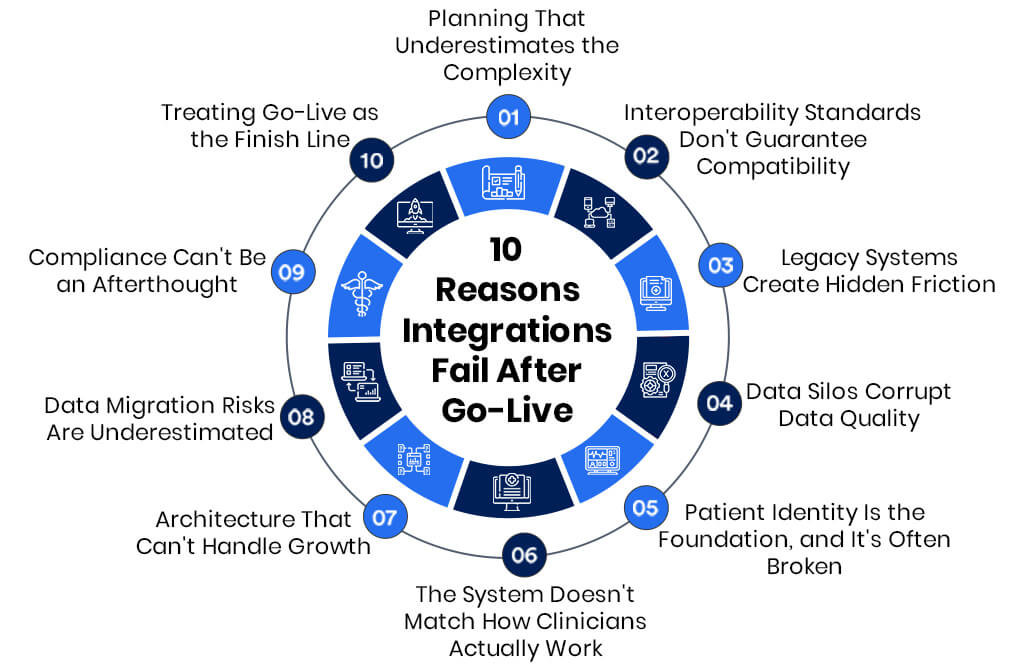
1. Planning That Underestimates the Complexity
Many organizations approach enterprise EHR implementation focused almost entirely on getting systems connected. But connectivity is only the beginning.
Integration touches clinical workflows, administrative processes, and data governance structures. When planning ignores these layers, the result is epic integration solutions that work on paper but break down in practice. Timelines are underestimated, workflows are disrupted, and data dependencies that were never mapped cause cascading problems down the line.
2. Interoperability Standards Don’t Guarantee Compatibility
Standards such as HL7 and FHIR enable data exchange across different systems. Enterprise HL7 integration and enterprise FHIR integration are now widely adopted, but they don’t guarantee that two systems will actually speak the same language.
Every EHR vendor implements these standards slightly differently. API behavior varies. Data structures don’t always align. Field mappings that work in one system break in another. Organizations that assume standards equal seamless interoperability consistently run into enterprise EHR integration failure in production.
3. Legacy Systems Create Hidden Friction
Most enterprise environments include older systems that were built long before modern interoperability standards existed. These legacy platforms weren’t designed to integrate; they were designed to work in isolation.
Connecting them to modern enterprise EHR integration software requires custom middleware, additional configuration layers, and ongoing maintenance. Over time, this complexity compounds and becomes one of the most common contributors to EHR integration failure.
4. Data Silos Corrupt Data Quality
Healthcare data is spread across multiple systems, such as billing, labs, imaging, pharmacy, and clinical notes, each built for a specific function and often managed by different teams. Without a unified data governance strategy, these silos produce inconsistencies that enterprise EHR integration solutions struggle to resolve.
The result is fragmented patient records, conflicting information across systems, and clinical decisions made on incomplete data.
5. Patient Identity Is the Foundation, and It’s Often Broken
If two systems disagree about who a patient is, every data exchange built on top of that disagreement is unreliable.
Patient identity errors are not rare edge cases. RAND reported that duplicate-record problems are widespread, noting that in one study of 112 master patient indexes, one-fourth had duplicate-record rates of 10% or more. Research has also linked duplicate patient records with a higher rate of missed laboratory results, 36% versus 28%.
Duplicate records, mismatched identifiers, and inconsistent demographic data are among the most common causes of silent EHR integration failure. Without a centralized patient identity strategy, a single, authoritative source of truth data becomes fragmented in ways that are difficult to detect and even harder to fix.
6. The System Doesn’t Match How Clinicians Actually Work
EHR systems don’t exist in a vacuum. They’re embedded in the daily routines of nurses, physicians, and administrative staff. When enterprise EHR software is designed around technical requirements rather than clinical workflows, adoption suffers.
Clinicians find workarounds. Data entry becomes inconsistent. The system that was supposed to support care delivery starts creating friction instead. This disconnect between system design and real-world workflow is a direct cause of enterprise EHR integration failure.
7. Architecture That Can’t Handle Growth
A system that works for one hospital management solution may break when scaled across a network of facilities. Enterprise EHR environments need an architecture that can absorb increasing data volumes, additional integrations, and growing user loads without degrading performance.
When scalability isn’t built in from the start, performance issues emerge gradually, and by the time they’re noticeable, troubleshooting EHR go-live failures becomes a resource-intensive exercise.
8. Data Migration Risks Are Underestimated
Enterprise EHR migration, moving clinical data from one system to another, is one of the most technically complex and risk-heavy aspects of any integration project. Data formats change. Records don’t map cleanly. Historical data that looks complete often has gaps that only surface during validation.
When migration is treated as a straightforward data transfer rather than a high-risk process requiring careful validation, the consequences range from missing patient histories to compliance violations.
9. Compliance Can’t Be an Afterthought
Compliance failures after go-live can also become financially significant. IBM reported that healthcare had the highest average data-breach cost for the 14th consecutive year in 2024, at $9.77 million per breach on average. That makes security, access governance, and data integrity controls critical parts of integration design, not post-launch cleanup items.
Healthcare operates under strict regulatory frameworks, such as HIPAA, HITECH, and varying state-level requirements. When compliance requirements aren’t addressed during the design and build phases of enterprise EHR implementation, organizations often discover the gaps only after go-live.
At that point, they’re dealing with a regulatory one, often requiring EHR integration failure consulting services to assess exposure and remediate issues under time pressure.
10. Treating Go-Live as the Finish Line
This is the most common and most expensive mistake of all. Many organizations declare success at go-live and reduce their investment in monitoring, optimization, and governance. Without continuous oversight, errors accumulate undetected. Performance degrades incrementally. Small issues compound into system-wide failures.
By the time the organization recognizes the problem, it’s no longer a minor fix. It’s a full-scale recovery, and the cost of fixing EHR integration issues at that stage is significantly higher than if they had been caught early.
What Enterprise EHR Integration Failure Actually Costs
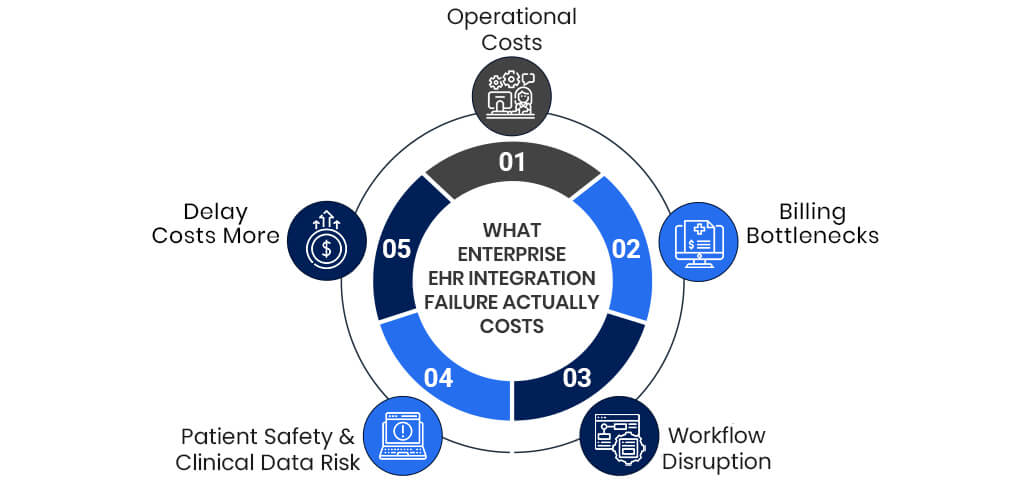
The consequences of EHR integration failure extend well beyond IT. Organizations face:
- Operational costs, staff time spent on manual corrections, reconciliation, and workarounds add up quickly across a large organization.
- Revenue delays, billing errors, and incomplete documentation caused by integration failures slow down reimbursement cycles.
- Workflow disruption: Clinicians lose time navigating unreliable systems, which pulls attention away from patient care.
- Patient safety risks incomplete or inaccurate clinical data at the point of care is not just an IT problem. It is a clinical risk.
- The cost of fixing EHR integration issues after deployment is almost always higher than the cost of preventing them. That gap widens with every month the problem goes unaddressed.
How to Actually Prevent EHR Integration Failure
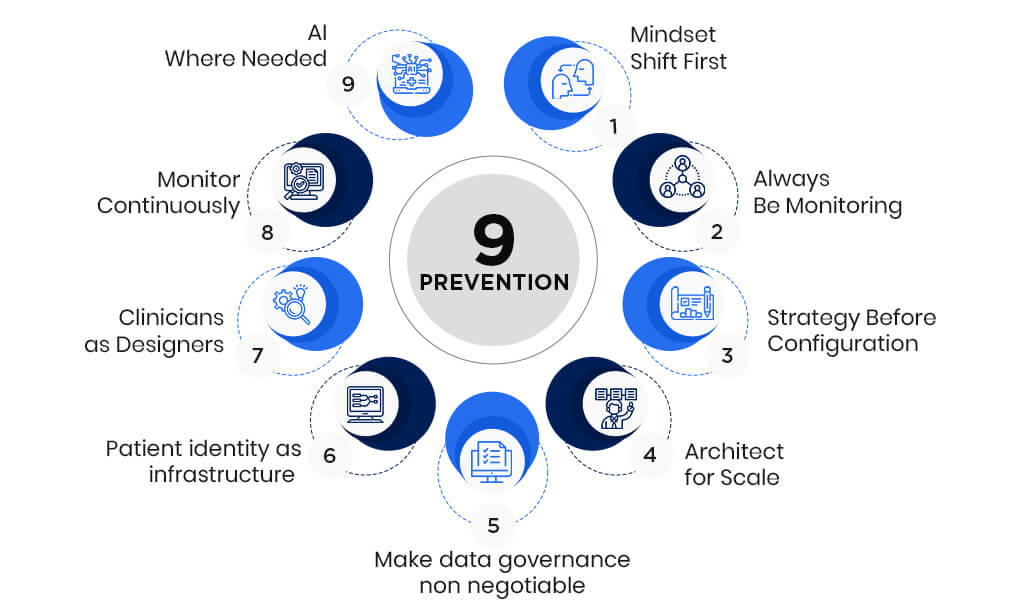
- Preventing EHR integration failure requires a fundamentally different mindset, one that treats integration not as a project with an end date, but as a long-term operational capability.
- Treat integration as continuous, not complete. Enterprise EHR integration software needs ongoing monitoring, optimization, and governance, not just at go-live, but for the life of the system. Building this mindset into the organization before implementation begins is the single most effective step in preventing EHR integration failure.
- Build an interoperability strategy before touching configuration. How to prevent EHR integration failure starts with planning. Define how enterprise HL7 integration and enterprise FHIR integration will be implemented, validated, and maintained across every connected system before a single API call is made.
- Design architecture for scale from day one. Enterprise EHR integration solutions built on scalable architecture perform reliably as the organization grows. Retrofitting scalability after the fact is expensive and disruptive.
- Make data governance non-negotiable. Data ownership, quality standards, and governance processes need to be defined before integration begins, not discovered during troubleshooting.
- Invest in patient identity as infrastructure. A centralized, validated patient identity strategy is foundational to everything else. Without it, every downstream integration is built on unreliable ground.
- Involve clinicians as designers, not just end users. The people who will live with the system every day need to shape how it works. Their input during the design phase reduces resistance, improves adoption, and surfaces workflow gaps before they become operational problems.
- Monitor as if the system is always at risk. Continuous monitoring, not periodic audits, is what allows organizations to catch enterprise EHR integration failure early, before it becomes costly and visible. This is a core part of any serious enterprise healthcare IT integration strategy.
- Use AI where it adds measurable value. Intelligent monitoring tools, anomaly detection, and predictive analytics can surface integration issues earlier than manual review. Used appropriately, AI strengthens enterprise EHR interoperability and reduces the manual burden on IT teams.
The Long Game
Enterprise EHR integration failure is an organizational problem in actuality. The organizations that avoid it aren’t necessarily using better tools. They’re using a better framework, one that starts with realistic planning, involves the right people, and treats enterprise EHR integration as something that requires sustained attention long after go-live.
The ones that struggle are the ones that arrived at go-live thinking the hard work was behind them. But It wasn’t. It was just beginning.
Conclusion
OSP Labs builds custom healthcare software and enterprise EHR integration solutions for organizations navigating the full complexity of healthcare IT. Their services span enterprise EHR integration services, enterprise EHR migration, and revenue cycle management solutions, telehealth solutions, interoperability, and AI-driven automation.
Their approach to enterprise healthcare IT integration is built around scalable architecture, clinical workflow alignment, continuous monitoring, and long-term optimization, the same principles that separate sustainable integration from one that quietly fails after go-live.
References
- https://www.klasresearch.com/report/interoperability-2023/3084
- https://www.healthit.gov/topic/interoperability
- https://www.hl7.org/fhir/
- https://www.ihe.net/resources/technical_frameworks/
- https://academic.oup.com/jamia
- https://www.healthaffairs.org/topic/health-information-technology
- https://informatics.bmj.com/
- https://www.mckinsey.com/industries/healthcare/our-insights
The post Why Enterprise EHR Integrations Fail After Go-Live (And How to Prevent It) appeared first on Osplabs.
Apa Reaksi Anda?
 Suka
0
Suka
0
 Kurang Suka
0
Kurang Suka
0
 Setuju
0
Setuju
0
 Tidak Setuju
0
Tidak Setuju
0
 Bagus
0
Bagus
0
 Berguna
0
Berguna
0
 Hebat
0
Hebat
0