





















































%20and%20Batch%20Production%20Records%20(BPR).png)















How Capital Constraints Are Reshaping Healthcare Project Delivery
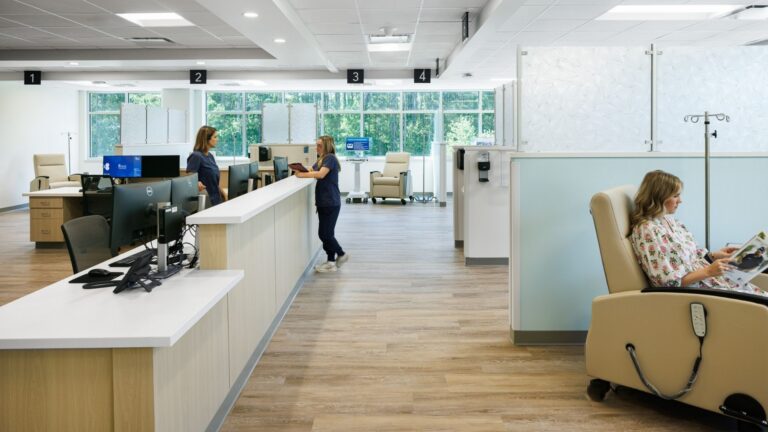
Frampton Construction delivered the 54,000-square-foot MUSC Health Bluffton Medical Pavilion. | Photo Credit (all): Courtesy of Frampton Construction
By Meghan Faulkner
Healthcare capital has less room for error than it did a few years ago. Construction costs have climbed up to 40% since early 2020, while health systems operate on thin margins and continue to face reimbursement pressure from both government and private payers.
That squeeze increases the importance of timing for some of the most critical project decisions that need to be made. Funding strategies, delivery methods and early contractor involvement can significantly contribute to a project’s success.
Funding Models Are Changing Project Delivery
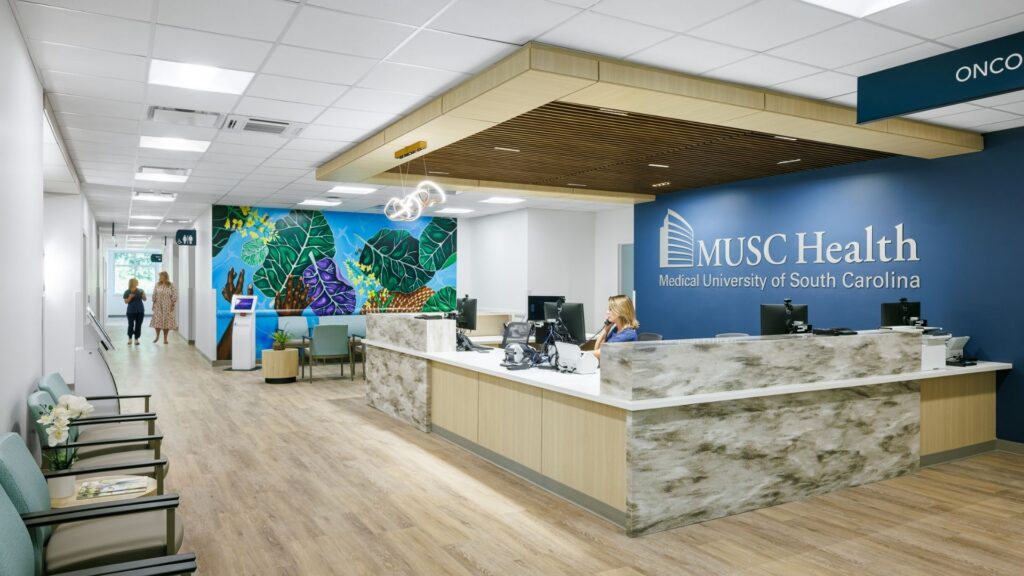
Sale-leasebacks, energy-as-a-service (EaaS) agreements and developer partnerships all give health systems ways to preserve capital, but they do so differently. A sale-leaseback may introduce a new owner or landlord into renovation and operational decisions, which can conflict with the hospital’s clinical or administrative priorities. EaaS shifts responsibility for major infrastructure systems to a third-party provider, whose requirements must be coordinated with the broader facilities and construction teams.
Developer-led projects show those delivery implications especially clearly. Under one common structure, a developer funds the land and core-and-shell construction while the health system funds the interior upfit and leases the facility. That can introduce separate design and construction teams, additional handoffs, and new sequencing constraints.
On developer-led projects, when the health system selects a separate architect and contractor for the interior upfit, that team cannot mobilize and begin interior upfit work until the developer’s contractor completes the core-and-shell. Work that might otherwise have been coordinated or performed in parallel instead becomes sequential. In the end, it can cost the health system both time and money, as the upfit is logistically more difficult once the shell is complete.
When possible, the most efficient scenario is for the health system to work with the developer’s existing design and construction team through the upfit. Keeping the work under one coordinated team allows decisions about the shell and interior to happen together, reducing handoffs and giving the team more flexibility to sequence work efficiently.
Earlier Decisions Carry More Value

For healthcare owners under capital pressure, preconstruction has become one of the most critical project phases.
There’s still a tendency to view competitive bidding at the end of design as the point where owners prove they are getting the best value. In reality, many of the decisions that most influence cost have already been made by then. The structural system has been selected, major materials have been specified, and the schedule has been built around assumptions that may no longer reflect the current market conditions.
That leaves the contractor pricing a largely fixed solution rather than helping shape a more efficient building design.
The greater opportunity comes earlier, while options remain. A contractor can test design decisions against current pricing and inquire about trade partner capacity, procurement timelines and constructability before those decisions become expensive to unwind.
Consider a parking structure designed around precast concrete. Lead times that once might have fit comfortably within a project schedule can now stretch well beyond it. If the project requires the material in nine months but procurement is closer to 18 months, discovering that after design is complete often leaves the owner choosing between delaying the project or redesigning it.
The same principle applies to dozens of smaller choices. A dimension or material that requires custom fabrication instead of a standard option, a trade partner with limited capacity or a system that could have been prefabricated can each affect cost and schedule. Those are the kinds of details that historical cost-per-square-foot benchmarks may not capture. In today’s market, real-time input from contractors and trade partners often tells an owner more about where a project is headed than a benchmark based on what a similar facility cost a year ago. h
Early involvement can also create schedule flexibility. Teams may be able to release site, structural or other early-release packages before the full set of construction documents are complete, allowing construction to begin while later design decisions and details continue. On developer-led projects, that coordination becomes even more important when different teams handle core-and-shell and tenant-improvement scopes.
MUSC Health’s new Bluffton Medical Pavilion shows what that continuity can look like in practice. Frampton Construction delivered the 54,000-square-foot facility from site work through interior construction as several MUSC practices were consolidated into one location. Keeping the work under one design and construction team gave the project a more unified approach from the shell through the finished clinical space, allowing decisions made early in the process to carry through the interior rather than being reinterpreted by a separate team later.
For health systems with less capital available to absorb redesign, delays, or missed procurement windows, that distinction matters. The strongest opportunity to control cost comes well before the project has a final design with a price attached to it.
Choosing the Right Partner for the project
No single delivery method is always the clear answer to solve today’s healthcare capital challenges. Some projects are driven primarily by schedule, others by budget, and many are balancing several pressures at once.
That makes the preconstruction phase increasingly important. Owners need partners who can identify where the project is most vulnerable and test key assumptions against current site specific and market conditions before those assumptions become an expensive change order.
The differentiator is the quality of insight a contractor can bring to those decisions. Strong trade-partner relationships and current local market knowledge give owners a clearer picture of what the project will actually cost and where the design or schedule may need to adjust.
When capital is tight, the best opportunity to control cost comes during the early conceptual and design phases. Delayed contractor involvement and collaboration may eliminate opportunities for cost savings and optimal project results.
Meghan Faulkner is Project Executive for Healthcare at Frampton Construction. For more information, visit framptonconstruction.com.
The post How Capital Constraints Are Reshaping Healthcare Project Delivery appeared first on HCO News.
The post How Capital Constraints Are Reshaping Healthcare Project Delivery appeared first on HCO News.
Apa Reaksi Anda?
 Suka
0
Suka
0
 Kurang Suka
0
Kurang Suka
0
 Setuju
0
Setuju
0
 Tidak Setuju
0
Tidak Setuju
0
 Bagus
0
Bagus
0
 Berguna
0
Berguna
0
 Hebat
0
Hebat
0