




















































%20and%20Batch%20Production%20Records%20(BPR).png)
















How Germinal Centers Generate Antibodies Through Noisy Rounds of Mutation and Selection
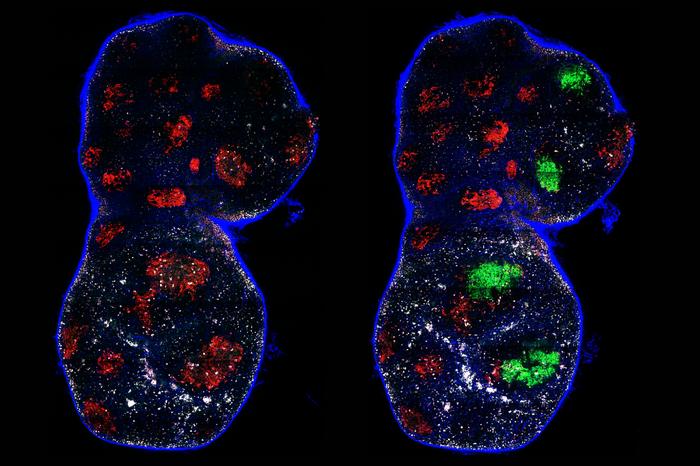
A study tracking thousands of B cells across more than 100 germinal centers (GCs) in mice has revealed how the system consistently produces highly effective antibodies. The findings overturn longstanding ideas about how germinal centers function, revealing that they are far more selective than once thought, and challenge the idea that antibody improvement is driven mainly by rare growth “bursts” among the most successful B cells. The discovery could have implications for immune cell evolution, and ultimately guide the design of vaccines against rapidly mutating pathogens like influenza. It could also lead to new ways of studying evolution itself.
“The traditional, mechanistic view of germinal centers is to think of them as selection machines sorting out the best antibodies,” said research lead Gabriel D. Victora, PhD, head of the Laboratory of Lymphocyte Dynamics at The Rockefeller University. “But when you look very, very closely, you see a process that’s almost essentially random—a little bit better than a coin toss—which repeats many times until the immune system arrives at the right answer consistently. That’s much more akin to how evolution operates than the way a machine does.”
Victora and colleagues reported on their findings in Cell, in a paper titled “Replaying germinal center evolution on a quantified affinity landscape.”
Inside germinal centers, B cells rapidly mutate and compete to produce antibodies that bind successively better to pathogens. “Darwinian evolution of immunoglobulin genes within germinal centers (GCs) underlies the progressive increase in antibody affinity following antigen exposure,” the authors wrote. That puts B cells under intense pressure to optimize a single trait: binding affinity, or how well an antibody recognizes its target.
But how they accomplish that feat has very much remained an open question, the team noted. “Whereas the cellular mechanics of how competition between B cells increases affinity are well established, the evolutionary dynamics of this process are less clear.” Because weak and strong B cells often coexist side by side in the germinal center, scientists have long wondered whether the immune system temporarily preserves weaker cells in case they later acquire useful mutations. The phenomenon of clonal bursts, in which the descendants of a single B cell rapidly take over an entire germinal center, are also poorly understood.
The authors explained that GC B cells evolve by rapidly mutating only two Ig genes, which are the heavy chain (Igh) and light chain (either Igk or Igl). Victora’s team engineered mice in which all competing B cells began with the same antibody sequences, allowing them to replay a single evolutionary process across more than 100 germinal centers at once. “… we established a system in which GCs are composed entirely of B cells carrying the same pre-rearranged Igh and Igk genes, ensuring identical starting specificity and affinity,” they explained. Victora added, “We simplified it to the bare bones, and asked how repeatable is the exact sequence of mutations that leads to stronger antibodies.”
Once each of the B cells was primed with the exact same unmutated antibody sequence, the team triggered germinal center formation through immunization. They then tracked the resulting sprint toward immune efficiency with multiphoton microscopy and laser-based photoactivation, and sequenced thousands of individual B cells across 119 germinal centers.
With this data, the team managed to construct a detailed family tree that mapped how different lineages of B cells had developed. They also built a mutational dictionary, using deep mutational scanning (DMS), a technique that links almost every possible amino-acid change to antibody performance. This advance allowed the team to determine how mutations affected binding strength and structural stability simply by reading a cell’s DNA sequence.
“DMS was the big technical advance here,” says first author Ashni Vora, PhD, a graduate fellow in the lab. “With it we could determine the affinities of thousands of cells just by looking at their sequence, without having to produce an antibody.”
The researchers compare the resulting picture to a casino game. Watching a single B cell evolve inside a germinal center looked almost random, with some cells rapidly expanding, others disappearing, and even promising mutations failing as if random chance ruled the day. Some germinal centers were overtaken by clonal bursts while others contained many competing lineages with no clear winner. The differences had little to do with affinity or merit. “We find that, even in this simplified setting, GC selection yields widely divergent tree topologies, ranging from clonal-burst-type structures to multi-pronged GCs where multiple line ages evolve in parallel,” they noted.
But the team discovered that the germinal center game is rigged. In a casino, the house always wins not because of the odds on any individual game, but because a slight statistical bias is built into the system and repeated thousands of times. Germinal centers appear to operate similarly. Each round of cellular competition is only slightly biased toward cells carrying beneficial mutations, and random chance means that there is often little correlation between affinity and success. But by repeating that same noisy, almost random process over and over across many germinal centers, the immune system ultimately produces stronger antibodies.
“If you see someone get a jackpot, you might wonder how the casino makes money,” Victora says. “The answer is that the casino puts in a little bit of bias, so that you win and you lose, but on average, you lose more than you win. If there are just one or two people playing, the casino might lose money due to random chance. But if there are a thousand people playing, it’s going to average out and the house wins. That’s essentially how germinal centers work.”
The researchers also found that the immune system favors mutations that are easiest for its cellular machinery to generate, rather than the mutations that would produce the strongest antibodies. And by tracking B cell lineages over time, they also showed that germinal centers are far more selective than previously thought, rapidly eliminating inferior B cells. “By combining phylogenetic reconstructions with a fitness landscape inferred from populations sampled over time, we show that both the apparent permissiveness of GCs to low-affinity lineages and the apparent early plateau in affinity maturation are best explained by survivorship biases that distort the histories of lineages present at sampling,” the investigators wrote in summary.
Taken together, the findings overturn several longstanding ideas about how germinal centers function and may provide new tools for vaccine developers hoping to steer antibody evolution against influenza and HIV. “What was once theoretical speculation about what must happen in the germinal center, we are now showing in action—the real thing,” Victora says.
At the same time, this work also illustrates how germinal centers could become a powerful model for studying evolution more broadly. Scientists have long relied on bacteria grown in the lab over many generations to plumb the depths of evolutionary biology and determine how much of evolution is driven by random chance. In clarifying the rules governing germinal centers, the researchers revealed why the immune system could offer a potentially more tractable experimental avenue: Unlike bacterial evolution, which centers around adapting to many possible survival strategies, B cells are all aiming for the same target. “I see this as an opening salvo in a longer effort to understand evolution by using the immune system as a model,” Victora added.
The post How Germinal Centers Generate Antibodies Through Noisy Rounds of Mutation and Selection appeared first on GEN - Genetic Engineering and Biotechnology News.
Apa Reaksi Anda?
 Suka
0
Suka
0
 Kurang Suka
0
Kurang Suka
0
 Setuju
0
Setuju
0
 Tidak Setuju
0
Tidak Setuju
0
 Bagus
0
Bagus
0
 Berguna
0
Berguna
0
 Hebat
0
Hebat
0