






















































%20and%20Batch%20Production%20Records%20(BPR).png)
















How to Use USMLE Step 1 Practice Questions Effectively

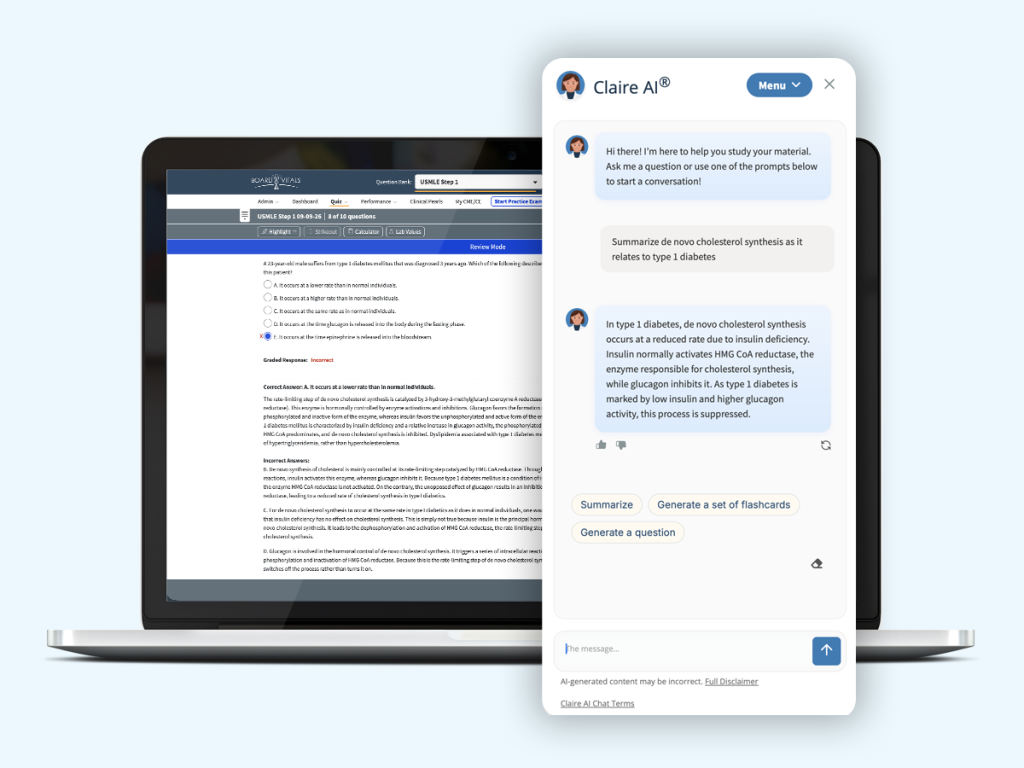
USMLE Step 1 practice questions should not be reserved for the final weeks before your exam. Used correctly, they can help you learn foundational science, develop clinical reasoning, identify weaknesses, and determine whether you are ready to test.
However, completing a large number of questions is not automatically an effective Step 1 strategy. The value of a question bank depends on when you begin, how you build your blocks, and what you do after submitting your answers.
This guide explains how to incorporate Step 1 practice questions into each stage of your preparation, from your first system-based blocks to full-length self-assessments and final exam-day practice.
Why Step 1 Practice Questions Are an Essential Learning Tool
Step 1 assesses more than a student’s ability to recall isolated facts. According to the official USMLE content specifications, approximately 60-70% of Step 1 questions assess the application of foundational science concepts. Another 20-25% involve patient diagnosis.
Questions are also deliberately integrative. A single vignette may require knowledge of physiology, pathology, pharmacology, and other disciplines rather than testing each subject separately.
That means reading a textbook chapter or memorizing a flashcard does not necessarily demonstrate that you can apply the information in an unfamiliar clinical scenario. USMLE Step 1 practice questions require you to retrieve that knowledge, interpret the information provided, and decide which concept is most relevant.
This approach is supported by research into retrieval practice. A systematic review of health professions education found that retrieval and distributed practice generally improved academic performance, although the researchers also noted differences in study designs and assessment methods.
In practical terms, questions serve two purposes:
- They assess what you currently understand.
- They create opportunities to learn through active retrieval and feedback.
This is why question-based learning should be part of your preparation, not simply a way to test yourself at the end.
When Should You Start USMLE Step 1 Practice Questions?
You do not need to finish reviewing every Step 1 topic before beginning practice questions. Waiting until you feel fully prepared can create two problems. First, you lose opportunities to reinforce new material through retrieval. Second, you may develop familiarity with the content without learning how to apply it in a Step 1-style vignette.
Instead, begin with questions that correspond to the material you are currently studying. For example, if you are reviewing cardiovascular physiology and pathology, you might complete a short set of cardiovascular questions after your content review.
At this stage, accuracy is less important than understanding:
- How foundational concepts appear in clinical scenarios
- Which details in a vignette are diagnostically important
- How similar answer choices differ
- Which areas require additional review
As your knowledge becomes more integrated, your question blocks should gradually become broader, more mixed, and more representative of the actual exam.
System-Based or Mixed Step 1 Practice Questions?
Both system-based and mixed blocks can be useful, but they serve different purposes.
Start with system-based questions when learning content
System-based blocks are often appropriate during the early stages of preparation. They allow you to apply information shortly after learning it and make it easier to identify gaps within a specific subject.
If you have recently studied renal physiology, for instance, completing renal questions can show whether you understand how changes in filtration, electrolyte handling, and acid-base balance appear in clinical cases.
There is one limitation: knowing the subject in advance gives you context that will not be available on exam day. If you begin a renal block, you already know that each answer is likely to involve the renal system.
Transition to mixed questions as your exam approaches
Mixed blocks require you to determine which system, discipline, and disease process a question is testing. This more closely reflects the Step 1 exam, where questions are not grouped by subject.
Begin introducing mixed blocks once you have reviewed a meaningful portion of the curriculum. During dedicated study, mixed questions should generally become a larger part of your schedule.
A gradual transition might look like this:
- Early preparation: primarily system-based, tutor-mode questions
- Intermediate preparation: a combination of system-based and mixed questions
- Dedicated study: primarily mixed, timed question blocks
- Final preparation: mixed blocks, NBME self-assessments, and official practice materials
This is a framework, not a fixed schedule. Your actual progression should depend on your foundation, school curriculum, assessment results, and available study time.
Tutor Mode or Timed Mode?
Tutor mode provides immediate feedback after each question. Timed mode requires you to complete the block before reviewing the explanations.
Tutor mode is usually more useful when you are still learning a subject. Immediate feedback helps connect the question to the underlying concept while your reasoning is still fresh.
Timed mode becomes more important as you move closer to the exam. It helps you practice:
- Maintaining an appropriate pace
- Making decisions without immediate confirmation
- Recovering after a difficult question
- Staying focused throughout an entire block
- Managing uncertainty without repeatedly changing answers
Do not wait until your final week to begin timed practice. Timing is a skill that develops through repetition.
How Many Step 1 Practice Questions Should You Complete Each Day?
There is no evidence-based number of daily questions that works for every student. The right amount depends on your study phase, timeline, baseline performance, and ability to review each block thoroughly.
Someone learning material alongside medical school classes may benefit from a smaller daily set. A student in dedicated study may complete several blocks while also scheduling time for review and targeted content reinforcement.
Instead of choosing a number because another student used it, work backward from three considerations:
- How many high-quality questions are available?
- How much time remains before your exam?
- How many questions can you review properly each day?
If increasing your daily total causes you to skim explanations, ignore recurring weaknesses, or abandon content review altogether, the added volume may not be productive.
The objective is not to finish the largest possible number of questions. It is to improve your ability to reason through new questions accurately and efficiently.
How to Review USMLE Step 1 Practice Questions
The review process is where much of the learning takes place. Checking the correct answer and moving on is rarely enough. For every incorrect answer, and every correct answer you guessed, identify why you selected your response.
Most missed questions fall into one of several categories:
- Knowledge gap: You did not know the underlying concept.
- Application gap: You knew the fact but could not apply it to the scenario.
- Recognition gap: You missed or misinterpreted an important clue.
- Reasoning error: You did not distinguish between plausible answer choices.
- Testing error: You rushed, misread the question, or changed a well-supported answer.
- Timing problem: You spent too long on one question and rushed later decisions.
This classification is more useful than simply recording the topic. Two students may miss the same question for completely different reasons and therefore require different corrections.
Use a focused review process
For each missed or uncertain question, ask:
- What concept was the question assessing?
- Which details in the vignette were essential?
- Why was my answer incorrect?
- Why was the correct answer better?
- How could the same concept appear in a different vignette?
- What action should I take before encountering this topic again?
That final action might involve reviewing a foundational concept, creating a concise flashcard, comparing two similar diagnoses, or completing another targeted question set.
Avoid copying entire explanations into a notebook. Long notes can create another passive resource that is difficult to review. Record only the information needed to prevent the same mistake.
Track Patterns, Not Just Percentages
Question-bank percentages can provide useful information, but they should not be interpreted in isolation. Performance may be influenced by block difficulty, selected subjects, whether the questions are new, and whether the block was timed or completed in tutor mode.
Look for patterns across multiple blocks.
For example:
- Are you consistently weak in a particular organ system?
- Do you struggle more with physiology than pathology?
- Are you missing questions because of knowledge gaps or misreading?
- Does your accuracy fall toward the end of a block?
- Are you performing well in targeted sets but poorly in mixed blocks?
A weekly review of these patterns can help you decide where to focus next. If you repeatedly miss respiratory physiology questions, more random questions alone may not solve the problem. You may need a focused content review followed by another set of respiratory questions to determine whether the gap has improved.
Use the Official Step 1 Content Outline to Guide Your Practice
Your question-bank performance should be considered alongside the official USMLE Step 1 content specifications.
The current outline shows that Step 1 questions remain highly integrated. Pathology appears in approximately 45-55% of the exam, while physiology appears in approximately 30-40%. Other disciplines, including pharmacology, microbiology, behavioral sciences, anatomy, biochemistry, immunology, and genetics, are incorporated throughout the exam.
These percentages overlap because individual questions can assess more than one discipline. They should not be used to predict the exact composition of your examination.
However, the outline can help you avoid an unbalanced study plan. Spending most of your time on a preferred subject while neglecting integrated physiology, pathology, or other tested disciplines can leave important gaps.
The USMLE also introduced enhanced nutrition content across the Step examinations beginning in June 2026. Students preparing under the current outline should make sure their resources reflect the latest specifications.
How to Use NBME Self-Assessments
Question banks and NBME self-assessments do not serve exactly the same purpose.
A question bank is primarily a learning resource. An NBME Comprehensive Basic Science Self-Assessment, or CBSSA, is designed to help students measure progress, identify strengths and weaknesses, and gauge readiness for Step 1.
NBME currently reports:
- An equated percent correct score
- Performance by content area
- An estimated probability of passing Step 1
- Question-level feedback and answer rationales
- Performance trends across multiple assessments
Take an initial self-assessment early enough for the results to influence your plan. Additional assessments can then help you determine whether the adjustments you made are producing progress.
Avoid treating a single result as a guarantee. NBME itself notes that estimated pass probability does not guarantee future Step 1 performance. Knowledge, testing conditions, fatigue, anxiety, and other factors may affect the final result.
When evaluating readiness, consider your performance trajectory across multiple assessments, the consistency of your question-bank results, and whether you can complete timed blocks under realistic conditions.
Practice With the Current Step 1 Format
Students sitting for Step 1 on or after May 14, 2026, encounter the examination in the updated testing software.
The current Step 1 format includes:
- Up to 280 questions
- Fourteen 30-minute blocks
- An eight-hour testing session
The USMLE provides more than 100 official sample questions in PDF and interactive formats. Students should use the current interactive testing experience to become familiar with the interface and shorter block structure.
These sample questions are particularly useful near the end of preparation because they provide direct exposure to official item style. They should not replace a full question bank or NBME self-assessments, but they can reduce surprises related to navigation, timing, and presentation.
Common Mistakes When Using Step 1 Practice Questions
Waiting too long to begin
Practice questions are part of the learning process. Saving all of them for dedicated study can limit your opportunity to develop question-based reasoning gradually.
Focusing exclusively on percentage correct
A percentage tells you what happened. It does not tell you why. Without analyzing the source of your errors, it is difficult to make meaningful adjustments.
Reviewing every question in the same way
A question you answered confidently for the correct reason does not require the same review as an incorrect answer caused by a foundational misunderstanding. Spend your time where it can produce the most improvement.
Memorizing individual questions
Recognizing an answer from a previous attempt is not the same as understanding the concept. Ask how the disease, mechanism, or experimental finding could be tested in a different scenario.
Using too many resources
Moving between several incomplete question banks can make it difficult to track progress and review mistakes consistently. In most cases, using one comprehensive question bank thoroughly is more productive than sampling several without completing or reviewing them.
Avoiding difficult subjects
It is tempting to complete questions in areas where you already perform well. However, improvement is more likely to come from identifying and addressing repeated weaknesses.
A Practical Weekly Question Strategy
A strong weekly plan should respond to your performance rather than repeat the same routine regardless of results.
At the end of each week:
- Review your question-bank performance by subject.
- Identify the two or three most consistent weaknesses.
- Determine whether each weakness reflects knowledge, application, timing, or another issue.
- Schedule focused review for the underlying concepts.
- Complete targeted questions to reinforce the review.
- Return to mixed questions to check whether the knowledge transfers to an unfamiliar context.
- Adjust the following week based on the new results.
This process turns question performance into an active study plan instead of a collection of percentages.
Final Thoughts
USMLE Step 1 practice questions are most effective when they are used throughout preparation, not saved exclusively for the end.
Begin with system-based questions while learning foundational material. Gradually introduce mixed and timed blocks as your knowledge develops. Review mistakes according to their underlying cause, track patterns across multiple blocks, and use NBME self-assessments to evaluate progress and readiness.
The number of Step 1 practice questions you complete matters less than the quality of the reasoning and review attached to them. Every question should help you understand what you know, where your reasoning breaks down, and what you need to do next.
If you are completing questions consistently but your performance is not improving, the problem may be difficult to identify on your own. An experienced Step 1 tutor can analyze your results, identify recurring patterns, and help you build a study plan based on your specific needs and timeline.
The post How to Use USMLE Step 1 Practice Questions Effectively appeared first on Elite Medical Prep.
Apa Reaksi Anda?
 Suka
0
Suka
0
 Kurang Suka
0
Kurang Suka
0
 Setuju
0
Setuju
0
 Tidak Setuju
0
Tidak Setuju
0
 Bagus
0
Bagus
0
 Berguna
0
Berguna
0
 Hebat
0
Hebat
0