


































%20and%20Batch%20Production%20Records%20(BPR).png)














The art of the possible: how 21D is scaling precision dentistry with Stratasys DentaJet
In digital dentistry, a well-considered plan is only half the story. For dental laboratories and clinical production teams, the real test comes later: can that plan be translated into a device that performs accurately, consistently and predictably once it reaches the patient?
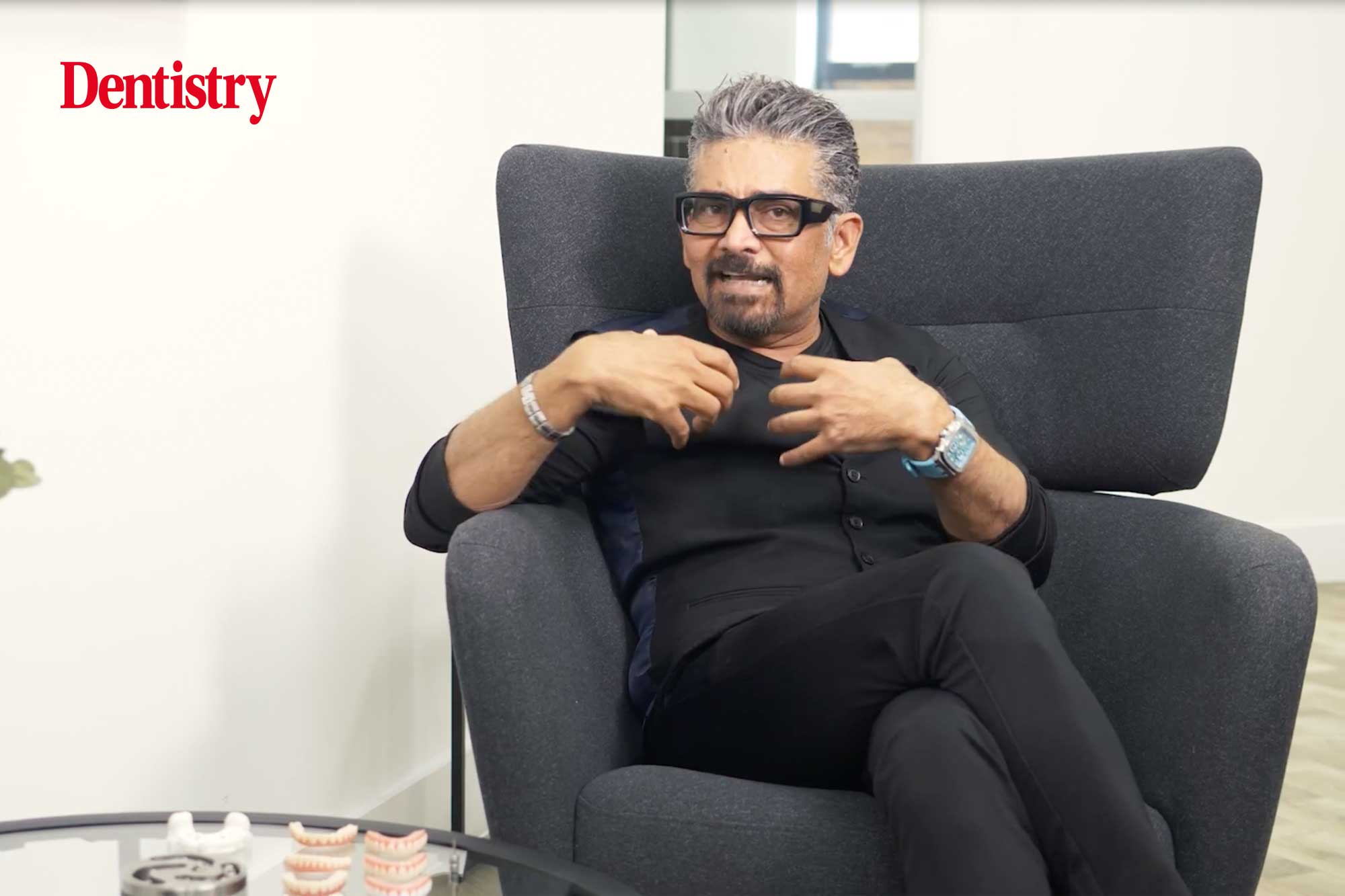
That question runs through the work of 21D, the full-mouth rehabilitation lab founded by Rajesh Vijay. A dentist with more than 30 years’ experience, including 27 years focused on full-mouth implants, Vijay has built 21D around a demanding view of precision. In his world, accuracy has to be engineered into the workflow from the beginning.
Engineering precision into full-mouth rehabilitation
As he explains: ‘It’s all well and good having an idea and a plan, but if you haven’t got the right tools that are going to deliver that plan, you’re going to have a great plan, and you’re going to have terrible execution.’
That is the thinking behind 21D’s investment in Stratasys DentaJet multi-material 3D printing technology. For Vijay, the decision was not driven by a desire to adopt 3D printing for its own sake. It was about finding a production platform capable of meeting the bioengineering standards he believes are essential for ultra-accurate surgical guides.
21D treats patients with complex needs: those who are terminally dentate, have advanced periodontal disease, have already lost more than half of their natural dentition, or are full denture wearers. Their workflow has to account for safe biology, implant positioning, load mechanics and long-term function, with manufacturing tolerances tight enough to support the clinical plan.
Vijay describes this as an engineering mindset. His view is that dentistry should move away from ‘yeah, that looks about right’ and towards measurable, auditable quality assurance. As he puts it, nothing is ‘fix and forget’; it is ‘fix and maintain’. Start with quality, and the maintenance burden will be lower over time.
That principle is reflected in the way 21D works. Designs are checked by both AI-supported systems and human expertise before moving into production. Once made, devices are scanned and overlaid against the original design to check whether they remain within the required tolerance. If they do not, they are remade.
From treatment planning to measurable quality assurance
The final kit sent to the clinical team brings together the surgical guide, prosthetics, implant components, and instructions in one box. For the clinician, the process is designed to be clear and repeatable: the start point, the end point and the route between the two have all been defined in advance.
Stratasys DentaJet technology plays a central role in that workflow. Vijay describes 21D’s asymmetric anatomical guides as ‘ultra, ultra, ultra customised’, enabling implant placement with discrepancies of less than 100 microns or ‘less than the width of a human hair’.
What makes the 21D story particularly striking is not only the level of accuracy being pursued, but the scale at which the business is now applying it. After first encountering the J5 DentaJet abroad, Vijay immediately ordered one machine. Today, 21D has four Stratasys machines, supported in the UK by SYS-UK Systems.
That support matters when 3D printing moves from being an occasional lab tool to part of a high-throughput production environment. Vijay describes SYS Systems as ‘great’ at managing the machines and supporting the wider 21D team with advanced application support, highlighting the value of local service and technical support when advanced additive manufacturing becomes embedded in day-to-day clinical production.
At 21D, the J5 DentaJet is used for stackable surgical guides, case models, and asymmetric anatomical guides, with applications including try-ins, temporary restorations, and dentures. Vijay also points to the large build plate as essential for scalable production of highly customized dental applications. For his technicians and bioengineers, the appeal is practical as much as technical: the system is a cartridge-based multi-material jetting printer and, in Vijay’s words, ‘plug and play’.
Why connected workflows matter in digital dentistry
For dental laboratories, the wider message is that successful digital dentistry relies on more than software, scanners or printers in isolation. It depends on a connected workflow in which planning, production, QA and support all work to the same standard.
At 21D, Stratasys DentaJet platform provides the production capability behind a highly precise, scalable workflow. SYS-UK provides the support needed to keep that capability running in a demanding real-world environment.
Vijay’s enthusiasm is hard to miss, but it is not simply enthusiasm for a machine. It is excitement about what becomes possible when precision-led dentistry, additive manufacturing and service support come together, and when a digital plan can be delivered with the accuracy it deserves.
Watch the full video above to hear Vijay’s story first-hand, from discovering the J5 DentaJet to scaling 21D’s precision workflow with four Stratasys machines, supported in the UK by SYS Systems.
This article is sponsored by Stratasys.
Apa Reaksi Anda?
 Suka
0
Suka
0
 Kurang Suka
0
Kurang Suka
0
 Setuju
0
Setuju
0
 Tidak Setuju
0
Tidak Setuju
0
 Bagus
0
Bagus
0
 Berguna
0
Berguna
0
 Hebat
0
Hebat
0