















































%20and%20Batch%20Production%20Records%20(BPR).png)















Two Proteins with Opposing Functions Found to Support Healthy Skin Maintenance

Research headed by a team at Stanford Medicine has identified two proteins with opposing functions that are involved in orchestrating the development and maintenance of healthy skin.
The proteins, NEDD8 and SUMO2, are part of a family called ubiquitin-like proteins (UBLs), and the researchers believe that modulating their activity with topical drugs could reduce inflammation, aid wound healing, and slow or halt the growth of skin cancer.
“These two ubiquitin-like protein systems are remarkably dedicated and opposite in their functions,” said Paul Khavari, MD, PhD, chair of dermatology at the Stanford School of Medicine and senior author of the study. “One promotes the stem-cell state while the other drives differentiation. It’s like having two opposing forces that determine a cell’s fate.”
Added clinical instructor of dermatology Mårten Winge, MD, PhD, “What’s really exciting is how specific these effects are. When we manipulate one system or the other, we see very clear and opposite outcomes. This specificity is unusual for ubiquitin-like pathways and makes these systems particularly attractive for therapeutic targeting.”
Khavari, who is the Carl J. Herzog Professor in Dermatology in the School of Medicine, chief of dermatology at Veterans Affairs Palo Alto, and a member of the Stanford Cancer Institute, is senior author, and Winge is co-lead author of the researchers’ published paper in Science, titled “Ubiquitin-like proteins NEDD8 and SUMO2 control epithelial homeostasis, regeneration, and inflammation.” The work was carried out in collaboration with researchers at Icahn School of Medicine at Mount Sinai.
Stratified epithelial tissues, such as the skin’s epidermis, differentiate to form protective barriers against environmental attacks, the authors wrote. “This process involves coordinated modulation of thousands of genes and is disrupted in many inflammatory or neoplastic diseases.
Ubiquitination controls the targeted destruction and disposal of unneeded proteins in a cell. “Ubiquitin and related ubiquitin-like proteins (UBLs) comprise a major layer of protein regulation,” the team continued. The study by Khavari and colleagues has now found that in the skin, certain ubiquitin-like proteins switch on or off wide swaths of genes involved in cellular growth and development. In particular, they trigger progenitor, or stem, cells in the lower layer of the skin to either mature and migrate to the skin surface or to self-renew.
The outer layer of your skin can be considered as two distinct compartments. On the lower level, progenitor cells or skin-specific stem cells wait to transform into keratinocytes, a more specialized cell type forming the critical skin barrier that keeps moisture in (and out), excludes infection-causing pathogens, repels DNA-damaging ultraviolet rays, and harbors the nerve endings that allow us to sense our surroundings.
These progenitor cells divide just enough to keep their numbers robust. But when needed—after injury or infection or when skin cells naturally slough off—a subset of progenitor cells differentiate and migrate to the skin’s surface. Disruptions in this delicate balance between stem cell maintenance and their maturation into adult keratinocytes can lead to psoriasis, poor wound healing, and skin cancer.
The researchers were interested in understanding how the differentiation switch is flipped. “We hypothesized that differentiation-dependent proteomic remodeling diverges from RNA-level effects due to posttranslational protein modifications,” they noted. They used a wide swath of experimental approaches to assess dynamic changes in the expression of thousands of genes and proteins at various stages of keratinocyte differentiation. The results found that the maturing cells expressed increasing levels of genes and proteins involved in skin formation and decreasing levels of others associated with stem cell maintenance. Many of the proteins that decreased during differentiation bore small molecular tags that identify locations recognized by other proteins in the ubiquitin pathways—giving a hint that ubiquitination may be involved in the differentiation switch the researchers were seeking.
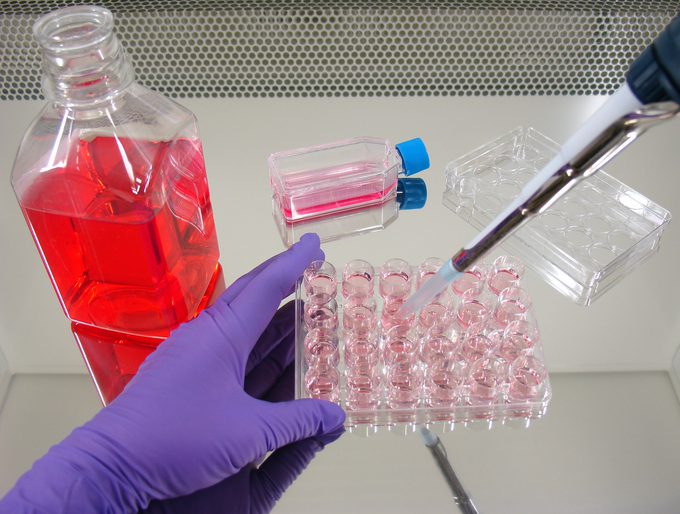
Disrupting the expression of more than 200 genes in the ubiquitin pathway during keratinocyte maturation highlighted two subpathways essential for proper differentiation: NEDDylation and SUMOylation. Hobbling the NEDDylation pathway supercharged differentiation, while blocking SUMOylation prevented differentiation. Similar results were obtained when the pathways were blocked pharmacologically with existing drugs in both human keratinocytes grown in the laboratory and in human skin organoids—three-dimensional sheets of tissue about the size of a quarter that mimic the multicellular structure of human skin.
Next, the researchers genetically engineered laboratory mice such that the expression of either Nedd8 or Sumo2—two key proteins in the NEDDylation and SUMOylation pathways—could be blocked when a triggering molecule is applied to the animals’ skin. They found that the skin of the mice developed abnormally when either Nedd8 or Sumo2 expression was halted, showing that both proteins are necessary for proper skin development.
“Generation of conditional knockout mice established essential roles for NEDD8 in progenitor maintenance, skin regeneration, and inflammation, whereas SUMO2 was required for differentiation,” they commented. Mice unable to make Nedd8 had an overgrowth of keratinocytes on their skin’s surface (similar to psoriasis), and animals lacking Sumo2 showed impaired differentiation and a loss of the distinct layers that make up healthy skin.
In addition to changes in the skin cells, the loss of Nedd8 and Sumo2 led to striking changes in the amounts and kinds of immune cells populating the skin. Nedd8 loss resulted in an increase in the numbers of immune cells called neutrophils in the skin and caused inflammation, while Sumo2 loss caused an increase in the numbers of another immune cell called a T cell. “In skin, NEDD8 maintained the undifferentiated epidermal state, enabled wound healing, and restrained neutrophilic inflammation,” they said. “SUMO2 promoted proper epidermal differentiation and suppressed T lymphocyte infiltration.”
Khavari commented: “We’re not just changing individual cells—we’re changing the whole tissue microenvironment. Manipulating these pathways could have therapeutic applications for wounds, inflammation, skin aging, and even cancer.”
Further experiments showed that the effect of Nedd8 on cell differentiation is due to its association with an RNA-binding protein called HNRNPU. “NEDD8 loss modulated the RNA binding and stabilizing functions of HNRNPU,” the team explained. In the absence of Nedd8, HNRNPU latches onto and stabilizes sets of RNA messages encoding genes for proteins essential for the differentiation of progenitor cells into keratinocytes, but when Nedd8 attaches to HNRNPU, the protein instead binds to and stabilizes RNA messages encoding proteins necessary for progenitor cell maintenance.
“Thus, NEDD8 and SUMO2 play opposite roles in epithelial homeostasis, regeneration, and inflammation, demonstrating multiple ways ubiquitin-like networks govern tissue homeostasis,” the team reported in their paper. “The researchers are now exploring whether topical drug treatments targeting the NEDDylation or SUMOylation pathways could tilt the balance of keratinocyte differentiation to progenitor cell maintenance and to treat a variety of skin diseases and disorders.
“The beauty of understanding these fundamental switches is that we can apply them to multiple disease states,” said co-lead author Leandra Jackrazi, an MD/PhD student. “Whether it’s promoting wound healing, reducing inflammation, or controlling cancer growth, having the ability to toggle between stemlike and differentiated states opens many doors.”
The post Two Proteins with Opposing Functions Found to Support Healthy Skin Maintenance appeared first on GEN - Genetic Engineering and Biotechnology News.
Apa Reaksi Anda?
 Suka
0
Suka
0
 Kurang Suka
0
Kurang Suka
0
 Setuju
0
Setuju
0
 Tidak Setuju
0
Tidak Setuju
0
 Bagus
0
Bagus
0
 Berguna
0
Berguna
0
 Hebat
0
Hebat
0