








































%20and%20Batch%20Production%20Records%20(BPR).png)
















Restoring trust in medicine, one conversation at a time

Trust has always been central to medicine, but today it is being tested in new ways. Patients are navigating a flood of health information from search engines, social media, influencers, and AI-generated tools — often without a clear way to separate evidence-based guidance from misinformation.
That challenge is accelerating as health care data increases by more than 36% annually and medical misinformation rises alongside it. Surveys show that 86% of physicians believe medical misinformation has increased over five-years, and global studies find 70% of people believe at least one of six divisive health claims about foods, vaccines and medicines.

For physicians, this infodemic poses a pressing challenge: How to deliver high-quality, evidence-based care when the integrity of medical science itself is constantly under threat?
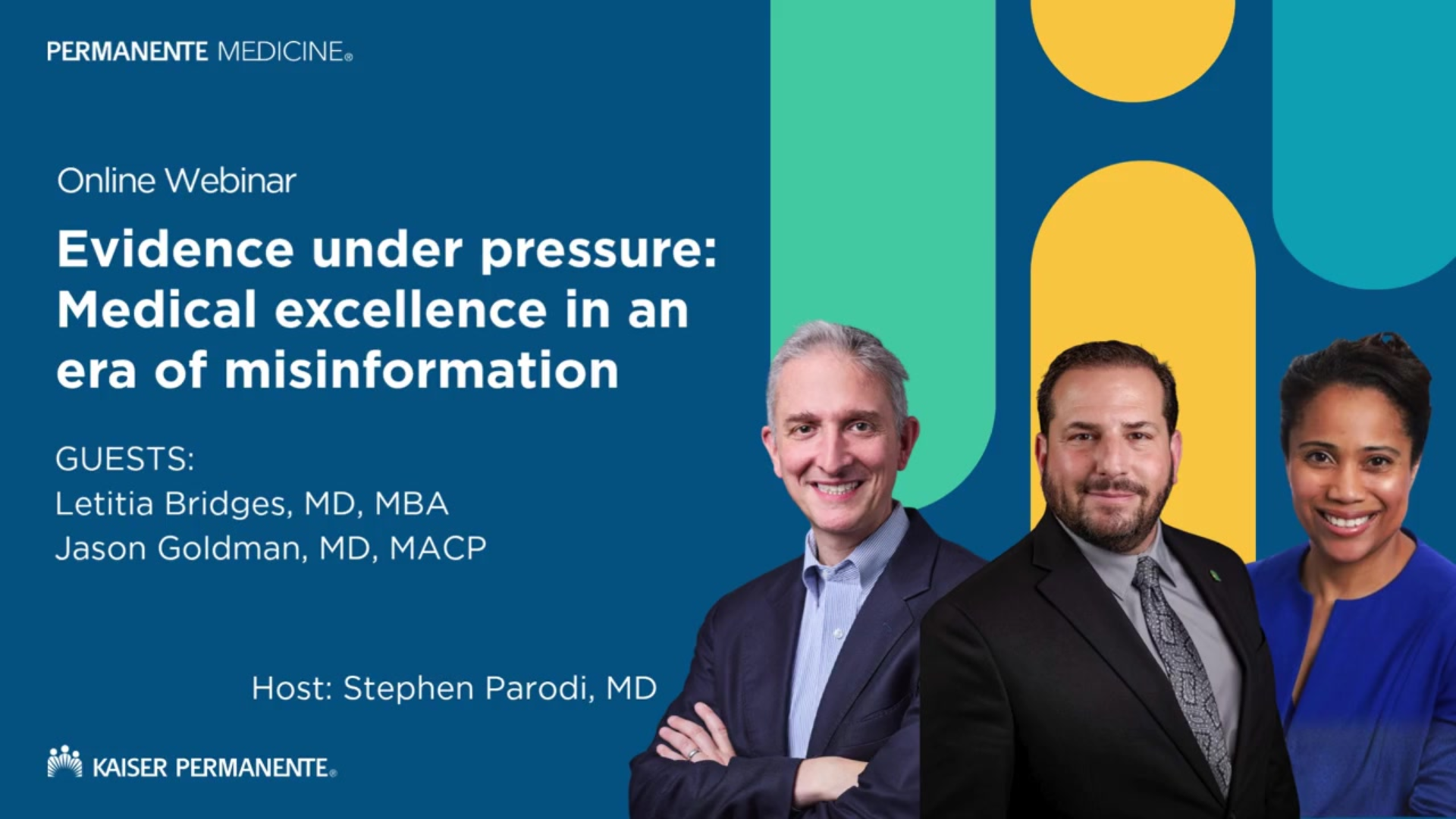
The following is an abridged version of an article written by Stephen Parodi, MD (link to full article at the end) exploring how clinicians can navigate conflicting guidance, preserve patient trust, and approach misinformation with courage and conviction. It’s the result of a recent fireside chat he moderated with guests Jason M. Goldman, MD, MACP, immediate past president of the American College of Physicians, and Letitia Bridges, MD, MBA, chief quality officer with The Permanente Federation.
Translating evidence into trust
Patients now encounter health information from search engines, social media, influencers, and AI-generated answers — often mixing credible facts with misinformation. That uncertainty can open up important conversations, but it can also erode trust and undermine the patient-physician relationship. Clinicians need to understand how these tools are created, what data they use, and how to evaluate them.
That makes trusted evidence more important than ever. When guidance appears inconsistent, health systems, medical societies, universities, and research organizations must help clinicians and patients navigate information with transparency and rigor. Kaiser Permanente and groups such as the Common Health Coalition are strengthening resources to support evidence-based clinical guidance.
But evidence alone is not enough. Physicians must translate science into trust by communicating clearly, acknowledging uncertainty, and using everyday language that addresses patients’ concerns. “Science is an iterative process,” Dr. Bridges said. Trust is rooted in relationships as much as research, and empathy is essential to helping patients make informed decisions.
Let curiosity and courage guide the conversation
Approaching misinformation requires curiosity and courage. If a patient brings a deeply held belief shaped by misinformation, dismissal should not be the first response. A simple invitation — “Tell me more” — can keep dialogue open. As Dr. Goldman observed, clinicians can often make the greatest difference with people who are unsure, want more information, and are open to new evidence.
This work takes persistence. Physicians may repeat difficult conversations many times a day, yet each one matters because patients carry what they hear into their families, workplaces, and communities. In this information age, the physician’s influence extends well beyond the exam room.
Speak up where health information is shaped
Not every physician needs to host a podcast or post on social media. But more trusted clinical voices in public spaces would help. Medical excellence increasingly requires the willingness to speak up, listen before correcting, acknowledge uncertainty without surrendering confidence, and show up as a trusted voice in the community.
Perhaps this is the new civic duty of physicians, as Dr. Bridges noted: “We need to be ambassadors not only of science, but actually of well-being and health and togetherness,” wherever health information is shaped and shared.
To read the entire article, click here.
The post Restoring trust in medicine, one conversation at a time appeared first on Permanente Medicine.
Apa Reaksi Anda?
 Suka
0
Suka
0
 Kurang Suka
0
Kurang Suka
0
 Setuju
0
Setuju
0
 Tidak Setuju
0
Tidak Setuju
0
 Bagus
0
Bagus
0
 Berguna
0
Berguna
0
 Hebat
0
Hebat
0