















































%20and%20Batch%20Production%20Records%20(BPR).png)














When the lab talks to the plant
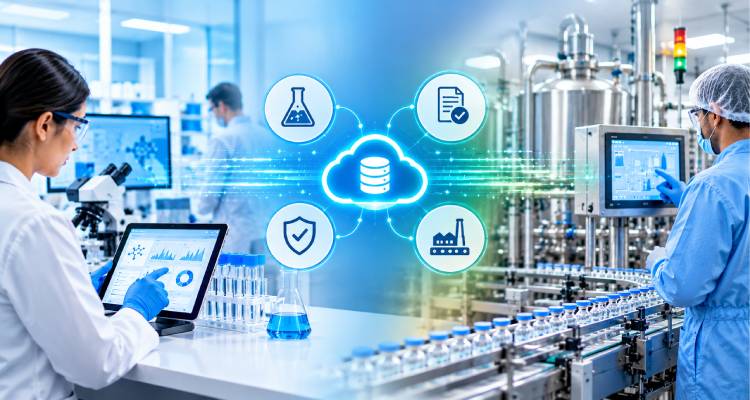
As pharma companies accelerate digital transformation, lab informatics is emerging as a strategic enabler of faster R&D, stronger data integrity, regulatory compliance, technology transfer and operational efficiency. Solutions such as Laboratory Information Management Systems (LIMS), Electronic Laboratory Notebooks (ELNs), Chromatography Data Systems (CDS), Scientific Data Management Systems (SDMS) and AI-powered analytics are helping labs move from fragmented, paper-based processes towards connected, data-driven operations.
The business case for connected laboratories
The growing focus on lab automation, data integrity, regulatory compliance and AI-driven analytics is translating into strong market momentum. According to Grand View Research1, the global lab informatics market was valued at approximately $5.9 billion by 2033, representing a CAGR of 4.9 per cent between 2026 and 2033. LIMS accounted for the largest product segment, while cloud-based solutions represented the largest delivery mode. The life sciences sector was the largest end-use segment in 2025.
India is also emerging as an important growth market. Grand View Research estimates that the Indian lab informatics market will generate $397.3 million by 2033, growing at a CAGR of 7.8 per cent.
These figures reflect a broader shift in how pharma companies view lab informatics. It is no longer simply an IT system for managing lab records; it is increasingly becoming part of the digital infrastructure supporting R&D, quality, technology transfer and manufacturing.
Linking the lab to the pharma value chain
One of the most significant benefits of lab informatics is the creation of a single, reliable digital environment for lab data. Analytical development laboratories generate vast amounts of information from HPLC, GC, spectroscopy, dissolution, stability and microbiological testing. Historically, this information was often distributed across instruments, spreadsheets, paper records and standalone applications.
Integrated informatics platforms can capture, manage and connect this information, reducing manual transcription, improving traceability and enabling faster retrieval and review. Automated workflows, electronic records, audit trails, electronic signatures and controlled access further strengthen data integrity and support regulatory expectations, including ALCOA+ principles.
The benefits extend well beyond the lab. Technology transfer and scale-up are emerging as important areas where connected informatics can deliver significant value. Transferring a product or process from R&D to manufacturing involves far more than exchanging documents. It requires the transfer of process understanding, analytical knowledge, historical data and often tacit expertise.
Data silos, inconsistent documentation, equipment differences and communication gaps can create delays, deviations and costly rework. Integrated LIMS, ELN, MES and document-management environments can provide a common data ecosystem, ensuring that development, QC, QA, technology-transfer and manufacturing teams work from approved and consistent information.
The interoperability challenge
Despite the benefits, digital transformation is not without challenges. Integration with analytical instruments and legacy systems remains one of the biggest barriers. pharma laboratories often operate instruments from multiple vendors with different data formats, communication protocols and software versions. Legacy equipment and applications can be particularly difficult to connect to modern platforms.
At the same time, regulatory expectations around data integrity, cybersecurity, electronic records and auditability continue to evolve. Organisations therefore need to balance modernisation with the need to preserve valuable historical data and maintain validated systems.
Industry experts point towards a phased approach to digitalisation, rather than largescale replacement programmes. Standardising data sources, using open interfaces, establishing robust governance and involving lab, quality, IT and compliance teams from the beginning can help organisations manage integration and validation challenges more effectively.
The rise of the intelligent laboratory
The next phase of lab informatics will increasingly be shaped by AI, automation and advanced analytics. AI can help identify trends in stability data, detect anomalies in analytical results, support method optimisation and potentially predict instrument or process failures before they affect operations.
Automation can reduce routine activities such as sample tracking, data compilation, result verification and report generation, allowing scientists to focus more on scientific interpretation, problem-solving and innovation. Real-time analytics can also enable laboratories and manufacturing teams to move from reactive investigation.
Towards predictive decisionmaking
Concepts such as digital twins, AI-powered lab assistants and real-time data review are likely to become increasingly relevant as informatics platforms mature.
However, successful digital transformation will depend on more than technology. Legacy infrastructure, investment constraints, cybersecurity, regulatory requirements, workforce skills and resistance to change can all slow adoption. Organisations that demonstrate value through targeted pilots, secure executive sponsorship, engage end users, invest in training and adopt scalable and interoperable platforms will be better positioned to realise the benefits.
Ultimately, the future-ready pharma lab will be connected, intelligent, standardised and increasingly autonomous. The convergence of lab informatics, AI, automation and advanced analytics can create a continuous flow of trusted data from discovery and development through quality control, technology transfer and manufacturing.
For pharma companies seeking faster development timelines, stronger compliance, improved quality and greater operational agility, lab informatics is increasingly becoming not just a technology investment, but a foundation for digital transformation and the lab of the future.
What the industry is seeing on the ground
The market trends and technology shifts point to a lab environment that is becoming increasingly connected, automated and data-driven.
- But how are these changes playing out on the ground?
- What are pharma companies prioritising, where are they encountering challenges
- How do industry leaders see the next phase of lab digitalisation?
To explore these questions, Express Pharma spoke with industry experts and technology leaders on how lab informatics is evolving, its growing impact on analytical development and technology transfer, and the challenges of integrating legacy systems. They also share their perspectives on how AI and automation can help build more connected, agile and future-ready laboratories. The interviews that follow bring together their views and insights on this evolving landscape.
What lies ahead
Their perspectives highlight a common theme – while technology is an important enabler, successful digital transformation also depends on data governance, interoperability, regulatory readiness, process understanding, workforce capabilities and change management.
The opportunity for pharma companies lies in moving beyond isolated technology deployments towards an integrated digital ecosystem in which instruments, laboratory systems, manufacturing platforms and enterprise applications can exchange trusted data seamlessly. As AI and automation mature, the value of informatics will increasingly be measured not only by how effectively laboratories store and manage data, but by how quickly they can convert that data into actionable scientific and operational insight.
Taking the guesswork out of technology transfer
Narotam Kumar Juneja, Technical Advisor, Uniserum Lifesciences discusses how lab informatics is helping organisations create a connected data environment, strengthen technology transfer and improve consistency across manufacturing sites

How is lab informatics improving the efficiency and reliability of technology transfer across development and manufacturing sites?
Data management systems play a crucial role in the pharma industry where the stakes are high and the need for accurate and efficient data management systems is paramount. In an industry that deals with sensitive patient information, complex clinical trial data, and stringent regulatory requirements, having a robust data management system is essential for ensuring compliance, efficiency, and ultimately the success of drug development and patient care.
Lab informatics systems improve data reliability, streamline workflows, and ensure compliance across R&D and manufacturing by centralising information and eliminating manual errors. These digital tools connect instruments, tracking systems, and secure data from early discovery through manufacturing. Their positive impact extends well beyond the lab bench.
Shorter development life cycles mean drug candidates progress more efficiently. Consistent and accurate data management strengthens regulatory submissions and reduces the risk of delays or rework. Enhanced collaboration between R&D and manufacturing accelerates technology transfer, which is critical during scale-up and commercialisation.
By capturing all data from connected labs in a centralised system, lab informatics significantly improve reliability and efficiency during technology transfer. There are no typing errors, and verified results can be shared instantly among cross-functional teams across all sites, simplifying reviews and preventing lastminute issues.
Lab informatics also eliminate traceability and data integrity concerns through digital audit trails that record every change made during an experiment. No information is captured in paper notebooks; all data resides securely in one unified platform.
These benefits extend to manufacturing as well. Realtime process monitoring, automated alerts, and centralised data control improve reliability, efficiency, and process robustness. Early detection of test failures prevents batch-release issues and strengthens overall regulatory compliance. Data analytics further enhances this framework by predicting and preventing potential issues before they occur, resulting in a more reliable and consistent manufacturing process.
Standardising data formats and terminology across systems ensures data quality, consistency, and interoperability. Decentralised and connected data environments also facilitate seamless data sharing and collaboration among researchers, clinicians, regulators, and patients—an essential requirement for advancing scientific research and improving patient care.
Overall, data analytics has had a transformative impact on pharma manufacturing, driving greater efficiency, quality, and safety in the production of pharma products.
What are the biggest challenges in ensuring seamless knowledge and data transfer between R&D and manufacturing, and how can digital technologies help?
Tech transfer represents a critical bridge between development and commercial manufacturing. The complex process of transferring product and process knowledge between development teams and manufacturing sites requires precision at every stage. It is far more than a handover of documents or equipment; it is the migration of institutional knowledge, process understanding, expertise, and tacit know-how needed to reliably replicate and scale manufacturing.
However, data silos, fragmented documentation, and variability across sites often turn this essential step into a bottleneck that strains both timelines and budgets. Typical hurdles include incomplete documentation, unrecorded tacit knowledge, raw-material variability, regulatory complexities, and communication gaps between R&D and plant teams.
Traditionally, R&D teams handed over a static package of documents to manufacturing. These packages often lacked essential context—historical insights, minor operational nuances, and the rationale behind key decisions. Many steps were based on unwritten habits rather than accurately documented procedures. As a result, manufacturing teams faced missing batch records, incomplete method validations, unclear cleaning procedures, and difficulties in analytical method transfer. This frequently forced receiving sites to reverse-engineer processes, leading to deviations, investigations, product delays, and financial losses from rejected batches.
To move beyond these limitations, organisations must migrate from static documentation to an integrated, data-driven approach. A unified digital data environment transforms scattered information into complete, traceable, and auditready records. However, even with digital systems, the biggest challenge in tech transfer remains ensuring process robustness and predictability.
Applying Quality by Design (QbD) principles is key. QbD establishes the design space— the relationship between raw materials, process parameters, and critical quality attributes. Without this deep understanding, a new manufacturing site may struggle to remain in a state of control, replicate consistent process parameters, and build a sustainable quality culture.
Historically, process control has relied on reactive quality management—waiting for deviations and then investigating them. Today, AIdriven predictive analytics and real-time data integration allow teams to anticipate deviations before they occur. This gives receiving sites a continuous monitoring system that ensures operations remain within the validated design space.
The result is a more reliable, predictable, and scientifically robust technology-transfer process that reduces quality risks and builds confidence in long-term manufacturing performance.
What role do connected lab informatics systems play in enabling successful technology transfer across multiple manufacturing locations?
Multi-locational technology transfer in the pharma industry involves transferring manufacturing processes and analytical methods across different facilities. These transfers often face challenges such as equipment and facility variations, undocumented critical know-how that remains with R&D staff, fragmented data systems, incomplete batch histories, and communication or cultural barriers. Re-establishing cleaning procedures, analytical methods, and process controls at each site demands significant time and resources.
Multi-country and multistate facilities also encounter differing regulatory interpretations, pharmacopoeia standards, and audit expectations. These complexities can be effectively addressed through connected laboratory informatics.
Connected lab informatics link laboratory instruments, software systems like LIMS, ELN, CDS, and databases across all locations to create a unified digital ecosystem. This enables seamless data flow from instruments and workflows through analysis and reporting. Instead of functioning as disconnected tools, informatics components operate as an integrated system that reduces cross functional communication gaps, supports compliance, and enhances reliability.
During technology transfer to any location, a connected informatics platform replaces paper-based systems and outdated, siloed electronic tools with a single, unified application environment. Centralised data capture minimises transcription errors and inconsistencies, while unified platforms ensure complete data lineage, improving reproducibility and audit readiness. Automated workflows reduce manual effort and increase reliability, efficiency, precision, and accuracy during tech transfer.
As a result, scientists no longer need to spend extended durations at manufacturing sites. Harmonised and streamlined tech-transfer processes significantly improve productivity, shorten cycle times, and eliminate data-integrity issues and regulatory-compliance risks.
For any organisation aiming to remain competitive globally, implementing connected laboratory informatics is not optional—it is essential. While the initial implementation may seem costly and timeconsuming, the return on investment is rapid and substantial.
Turning lab data into the next decision
Anurag Chauhan, Assistant GM, Digitalisation, Automation & Analytics (India & Ireland), Amneal Pharmaceuticals discusses how LIMS, ELN, CDS, AI and automation are transforming analytical workflows, while also highlighting the challenges of integrating diverse instruments and legacy systems

Analytical laboratories generate vast amounts of complex scientific data. How has lab informatics changed the way analytical development teams manage data, improve productivity, and ensure data integrity?
Analytical laboratories today generate data from multiple sources including HPLC, GC, dissolution systems, spectrometers, stability studies, and microbial testing platforms. Historically, much of this data was managed through standalone systems and paperbased records, making retrieval, review, and compliance management challenging.
Lab informatics has transformed this landscape by creating a connected digital ecosystem where instrument data, test results, methods, and workflows are managed seamlessly. Systems such as LIMS, ELN, and CDS enable automatic data capture, electronic review workflows, and centralised storage, reducing manual intervention and the risk of transcription errors.
For example, instead of analysts spending hours compiling chromatographic results from multiple instruments and manually preparing reports, data can now be collected, reviewed, and approved digitally within a controlled workflow. This significantly improves laboratory productivity and shortens turnaround times.
The recent trend is more towards compliance related solutions. New AI solutions focused on audit trail review, controlled user access, and real time alert support regulatory expectations around ALCOA+ principles. Beyond compliance, these systems enable laboratories to shift from simply generating data to extracting meaningful insights that support faster and better decision-making.
What are the key challenges in integrating laboratory informatics platforms with analytical instruments, legacy systems, and evolving regulatory requirements, and how can organisations overcome them?
While most pharma companies recognize the value of laboratory digitalisation, integration remains one of the biggest challenges.
Laboratories often contain instruments from multiple vendors, each with different communication protocols, data formats, and software versions. In addition to this Legacy equipment that has been in service for more than a decade is very common in the Pharma landscape. Connecting these diverse systems into a unified digital environment can be complex.
Another challenge is regulatory evolution. Expectations around data integrity, cybersecurity, electronic records, and auditability continue to increase, requiring organisations to continuously review and validate their digital infrastructure.
The most successful organisations address these challenges through a phased digitalisation strategy rather than attempting large-scale replacements. Standardizing data sources, leveraging open interfaces, establishing robust governance, and involving laboratory, quality, IT, and compliance teams right from the beginning of any project are key factors to mitigate integration challenges.
Looking ahead, what capabilities do you believe will define the analytical laboratory of the future, and what role will AI, automation, and digital workflows play in achieving that vision?
The analytical laboratory of the future will be connected, intelligent, and increasingly autonomous. Data from laboratory instruments, manufacturing systems, quality platforms, and enterprise applications will flow seamlessly across a digital ecosystem, creating a single source of truth.
Artificial Intelligence will help laboratories move from reactive analysis to predictive decision-making. For instance, AI can identify trends in stability data, detect anomalies in chromatographic results, recommend method optimisations, or predict potential instrument failures before they impact operations. The process of review will be completely removed from systems as all systems will be having inbuilt Realtime review mechanism.
Automation will continue to reduce routine manual activities such as sample preparation, data compilation, result verification, and report generation. This will allow scientists to focus more on problem-solving and scientific innovation rather than administrative work.
Looking ahead, concepts such as digital twins, advanced analytics, and AI-powered laboratory assistants will become increasingly relevant. The laboratories that embrace AI, automation, and integrated digital workflows will be better positioned to accelerate development timelines, strengthen compliance, improve quality, and ultimately enhance accessibility.
Connecting the dots across the laboratory
Dhananjay Dwivedi, Vice President -ARD, Amneal Pharmaceutical examines how connected informatics platforms can improve data management, productivity, collaboration and data integrity, while addressing the integration, regulatory and change-management challenges involved in digital transformation

How does lab informatics transform analytical development laboratories in terms of data management, productivity, data integrity, decision-making, and collaboration?
Analytical development laboratories generate large volumes of complex data from instruments such as HPLC, GC, spectroscopy, dissolution, and stability studies. Lab informatics solutions, including LIMS, ELN, and Scientific Data Management Systems (SDMS), have transformed how this data is managed and utilised.
- Improved data management: Lab informatics centralises data from multiple instruments and experiments into a single digital platform, making data storage, retrieval, and sharing more efficient. This eliminates data silos and enables researchers to access historical information quickly for method development and investigations.
- Enhanced productivity: Automation of sample tracking, data capture, calculations, and report generation reduces manual effort and turnaround times. By minimizing administrative tasks, scientists can focus more on data interpretation, problem-solving, and innovation.
- Strengthened data integrity: Electronic records, audit trails, electronic signatures, and controlled user access ensure that data remain accurate, traceable, and secure. Automated data acquisition also reduces transcription errors and supports compliance with regulatory requirements.
- Better decision-making: Advanced analytics and realtime monitoring tools help identify trends, deviations, and potential issues early. Interactive dashboards and data visualisation support faster, evidence-based decision-making and continuous process improvement.
- Improved collaboration: Cloud-based and integrated informatics systems facilitate seamless data sharing among analytical, quality, formulation, and regulatory teams, enhancing collaboration and knowledge management across sites.
What are the major challenges organisations face when integrating lab informatics with analytical instruments, legacy systems, data integrity requirements, evolving regulations, growing data volumes, and laboratory workflows—and what strategies can help overcome them?
Laboratory informatics platforms such as LIMS, ELNs, and LES are essential for managing laboratory operations, ensuring data integrity, and supporting regulatory compliance. However, organisations often face significant challenges when integrating these platforms with analytical instruments, legacy systems, and evolving regulatory requirements.
- Integration with analytical instruments: Modern laboratories use instruments from multiple vendors, each generating data in different formats and using proprietary software. This often results in manual data transfer, increasing the risk of transcription errors, data loss, and inconsistencies. Integrating instruments with LIMS or ELN systems can also be technically challenging due to compatibility and validation requirements. Organisations should implement standardised interfaces, middleware, and automated data capture solutions that enable direct transfer of data from instruments to informatics platforms. This reduces human intervention, improves data accuracy, and enhances traceability.
- Legacy system integration: Many pharma and life sciences companies continue to rely on older systems that contain valuable historical data but lack modern integration capabilities. These systems often create data silos, limiting visibility across the organisation and complicating data sharing and reporting. A phased modernisation approach should be adopted, using integration middleware and carefully planned data migration strategies. This allows organisations to preserve historical data while gradually transitioning to modern, scalable platforms.
- Maintaining data integrity: Data integrity is a critical requirement in regulated environments. Laboratory data must remain accurate, complete, consistent, and traceable throughout its lifecycle. Manual data entry and disconnected systems increase the likelihood of errors and regulatory findings during inspections.
Automated workflows, electronic records, audit trails, and strong data governance practices help ensure compliance with ALCOA+ principles and improve confidence in laboratory results.
- Meeting evolving regulatory requirements: Regulations such as FDA 21 CFR Part 11, EU Annex 11, and GxP guidelines continuously evolve, placing additional demands on laboratory systems. Every integration, system upgrade, or process change may require validation and compliance assessments. Organisations should implement risk-based validation, establish strong change-control processes, conduct regular audits, and continuously monitor regulatory updates to ensure ongoing compliance.
- Handling large and complex data volumes: Advances in analytical technologies, genomics, automation, and high throughput screening have resulted in enormous data generation. Traditional systems often struggle to manage and analyze these growing datasets effectively. Cloud-based informatics platforms, advanced analytics, artificial intelligence, and machine learning tools provide the scalability needed to store, process, and derive insights from large datasets while improving decisionmaking and research productivity.
- User adoption and change management: Even technically successful implementations can fail if scientists and laboratory personnel resist adopting new systems. Common barriers include workflow disruption, lack of training, system complexity, and concerns about usability. Successful organisations involve end users early in system selection and design, provide comprehensive training programs, and ensure that new systems align with existing laboratory workflows. Effective change management significantly improves adoption and long-term success.
Connecting development, transfer and manufacturing
Technology transfer is increasingly becoming a data-driven process, with laboratory informatics helping bridge the gap between R&D, quality and manufacturing. Deepak Shinde, Sr Executive – R&D (Formulations-TT), FDC explores how connected systems can improve knowledge transfer, standardise processes, strengthen data integrity and accelerate technology transfer across development and manufacturing sites

How does lab informatics enable better control, consistency, and knowledge management throughout the technology-transfer process from development to manufacturing?
Technology transfer is a critical stage in the pharma development lifecycle, where scientific knowledge, analytical methods, process understanding, and quality requirements must be transferred accurately from development to manufacturing. Lab informatics plays an increasingly important role in making this process more structured, transparent, and reliable. By connecting laboratory data, analytical workflows, documentation, and knowledge across sites, informatics solutions help reduce manual effort, improve data integrity, maintain process consistency, and provide greater visibility throughout the transfer lifecycle.
Key contributions include:
- Centralised and standardised data – Laboratory data, analytical methods, specifications, test results, and stability data can be maintained in integrated systems such as LIMS/ELN, reducing dependence on spreadsheets and manual records.
- Improved data integrity – Automated workflows, audit trails, electronic signatures, controlled access, and version control help ensure ALCOA+ principles are maintained throughout the technology transfer lifecycle.
- Better method transfer – Analytical methods, method parameters, system suitability requirements, and validation/verification data can be transferred in a controlled manner, reducing transcription errors and interpretation differences between sites.
- Real-time visibility – Development, QC, QA, manufacturing, and technology-transfer teams can access the same approved information, making it easier to identify gaps and resolve issues before commercial manufacturing.
- Process consistency – Standardised electronic workflows and templates help ensure that the same procedures, specifications, sampling plans, and acceptance criteria are followed at both sending and receiving sites.
- Trend and comparative analysis – Historical batch, analytical, and stability data can be rapidly compared between sites. This is particularly useful for identifying differences in assay, dissolution, impurities, process parameters, or other critical quality attributes during site transfer.
- Reduced transfer timelines – Automated data capture, approval workflows, document management, and electronic review reduce manual effort and accelerate activities such as batch document review, analytical transfer, deviation assessment, and change control.
- Stronger knowledge retention – ELNs and electronic document repositories preserve development knowledge, experimental data, process understanding, and previous investigation outcomes, making this information readily available during future site transfers or process improvements.
What are the main barriers to transferring scientific knowledge and data from R&D to manufacturing, and how can digital solutions help overcome them?
The biggest challenges in transferring knowledge and data from R&D to manufacturing are data fragmentation, inconsistent documentation, loss of process knowledge, differences in equipment and processes, manual data entry, and lack of real-time visibility between sites. Digital technologies can address these challenges in several ways:
- Data silos and fragmented information – R&D, QC, QA, and manufacturing may use different systems. Integrated platforms such as LIMS, ELN, MES, and document management systems can create a common data environment.
- Inconsistent documentation and version control – Multiple versions of MFRs, specifications, analytical methods, and development reports can create confusion. Electronic document management with controlled workflows ensures that teams work with the latest approved information.
- Loss of tacit process knowledge – Important development knowledge may remain with individual scientists. ELNs and structured knowledge management systems can capture process rationale, development history, experimental results, and lessons learned.
- Manual data transfer and transcription errors – Reentering laboratory or process data into different systems increases the risk of errors. System-to-system integration and automated data transfer improve accuracy and reduce manual intervention.
- Differences between development and manufacturing equipment – Scale-up may introduce differences in equipment capability and process parameters. Digital tools can support process mapping, historical batch-data analysis, equipment comparison, and data-driven scale-up decisions.
- Limited visibility during technology transfer – Teams may not have immediate visibility of transfer activities, deviations, analytical results, or pending actions. Digital dashboards and workflow systems provide real-time status and accountability.
- Data integrity and traceability – Maintaining reliable and attributable data throughout the transfer is critical. Audit trails, electronic signatures, role based access, and automated controls strengthen data integrity and regulatory compliance.
- Difficulty comparing R&D and manufacturing data – Analytics and visualisation tools can rapidly compare CPPs, CQAs, assay, dissolution, impurities, yield, and stability trends between development and commercial batches.
How can connected laboratory informatics systems support standardised and efficient technology transfer across global manufacturing sites?
As pharma companies expand globally, connected laboratory informatics systems play a critical role in ensuring that the same scientific knowledge, data, methods, and quality standards are consistently applied across multiple manufacturing locations. Key roles include:
- Global data standardisation – Connected LIMS, ELN, and other laboratory systems provide standardised formats for analytical methods, specifications, test results, and stability data, making information easier to transfer between sites.
- Single source of truth – Centralised or integrated systems ensure that R&D, QC, QA, and manufacturing sites access the same approved and current information, reducing discrepancies caused by multiple local versions of documents or data.
- Faster technology transfer – Analytical methods, specifications, historical results, validation data, and process knowledge can be accessed electronically by receiving sites, reducing reliance on manual document exchange and accelerating transfer activities.
- Consistent analytical practices – Controlled methods, workflows, calculations, system suitability requirements, and specifications help ensure that laboratories at different locations perform testing consistently.
- Real-time visibility across sites – Global teams can monitor transfer activities, analytical results, deviations, investigations, and stability trends remotely. This enables faster identification and resolution of issues.
- Improved data integrity and compliance – Electronic audit trails, access controls, electronic signatures, and controlled workflows support ALCOA+ principles and help maintain regulatory compliance across different regions.
- Cross-site comparison and trending – Connected systems allow companies to compare analytical and manufacturing data across locations, helping identify differences in assay, dissolution, impurities, process parameters, yield, and stability performance.
- Knowledge retention and continuity – Development history, process understanding, analytical knowledge, and previous investigations remain digitally available even when personnel or manufacturing locations change.
- Better collaboration and decision-making – R&D, technology transfer, QC, QA, and manufacturing teams can work from a common data environment, reducing communication gaps and enabling faster, evidence based decisions.
Investing in the lab of the future
Drawing on his extensive industry experience, Shirish G Belapure, Sr Technical Advisor, IPA looks at the milestones that have shaped this evolution, the factors slowing adoption, and the strategic investments pharma companies should prioritise to build future-ready laboratories

Based on your industry experience, what have been the biggest milestones in the evolution of laboratory informatics, and what trends are likely to define its next phase of growth?
The field has transformed dramatically over the decades—from manual, paper-based processes to robust digital platforms like LIMS and ELN. Integration across instruments and seamless data exchange have been game-changers, further enhanced by cloud adoption for scalability and collaboration. The rise of AI and advanced analytics has taken laboratory operations to a new level. Going forward, I expect intelligent automation, data standardisation following FAIR principles, support for precision medicine, and heightened cybersecurity will be key trends.
Despite significant advancements in digital laboratory technologies, adoption remains uneven across the industry. What factors are slowing adoption, and how can organisations accelerate their digital transformation journey?
Despite these advances, digital adoption is uneven across the industry. Legacy infrastructure, budgetary limits, regulatory challenges, and resistance to change are common hurdles.
Organisations can accelerate digital transformation by securing executive buy-in, demonstrating ROI through well-designed pilot projects, engaging users with thorough training, and phasing implementation to build confidence and momentum.
If you were advising pharma companies on building future-ready laboratories, what strategic investments and capabilities would you recommend they prioritize over the next five years?
My recommendation for pharma companies is to invest in scalable cloud platforms, robust AI and analytics capabilities, interoperable systems, advanced cybersecurity, workforce upskilling, and sustainable lab practices. These priorities will help labs stay agile, innovative, and competitive in the fast-evolving landscape.
Drawing on nearly five decades of experience, I’m confident that organisations focusing on these areas will drive operational excellence and industry leadership.
swati.rana@expressindia.com
swatirana.express@gmail.com
The post When the lab talks to the plant appeared first on Express Pharma.
Apa Reaksi Anda?
 Suka
0
Suka
0
 Kurang Suka
0
Kurang Suka
0
 Setuju
0
Setuju
0
 Tidak Setuju
0
Tidak Setuju
0
 Bagus
0
Bagus
0
 Berguna
0
Berguna
0
 Hebat
0
Hebat
0