


























Heritage Cattle in American History
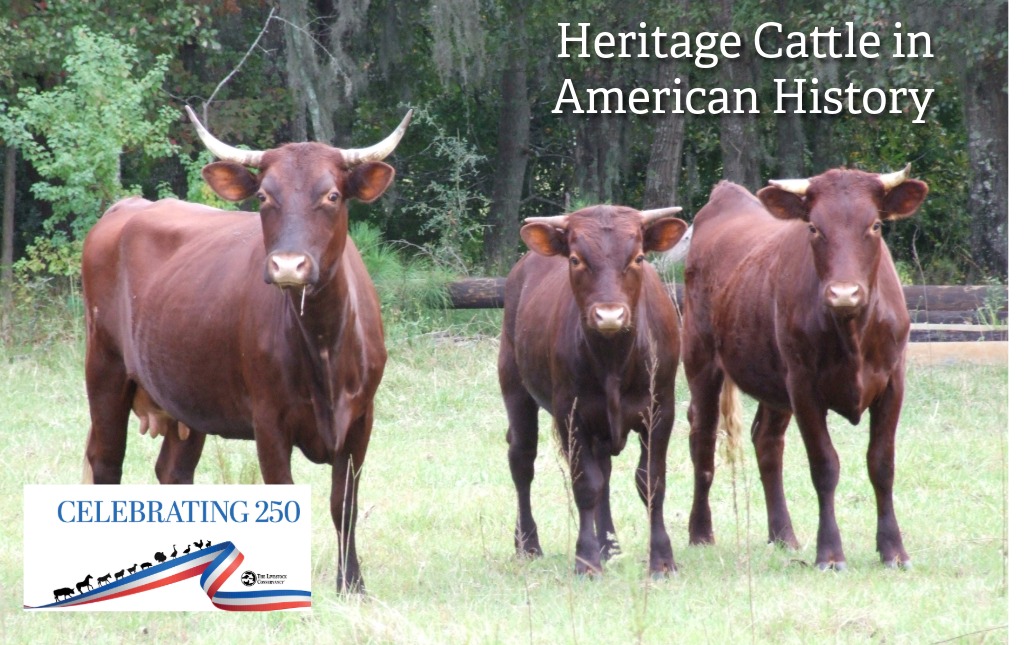
Heritage Cattle in American History: Sailing Into the Future
By Marston White
What do sailing ships and the promise of a new life have in common with The Livestock Conservancy’s mission? Everything. Many of the breeds on The Livestock Conservancy’s Conservation Priority List originated hundreds of years ago, arriving here by sailing ships to provide for the settlers looking for a better future. We have inherited a rich legacy from those who sailed toward unknown shores. Sailing into the future, where are we heading with our livestock choices?
Coming to America
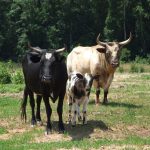
Florida Cracker cattle
Cattle were not indigenous to the New World. They, along with other domesticated livestock and poultry, came to the Americas from the Old World during the Age of Sail. Cattle first arrived on this continent from Spain in the 1500s, initially by way of the Caribbean islands before landing on the continent and later on North American shores. From these Spanish cattle, four American breeds emerged, adapting to the environments of the respective regions to which they were introduced: the Florida Cracker and Pineywoods in the southeast and the Texas Longhorn and Corriente in the southwest. About a century later, Devon cattle arrived in Plymouth (Plimouth), Massachusetts, aboard the ship Charity from England in 1623. These early cattle laid the foundation for the diversity of the heritage breeds that developed.
Role in Early American Culture
Cattle profoundly impacted early American Culture, serving multiple roles beyond providing food. They were essential to the economic and social structure of the time, supplying milk, beef, leather, horns and tallow, while many also served as draft animals. Devons were vital for early New England settlers, with nearly every family keeping a family cow. Semi-feral Texas Longhorns were used for beef, tallow, and hides, while Pineywoods cattle served similar purposes and were crucial for logging in the Southeast’s pine forests.
Adaptation to New Environments
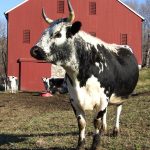
Randlall cow
Surviving in the New World required hardy cattle that could adapt to the new environments. The breeds that thrived were those resilient to harsh climates, available forage and local insects and parasites. A prize-winning animal in another country might fail in these conditions, making adaptability crucial. The animals that survived produced offspring capable of surviving harsh conditions. For instance, the breed now known as Randall Lineback emerged in New England in the late 1600s, likely from a mix of Dutch, English, Swedish and French cattle, selectively bred for their hardiness, forage efficiency and disease resistance. These cattle were vital to pioneers, as cattle needed to fatten and reproduce on available forage without the support of supplemental feed, modern veterinary care and, in most cases, shelter from the environment. When settlers were barely eking out their own survival, they did not have the capacity to tend to animals that needed pampering.
Cattle Across the Country
As the United States expanded westward, various cattle breeds arrived with emigrants from various countries. They migrated west, including ancestors of the Native Heritage Shorthorn, Red Poll from England, Kerry and Dexter from Ireland, Guernsey from the Channel Islands, Dutch Belted from the Netherlands and Galloway from Scotland. These breeds reflect the diverse cultures and origins of the immigrants who brought them to the New World.
In the 19th century, thousands of cattle traveled westward. Large breeds like Devon or Shorthorn served as oxen pulling emigrants’ “prairie schooners” and freight companies’ wagons. In the Southwest, the Texas Longhorn evolved on the open range from Spanish cattle brought by missionaries and settlers in the late 1700s. After the Civil War, vast herds were rounded up and driven east, contributing to the legend of the iconic American cowboy.
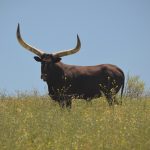
Ankole-Watusi
In the early 20th century, Tibetan Yaks and East African Ankole-Watusi were imported for display in U.S. zoos. During World War II, England sent Ancient White Park cattle, originating over 3000 years ago, to the U.S. for protection from advancing forces. Although U.S. populations of these breeds are small, they possess traits valuable in specific regions of our country. More recently, Belted Galloways from Scotland and Lincoln Reds from England, originating in the 18th and 19th centuries, have been imported for their multipurpose uses and their role in sustainable farming systems.
Endangerment of Heritage Breeds
The decline of multipurpose heritage cattle breeds since the mid-20th century has resulted primarily from industrialized agriculture’s prioritization of high-yield beef and dairy breeds. The shift towards monoculture farming practices, with specialized facilities and equipment, led many farmers to lose interest in raising multipurpose breeds. The dwindling number of these heritage-breed cattle threatens the genetic diversity that once flourished on American farms and ranches across the country.
Importance of Heritage Breeds
This resilience and genetic diversity are why we still need to support heritage breeds. They survived very harsh and hostile conditions for hundreds of years, adapting and flourishing. Each of our heritage breeds has a wonderful history, distinguishing beauty and has been well-suited to thrive off what the land produced. Often, it has been a single person, family or group that has prevented the extinction of a specific heritage cattle breed. Historically, regions of the country have valued and appreciated the breeds that had a significant impact on their lives and their families’ survival. The Ark of Taste, a catalog of food diversity at risk of extinction by Slow Food International, has celebrated local food traditions using these breeds.
How You Can Help
Whatever your interest in cattle may be, consider whether you can achieve your farm dreams with heritage breeds and pay it forward. If you don’t have farm dreams, does the desire to help these breeds tug at your heartstrings? Breed stewards and champions are needed in every generation to continue the breed to the next generation. Management practices that prioritize resilience and sustainable agriculture may find heritage cattle best suited for their needs.
Maybe you can establish new family traditions that make room for the heritage breed of your choosing. Pasture pets and retirement pastures are meaningful, too. Decades from now, future generations will appreciate the choices you make now. The pictures taken and memories made with livestock will endure in stories and digital legacies until their turn comes to take the helm and navigate toward unknown shores. Heritage breeds have helped us make it this far; take them with you as you chart the course ahead.
If you’re considering cattle ownership, you can learn more about each heritage breed on The Livestock Conservancy’s Conservation Priority List at https://livestockconservancy.org/heritage-breeds/conservation-priority-list/.
If you’re ready to purchase cattle or want to talk with a breeder, you can most likely find what you’re looking for in our online Breeders and Products Directory at https://livestockconservancy.org/heritage-breeds/breeders-directory/
If you would like to support the ongoing work of The Livestock Conservancy, you can become a member or make a donation at https://livestockconservancy.org/
Raising awareness of heritage breeds is the first step to preventing their extinction. You can help by following our Facebook or Instagram page and sharing our posts to spread the word. https://www.facebook.com/livestockconservancy
The post Heritage Cattle in American History appeared first on The Livestock Conservancy.
Apa Reaksi Anda?
 Suka
0
Suka
0
 Kurang Suka
0
Kurang Suka
0
 Setuju
0
Setuju
0
 Tidak Setuju
0
Tidak Setuju
0
 Bagus
0
Bagus
0
 Berguna
0
Berguna
0
 Hebat
0
Hebat
0