











































%20and%20Batch%20Production%20Records%20(BPR).png)
















After 50 years of biotech, can AI help answer the next impossible question?
What started as a conversation, in a bar, written on a napkin in 1976, between biochemist Dr. Herbert W. Boyer and investor Robert A. Swanson, turned into the creation and commercialization of recombinant DNA (rDNA) technology to engineer bacteria to produce vital human proteins.
“Standing here today, I can’t help but reflect on the historic firsts that brought us to this moment,” said Fritz Bittenbender, Board Chair at the Biotechnology Innovation Organization (BIO), and Senior Vice President of Public Affairs and Access at Genentech.
“We watched the recombinant DNA yield human insulin,” he continued. “We saw multiple antibodies pioneer targeted therapeutics, and most recently, we witnessed the incredible leap of mRNA vaccine technology, providing the breakthrough that we can now use our old cells to train our immune system on how to fight and heal from within.”
But biotech’s 50-year anniversary is not just about looking back; it is also about looking forward and asking, What is the next impossible question?
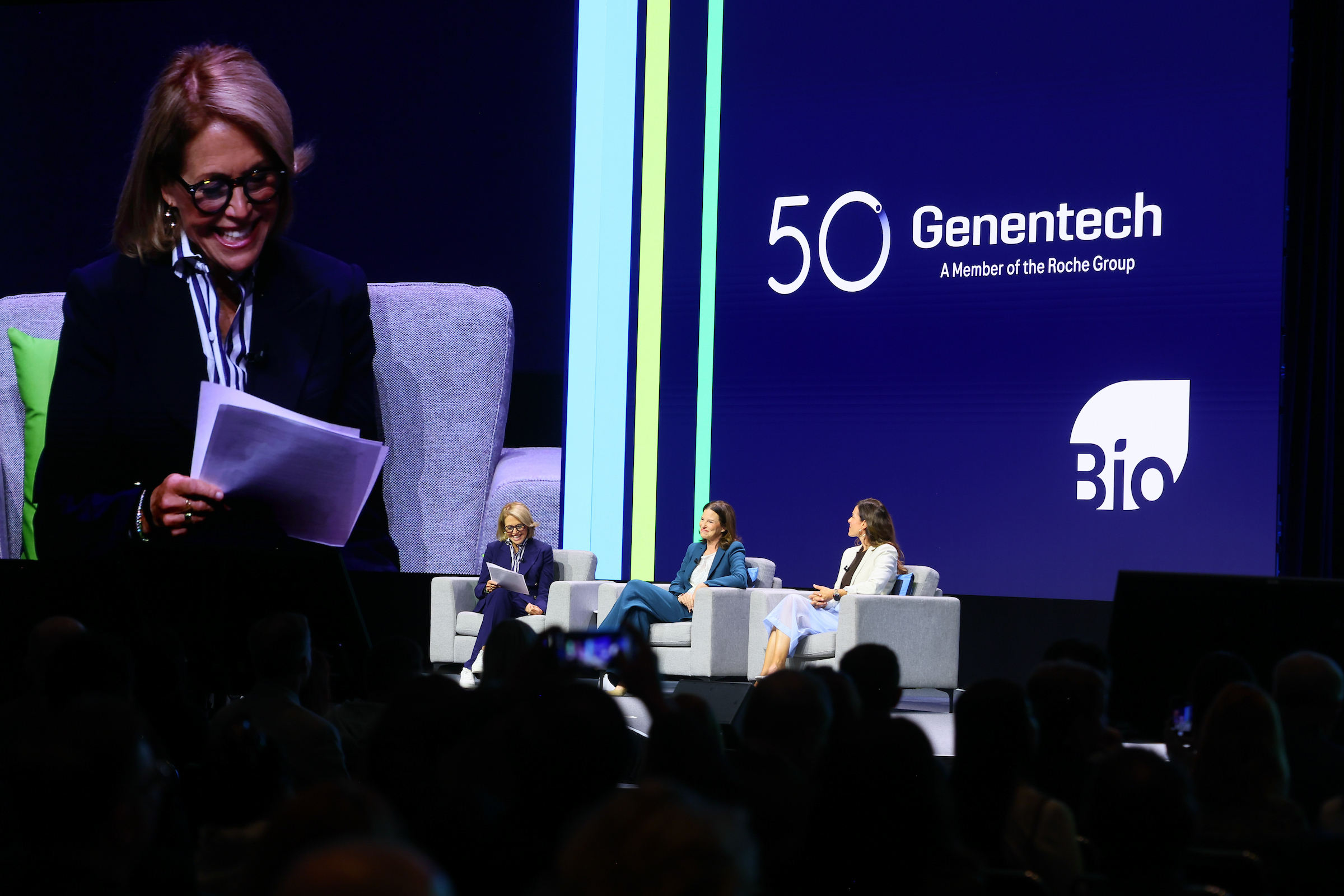
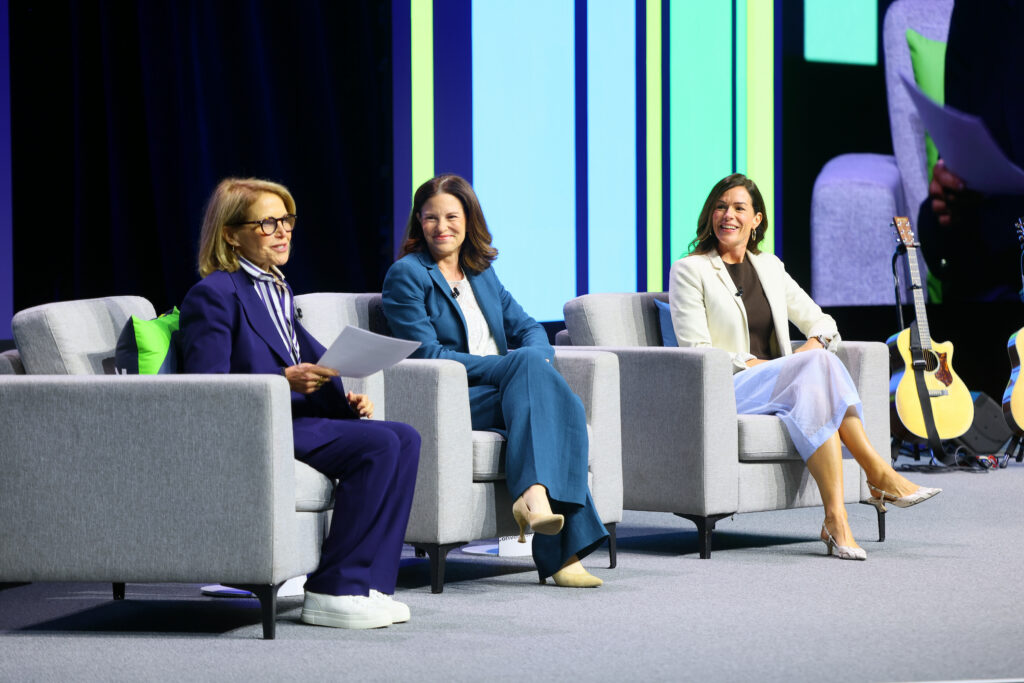
To begin to answer that, award-winning journalist Katie Couric sat down with Ashley Magargee, CEO of Genentech, and Kimberly Powell, Vice President of Healthcare at NVIDIA, on the Wednesday morning mainstage at the 2026 BIO International Convention.
The trio discussed the growing partnership between biotech and AI to accelerate innovation, enable scientists to work at a higher level, and make healthcare more personalized – giving us more years with our loved ones.
Can AI make drug discovery cheaper and faster?
Biotech has yielded some amazing breakthroughs – but it’s not easy.
“We still have 90% of all molecules that enter clinical studies fail, and that’s an incredible failure rate,” said Magargee. “And it’s because drug discovery is very, very difficult – every aspect of it is very difficult.”
Biotech development is like running a series of marathons, she explained, from figuring out which disease a company wants to treat, to building a molecule, to designing clinical studies, to recruiting patients for clinical studies. And with each step comes the risk of failure.
“It takes 10 to 15 years to get medicine to patients at a cost of $2 billion on average,” she noted.
That’s why many biotech leaders are looking to AI not only to shorten timelines and reduce costs in drug discovery, but also to expand its potential by training AI agents on datasets that can then analyze ever more data that humans simply cannot process individually.
“It’s not about effort. It’s not even about expertise. It’s about predicting better the capacity of biology. Can we predict better what’s not going to work and what will work, so that we can then put our focus and emphasis there,” said Magargee.
Magargee and Powell believe the math supports this.
“The potential therapies in the world are essentially infinite,” said Powell. “The number of chemicals out there that could be a therapeutic is 10^60 – that’s 60 zeros. The number of proteins that could be a potential therapy is 10^180. It makes you think of the metaphor of the needle in the haystack. Part of solving that challenge is creating conditions where we could potentially model biology in a computer in a way that is far beyond human capabilities.”
And there have been early successes.
“We’ve been able to design a molecule recently that usually would have taken us years to do, and we did it in a matter of months,” said Magargee.
AI is the tool, not the scientist
There has been some anxiety around the AI revolution, not only because it is a brave new world of technological progress, but also because its effects on the job market are already evident.
But Magargee and Powell are more interested in using AI as a tool, not a replacement for human ingenuity.
“I think the first concern you always hear about is, Oh, this is going to take away people’s jobs. And the way we view it is, actually, we need more scientists than we ever have before, because when they’re equipped and empowered with these tools, they’re asking bigger and more important questions than have ever been able to ask before,” said Magargee.
And, in particular, Magargee and Powell discussed how AI could be used effectively in the regulatory space to accelerate the review and approval process.
“The Food and Drug Administration’s systems are based on a very different era,” said Magargee, “when there was much more linear drug discovery. That drug development era, and those systems have to modernize.”
The modernization of both innovation and regulation is important because one cannot be constrained by the other. Patients do not have time.
“It’s going to be not just faster computers or better algorithms or more interesting science,” concluded Magargee to applause, “it’s going to be so many more birthdays for people, it’s going to be so many more memories, and so much more time with your loved ones, and that’s going to be the impact that we’re going to have together.”
“Science is fundamentally changing,” added Powell, “and I believe that we will create the conditions where medicines will be created not just for populations at large, but for a person of one. It will be specialized just for you.”
The post After 50 years of biotech, can AI help answer the next impossible question? appeared first on Bio.News.
Apa Reaksi Anda?
 Suka
0
Suka
0
 Kurang Suka
0
Kurang Suka
0
 Setuju
0
Setuju
0
 Tidak Setuju
0
Tidak Setuju
0
 Bagus
0
Bagus
0
 Berguna
0
Berguna
0
 Hebat
0
Hebat
0