

















































%20and%20Batch%20Production%20Records%20(BPR).png)















Fur Real: Biotech Startup Eliminates Major Dog Allergen in Beagle Pups Using CRISPR
Researchers at Kindred Companion Sciences, a New York-based start-up company, have successfully used CRISPR-Cas9 gene editing to breed dogs lacking the primary protein responsible for human dog allergies.
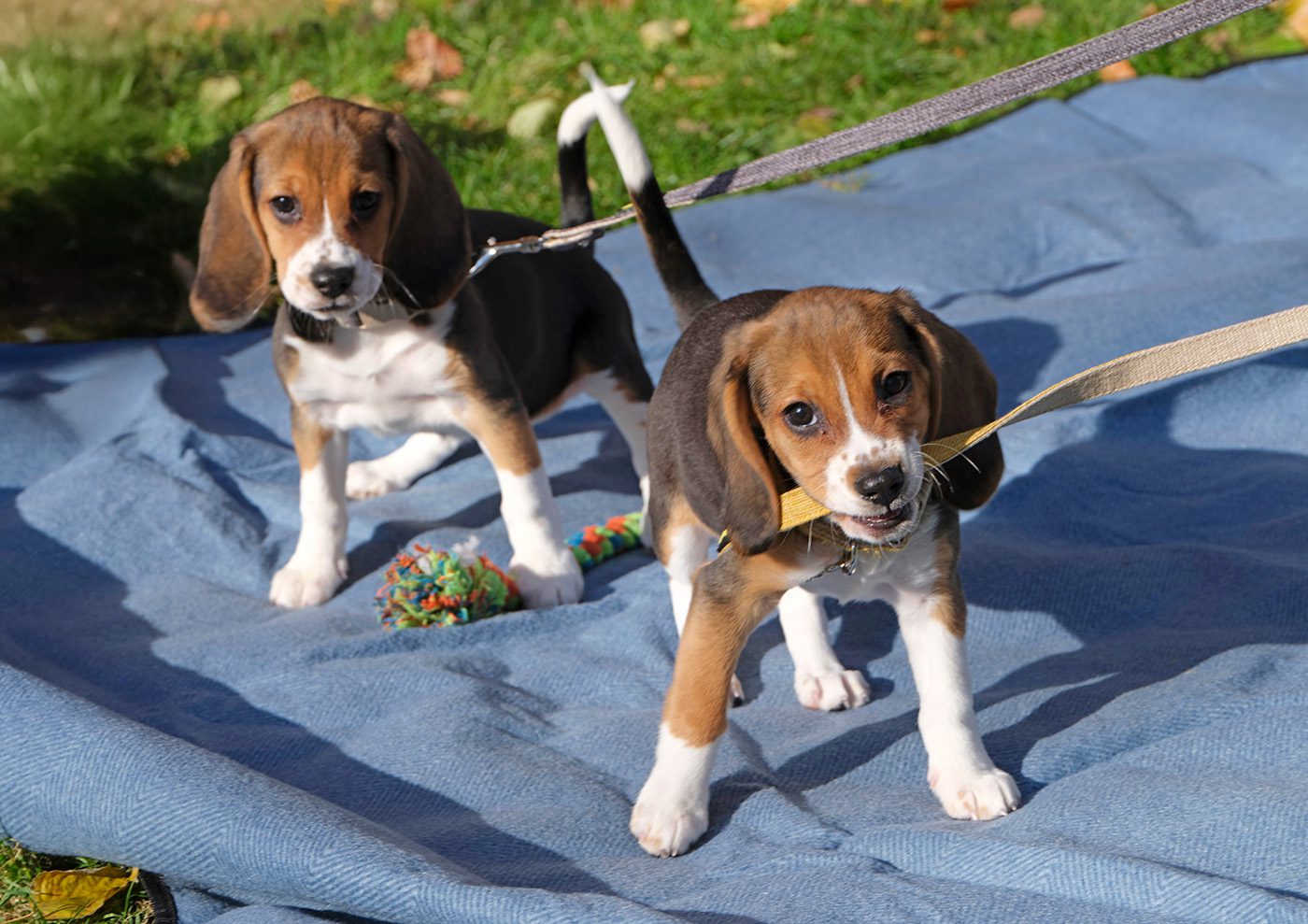
The study, published online in The CRISPR Journal (a sister journal to GEN), details the engineering and birth of a pair of healthy beagle puppies, Alfie and Bailey. The puppies represent a key first step towards addressing canine allergenicity and mark potentially a significant advance in veterinary biotechnology. The CRISPR Journal article is entitled: “Targeted Genetic Knockout of Can f 1, the Major Allergen in Dogs.”
About one in seven people (15 percent of the world population) experience allergies to dogs, resulting in allergic rhinitis and asthma. Among them is Canadian geneticist Matt Walker, PhD, CEO of Kindred Companion Sciences and lead author of the new study.

“I’ve been allergic to dogs my whole life,” Walker told GEN in an interview. Proximity to dogs results in skin rashes, sneezing, and itchy eyes. The symptoms were so bad that Walker’s family could not own a dog until he left for university, when it finally got a goldendoodle. Although the breed is generally considered hypoallergenic, Walker still suffered allergic reactions when he returned home.
Years later, Walker was working on gene editing in the Columbia University lab of the late Nobel laureate, Martin Chalfie, PhD, when the family dog died. “That made me question this imprecise and ineffective way that we breed dogs for certain traits,” Walker recalled. “I wondered if we could more directly address the problem of allergies by targeting the allergen at its biological source.”
Targeting Can f 1
The chief allergen in dogs is a small lipocalin protein called Can f 1. The protein is secreted from the tongue tissue into saliva as well as some glands in the skin, where it’s deposited into dander. Researchers had previously shown that knocking out the homologous gene in mice had no detrimental effect on the health and viability of the animals. That gave Walker and colleagues confidence that the gene could be safely knocked out in dogs.
Working with canine primary fibroblasts, Walker used CRISPR to introduce a single-base insertion in exon 1 of the Can f 1 gene. The resulting frameshift mutation disrupted production of the corresponding protein. (The team performed whole-genome sequencing to establish that no off-target mutations or large-scale chromosomal rearrangements occurred.)
“We didn’t introduce any foreign DNA,” Walker said. “This type of genetic change occurs naturally in dogs. All we did was direct it at this specific site.”
Those gene-edited cells were next used as nuclear donors for somatic cell nuclear transfer. The resulting embryos were transferred to a surrogate beagle, leading to the healthy births of Alfie and Bailey, genetically identical twins, in September 2024.
Western blot analysis of saliva and dander extracts from the two pups failed to detect any residual Can f 1 protein, while high levels were present in poodle and goldendoodle controls. Walker’s group also performed skin prick testing: while the sensitized subject reacted strongly to extracts from wild-type beagles and poodles, there was no response to extracts from Alfie or Bailey.
“When I had no reaction to Bailey after she came home with us, my immediate reaction was skepticism,” Walker recalled. “What if my allergies have just gone away? What if I’m not allergic to puppies? So, I called some friends in Brooklyn and spent some time with their dog and confirmed that my allergies were still roaring.”
In the paper, the authors write: “These findings demonstrate that targeted genetic knockout of the major dog allergen is compatible with canine development and can abolish the IgE-mediated allergic response, supporting the feasibility of a gene-based approach to reducing canine allergenicity.”
A key concern in animal bioengineering is whether the removal of a physiologically relevant protein will impair the animal’s health. However, Alfie and Bailey, now almost two years old, have shown normal physical development, steady growth, and no apparent health or behavioral abnormalities. The study supports the notion that Can f 1 is biologically non-essential for the host dog, despite its high immunological impact on humans.
Interestingly, the Can f 1 allergen in dogs is unrelated to the major allergen found in cats. Following a 2022 report in The CRISPR Journal authored by Nicole Brackett and colleagues that demonstrated the feasibility of using CRISPR to edit the gene encoding the Fel d 1 allergen, researchers in South Korea engineered the first gene-edited hypoallergenic cats in 2024.
Kindred spirit
Kindred Companion Sciences was originally named Can9 Bioengineering, but Walker told GEN that the name—a play on both ‘canine’ and Cas9—proved too hard for people to pronounce. Walker says that starting a company is not unlike finishing a PhD, which he did at Columbia last year. “Both of these things come down to solving problems in imaginative ways and I definitely learned how to do that during grad school!”
While Bailey, adopted by Walker, enjoys life on the Upper West Side of Manhattan, Alfie lives with Kindred Companion’s other co-founder, Nick Gavin, in Florida. Walker and Gavin originally met when they were students at Harvard; Walker is the sole employee of the company. He makes use of “an awesome co-working wet lab facility in Harlem” near Columbia, where numerous young startups share wet lab space. “We each have our own small bench. It’s pretty scrappy, but it’s a wonderful community.”
Walker and his colleagues note in the paper that their research represents a “conceptual departure from conventional allergy therapeutics that primarily act by modulating the patient’s immune response.” Walker hopes to establish a genetic platform for future efforts that could target a number of secondary dog allergens, potentially opening the door for a new generation of allergy-safe companion and service animals.
“We’re going to be tackling other breeds and hopefully applying our work to service animals. We’re going through the regulatory process,” he said. Genome-edited organisms are regulated by the U.S. Food and Drug Administration, as Walker explains it, “to make sure the health and safety of the animals are not affected.” Eventually, Walker hopes to breed hypoallergenic animals for several dog breeds that are not traditionally hypoallergenic.
I asked Walker via Zoom how it feels to finally have a dog curled up sleeping at his feet. “It’s amazing! She’s totally changed my life!”
The post Fur Real: Biotech Startup Eliminates Major Dog Allergen in Beagle Pups Using CRISPR appeared first on GEN - Genetic Engineering and Biotechnology News.
Apa Reaksi Anda?
 Suka
0
Suka
0
 Kurang Suka
0
Kurang Suka
0
 Setuju
0
Setuju
0
 Tidak Setuju
0
Tidak Setuju
0
 Bagus
0
Bagus
0
 Berguna
0
Berguna
0
 Hebat
0
Hebat
0