
















































%20and%20Batch%20Production%20Records%20(BPR).png)











India’s race for the CDMO crown
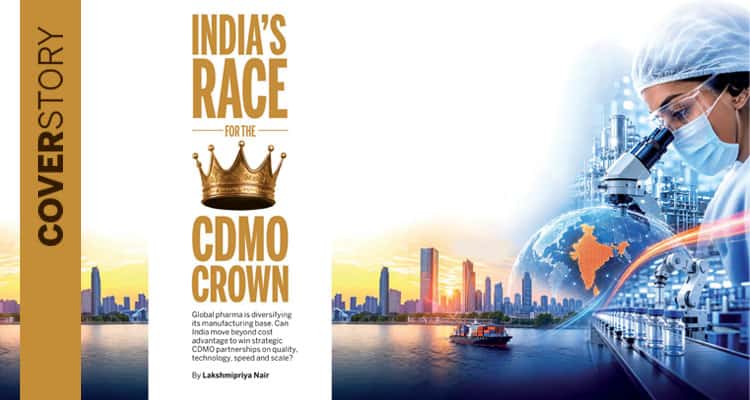
For years, China+1 has been the big story in India’s CDMO opportunity. Now, it is no longer enough. The shift away from China is well underway as global pharma seeks to lessen their exposure to geopolitics, and this clearly benefitted India.
A BCG-IPSO’s report titled, Unleashing the Tiger: Indian CRDMO Sector 2025 estimates that “India’s CRDMO industry could grow from around $3–3.5 billion in 2024 to $22–25 billion by 2035.”
The same report also identifies $10-15 billion of potential value from global supply-chain realignment, along with opportunities in new modalities and India’s emerging innovation ecosystem. Its customer research, a survey of more than 200 CRDMO customers, estimates that around $5 billion of demand could move to India, while another $9-10 billion represents unmet demand that India could potentially capture.
The opportunity is significant. But some of the business coming to India today is still risk management, not conviction. Being the alternative is not the same as being the partner of choice.
The harder question is whether India can turn this initial advantage into something more durable such as long-term relationships with global pharma, a deeper position inside development pipelines and a place among the world’s preferred CDMO destinations.
As competition intensifies, India will have to earn that position on its own merits.
Beyond China+1
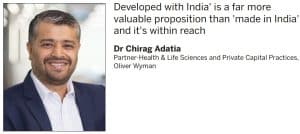
The industry is increasingly questioning whether China+1 can become the foundation of India’s long-term CDMO strategy. Dr Chirag Adatia, Partner Health & Life Sciences and Private Capital Practices, Oliver Wyman, thinks India should stop measuring its CDMO opportunity in terms of business that could move out of China.
“China+1 is a door-opener, not a moat,” Dr Adatia asserts.
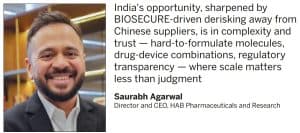
Saurabh Agarwal, Director and CEO, HAB Pharmaceuticals and Research, is direct, “China’s CDMO market is roughly double India’s and built for volume; India’s opportunity, sharpened by BIOSECUREdriven derisking away from Chinese suppliers, is in complexity and trust — hard-to-formulate molecules, drug-device combinations, regulatory transparency — where scale matters less than judgment. India competing on China’s terms is a losing game; competing on a different axis is not.”
Hari Kiran Chereddi, Founder, MD & CEO, HRV Pharma, arrives at the same conclusion from a different route, “China achieved its position through vertically integrated, large-volume chemical manufacturing on a scale that India won’t be able to match in the short term, so if India wants to enter that arena it has to compete against China on her cost structure while also facing China’s advantage in infrastructure. India’s more sustainable approach is to compete along a different line: by building regulatory trust, through partnership models based on intellectual property, and by offering flexibility when it comes to complex, low-volume, high-value molecules, since global sponsors are looking for a partner who naturally understands FDA and EU-GMP requirements rather than one who is simply focused on volume. Global innovators do not intend to substitute one single-source dependency with another; instead, they are seeking a credible alternative source, either a second or third one with genuinely different risk profiles. That is the opportunity, and it is not about scale.”
Aniel Khubchandani, CEO – Development & Manufacturing Solutions, Aragen, frames the opportunity differently. He says, “India does not need to replicate China’s CDMO model; it needs to build a differentiated proposition of its own. China has developed significant scale, infrastructure and deep manufacturing ecosystems over many years. India’s opportunity lies in combining its established strengths in chemistry, scientific talent and cost competitiveness with stronger capabilities in integrated drug development, biologics, advanced modalities and high-quality manufacturing.”
Tuneer Ghosh, President – CMC at Sai Life Sciences, also shares similar views and looks at the same idea in operational terms. He says “China+1 is an important catalyst. Customers are looking to diversify their supply chains because of geopolitical uncertainty, intellectual property considerations, and the need for greater resilience. But this is not simply about moving work from China to another location. Customers are also looking for partners who can take on more complex programs.”
That shift is not just geographical. It is also about the kind of work India is expected to handle.
Chereddi puts the test more bluntly. He says, “The reason India has made it to the shortlist is scale, talent, and cost, but it won’t end up at the top of the list. Global innovators are not only moving away from China’s low costs but also from concentration risk that is, relying on a single geographical location for critical APIs and intermediates. India’s advantage is structural, not merely competitive. Yet having the capacity does not guarantee reliability, and it is reliability that determines a CDMO’s decision. The straightforward answer is that India has deserved a place at the table. Whether or not it wins the contract will depend on what happens in the future, specifically on the consistency of its quality systems, the speed of technology transfer, and the predictability of supply, not on cost advantages.”
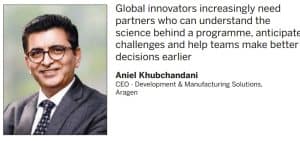
Khubchandani outlines how the role of a CDMO has evolved. “Indian CDMOs are already moving beyond a model defined primarily by cost and manufacturing scale. The next phase of the industry will be defined by how effectively CDMOs can contribute across the drug development journey, from early discovery and process development to scaleup, regulatory support and commercial manufacturing. Global innovators increasingly need partners who can understand the science behind a programme, anticipate challenges and help teams make better decisions earlier,” he points out.
However, he doesn’t present the transition as automatic and points out that it “requires deliberate capability investment, business model evolution, and willingness to own risk alongside clients – things most Indian CDMOs have historically avoided.”
That is where the definition of a CDMO partnership starts to change.
Peter DeYoung, CEO, Piramal Global Pharma, says development partnership requires a different level of engagement with the client.
He explains, “Generally speaking, acting as a development partner requires proactive regulatory (CMC) strategy, scientific and operational problemsolving expertise, and a commitment to project management. Taking a consultative approach to the clients’ programs helps innovators optimise molecules long before they hit clinical manufacturing.”
He adds, “Evolving from a transactional manufacturing model to a true development partnership requires owning the science from early-stage discovery and route scouting through to commercialisation. Piramal Pharma Solutions was built with this concept in mind; our cross-functional scientific expertise integrates discovery, development and manufacturing. To eliminate vendor handoffs, this model requires integrated process development, advanced analytical services, and multi-site tech transfer – all supported by a deep commitment to quality and patient centricity that spans every function.”
Ghosh sees that evolution already underway in the kind of work now coming to India. He outlines, “Historically, much of the work coming to India was discovery- and early-phase-oriented, while late-phase and manufacturing work was more tactical. Over the last few years, however, we have seen customers increasingly look to outsource late-phase development and manufacturing work to India. This is an area where we believe Sai Life Sciences is well prepared to take on that challenge.”
He predicts, “If we can do that, China+1 can help India evolve from an alternative supplier into a more strategic partner for global pharma.”
Where the money moves
The opportunity is also changing at the molecule level.
Dr Adatia breaks it down by segment, “Small molecules will continue to anchor the CDMO value pool — 75%+ of it. Beyond that, the highest-value ground is peptides, ADCs, oligonucleotides and HP-APIs, along with enabling platforms like flow chemistry, biocatalysis and continuous manufacturing. GLP-1 manufacturing alone could be a $20–25 billion opportunity by 2030, with roughly $5–6 billion genuinely addressable by CDMOs, that’s a category India cannot afford to sit out. Biologics is attractive but capital-hungry, and India is still sub-scale there. Peptides, oligonucleotides and ADCs are where India’s synthetic chemistry heritage transfers most directly, and that’s where I’d expect the fastest gains,” he predicts.
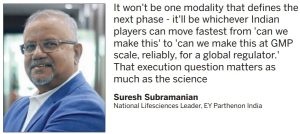
Suresh Subramanian, National Lifesciences Leader, EY Parthenon India, arrives at a similar shortlist but, in his opinion, “It won’t be one modality that defines the next phase – it’ll be whichever Indian players can move fastest from ‘can we make this’ to ‘can we make this at GMP scale, reliably, for a global regulator.’ That execution question matters as much as the science.” Ghosh also states, “Biologics will continue to be important, while peptides, ADCs, oligonucleotides, and other new modalities are creating new opportunities. And when we talk about peptides, it is important not to think only about GLP-1s. There are a lot of peptides outside of the realm of GLP-1s and hence a very interesting opportunity for us.”
He believes that what ties these modalities together isn’t the molecule but the capabilities required to develop and manufacture. Citing ADCs as an example, he says, “Supporting an ADC program requires capabilities around payloads, linkers, conjugation, and analytical characterisation, as well as the ability to manufacture the product. Similarly, peptides and oligonucleotides require specialised chemistry, analytics, and manufacturing infrastructure.”
He emphasises, “That is why I think the opportunity is increasingly about bringing capabilities together around the molecule, rather than building a business around one modality.”
Young also points to complex modalities and bioconjugates as important growth areas.
He states, “It’s fair to say that historically, India has been associated with cost as its primary benefit. But in an industry where patients are the end customers, cost does not supersede quality, safety, and functionality. As such, the real focus of partnering with an Indian CDMO should be on value. Value creation must be anchored in flawless compliance records, robust data integrity, sophisticated technical execution, and delivery.”
He adds, “The next wave of growth engines in pharma represents additional opportunities. For example, complex modalities and bioconjugates are a segment where Indian CDMOs are poised to move the needle. Piramal has made investments in capabilities and talent in Antibody-Drug Conjugates (ADCs), highly potent active pharmaceutical ingredients (HPAPIs), and complex peptides for exactly this purpose. Likewise, investing in specialized processing technologies and advanced delivery technologies such as advanced spray-drying suites for poorly soluble molecules and biotherapeutics aligns with where the market is heading.”
For an Indian CDMO, however, the opportunity is not only about what it can make. It is also about how reliably it can deliver.
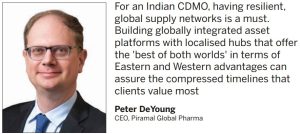
Young says, “For an Indian CDMO, having resilient, global supply networks is a must. Building globally integrated asset platforms with localized hubs that offer the ‘best of both worlds’ in terms of Eastern and Western advantages can assure the compressed timelines that clients value most.”
Dr Adatia concurs, “On large, complex programmes: a handful of Indian players can already run them end to end. For most of the rest, the constraint isn’t chemistry — it’s scale: reactor capacity, sterile fill-finish and programme-management maturity. That’s a solvable problem, but it takes capital and discipline, not just ambition.”
The complexity test
The answer from the industry is increasingly yes, but the differentiator is becoming the ability to execute those programmes consistently across development, manufacturing, technology transfer and supply.
Young says, “Leading Indian CDMOs have systematically dismantled the legacy perception that they are suited only for mature, generic APIs or simple packaging projects. Today’s Indian CDMOs feature state-ofthe-art facilities and the ability to handle complicated projects across both small and large molecules. Piramal has focused its most recent capex commitments with support of these complex programs in mind, including major investments in the areas of bioconjugates, high potency APIs, and commercial scale fill finish.”
This brings the discussion back to one of India’s most important advantages, the capabilities it already has.
What India already has
The case for India does not rest on geopolitics alone. It also has several structural strengths.
Subramanian points out that India already possesses several advantages. He lists them out, “The largest pool of pharma chemistry talent outside the West. One of the highest numbers of USFDA-approved manufacturing sites outside the United States. Deep expertise in process chemistry, scale-up and complex generic development. A growing biotech ecosystem and increasing biologics capabilities.”
Chereddi also says, “When it comes to quality, India is already in competition since the country possesses more US FDA-approved manufacturing sites than any other nation outside the US”.
Agarwal agrees, “On core quality systems and USFDAapproved facility counts, India already competes credibly.”
Khubchandani also concurs, but distinguishes between the industry’s top layer and its average. He says, “Tier 1 Indian CDMOs operate with genuinely embedded quality systems and have clean regulatory track records. Global pharma clients conducting audits are increasingly aware of this bifurcation.”
But that bifurcation may be one of the industry’s key challenges.
India does not have a capability problem, but it has a consistency problem across the ecosystem.
As Dr Adatia also highlights, “Capability depth also remains uneven in biologics, complex peptides, ADCs, high potency manufacturing, sterile drug product and advanced analytics. India has islands of excellence today. What it doesn’t yet have is ecosystem-wide depth, and that’s the gap to close.”
Cost is no longer the pitch
That also changes the way Indian CDMOs need to sell themselves.
Global pharma companies no longer just want a manufacturer that can execute a defined process. Increasingly, they want a partner that can help move a molecule through development, end to end.
Asked whether India can still win on price, Dr Adatia says, “Yes, but this requires a different business model. Global leaders earn 30%+ EBITDA through technology, reliability and speed, rather than labour arbitrage. Cost is table stakes; it gets you into the conversation, nothing more. In our conversations with pharma CXOs globally, technical capability, dependability, on-time delivery and problem-solving consistently rank above price. That’s because a molecule won at Phase I can convert into commercial supply a decade later, customers are choosing a long-term partner, not shopping for a quote,” he says.
He cautions, “India needs to retire the ’30–50 per cent cheaper’ pitch. If a delayed drug launch can destroy hundreds of millions of dollars of value, customers will pay a premium for speed and certainty every time.”
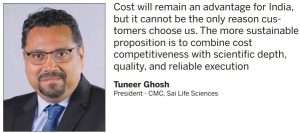
Ghosh shares similar views and reiterates, “Cost will remain an advantage for India, but it cannot be the only reason customers choose us. The more sustainable proposition is to combine cost competitiveness with scientific depth, quality, and reliable execution.”
He adds, “We are seeing work move beyond simply transferring an established process to India for manufacturing. Customers are increasingly bringing development activities and earlier-stage work, which suggests that they are placing greater confidence in the scientific capabilities available here.”
Khubchandani captures the mindset change in a single line and states, “The firms that survive and lead will be those that have moved from execution for-hire to genuine scientific partnership.”
The real gaps
The opportunity is clear. The gaps are becoming clearer too.
Dr Adatia’s diagnosis is direct. “India’s biggest constraint today is not manufacturing competence, it’s consistency of execution. Global customers expect faster RFQ turnaround, shorter technology-transfer timelines, stronger programme management and near-flawless delivery. That bar keeps rising, and India has to rise with it,” he says.
Ghosh makes the same point from a delivery standpoint and opines,”I also think we need to be clear about the difference between demonstrating a capability and being able to deliver it consistently at scale. Global innovators expect the same level of quality, reliability and execution whether the program is being run in India or anywhere else in the world.”
Chereddi locates the risk with precision. “Regarding speed and reliability, however, the situation is more uneven, and this unevenness is in fact the main limiting factor, not a lack of technical ability. One warning letter or one missed delivery deadline can nullify years of hard-earned reputation with a global client.”
His prescription is operational, not promotional. He advises, “The way to bridge that gap is not through a marketing effort but by adopting operational discipline: by making audit-ready documentation a permanent condition rather than something only done in anticipation of an inspection, by ensuring real-time visibility into a CMO’s performance rather than relying on reports at the end of each quarter, and by treating compliance as a design principle rather than as a mere checkpoint. The Indian companies that are securing repeat business from abroad have made this operational discipline a regular part of their operations rather than something they only do on an ad hoc basis.”
The talent bottleneck
Underneath the consistency problem sits a talent problem.
Agarwal names the exact functions India is short on and informs, “Talent depth in the functions that actually decide whether a global innovator signs a multi-year contract — EU-GMP-trained regulatory affairs, quality-by-design formulation science, project management for tech transfer — is where India is genuinely stretched. India adds capacity faster than it adds qualified regulatory and quality professionals, and that gap, not plant count, is what slows conversion from enquiry to contract.”
He returns to it in market terms and says, “‘Strategic partner’ status is earned deal by deal, through demonstrated regulatory judgment during a tech transfer or an FDA query, not through capacity announcements. The industry has the assets; it hasn’t yet built enough of that decisionmaking bench strength across mid-size players, which is where most of India’s real capacity actually sits.”
Technology remains part of the same equation. “The honest gap is technology adoption in mid-market plants — QMS, LIMS and MES are still inconsistently deployed outside the top-tier players — and that inconsistency is what innovators read as reliability risk. Speed follows the same pattern: the best Indian sites move as fast as anyone; the sector’s average doesn’t, because digital maturity and regulatory bench strength aren’t evenly spread.”
Khubchandani’s numbers point to progress and a persistent gap sitting side by side. He says, “AI-linked skill demand in Indian CDMO grew 180 per cent in last two years — the intent and the talent pipeline are real. Yet continuous manufacturing, where Lonza and Pfizer CentreOne are genuinely ahead, remains India’s clearest technology gap in small molecules. We are catching up fast.”
Chereddi adds, “Capacity utilisation in Indian API manufacturing is around 30 to 40 per cent, considerably lower than that in China, which shows that the industry has more untapped potential than it is currently bringing to market.” Subramanian identifies three structural gaps.
The first is regulatory agility, where “approval timelines, import clearances for research materials, and multiagency regulatory processes remain less predictable than competing jurisdictions”.
The second is innovation and risk capital, where “India remains underinvested in biotech innovation compared to the US, Europe and China”.
The third is talent in emerging technologies, where “the industry needs significantly larger pools of talent in biologics, bioprocess engineering, automation, data integrity, AIenabled quality systems, and regulatory science.”
From vendor to partner
The shift from manufacturing vendor to development partner is perhaps the clearest test of how far India’s CDMO industry has moved.
“Developed with India’ is a far more valuable proposition than ‘made in India’ and it’s within reach,” Dr Adatia says. “We’re already seeing several Indian players move upstream into discovery chemistry, DMPK, process development and clinical supply, with earlystage molecule counts up several-fold over the past two to three years,” he adds.
Chereddi is clear about what that transition requires.
In his opinion, “The move from being a vendor to being a partner is not about gaining new capabilities; it’s about altering the ownership model. When a vendor receives a specification, they carry out the specification. A strategic partner, on the other hand, shares in the regulatory and technical risks associated with getting a molecule to market, from the DMF filing all the way through to scale-up. This means that Indian companies must make investments upstream, in regulatory intellectual property, in process development, and in having the ability to enter a partnership conversation by owning the filings and the data, not just the factory floor space. The companies that close this gap by developing real development and filing capabilities rather than simply running someone else’s process are the ones who will be asked back for the next molecule, not just the current one.”
Young’s view reinforces that shift. The development partner has to be involved much earlier, own the science and remove handoffs across the development and manufacturing journey.
That is also where BCGIPSO reports recommendation runs parallel.Move from being a preferred outsourcing destination to a genuine innovation partner, by building differentiated capability rather than stacking commodity capacity, building end-to-end platforms across the value chain, locking in longer-term relationships instead of leaning on spot business, treating inspection readiness as a daily discipline, and building supply-chain resilience by localising critical starting materials.
The opportunity, then, is no longer simply about attracting work to India. It is about retaining that work through deeper relationships.
Execution, not potential
Dr Adatia gives that ambition a number and a deadline. He says, “My view is that the ambition should be explicit, not implicit: become a top-three global CRDMO geography, and move toward 10–12 per cent of global outsourced work within the next decade. That will take sustained investment in talent, specialist suppliers, worldclass quality systems and stronger customer-facing teams. The opportunity is real. Whether India captures it is now a question of execution, not potential.”
Ghosh frames the same ambition in terms of complexity. He states, “I think India should aspire to be one of the world’s leading CRDMO hubs, but I would measure that ambition by the complexity and value of the work we are able to undertake, rather than simply by the size of the industry.”
Capturing the larger opportunity, he explains, “The real ambition should be to build an industry that is globally competitive on science, technology, quality, and execution, while retaining the cost advantage that India has today. If we can make that transition, India can move from being an important outsourcing destination to becoming a strategic development and manufacturing partner for global pharma.”
Agarwal and Chereddi reach for almost the same conclusions.
Agarwal says “The CDMOs that get there first won’t be the ones with the most capacity; they’ll be the ones that closed the talent gap before their competitors noticed it existed.”
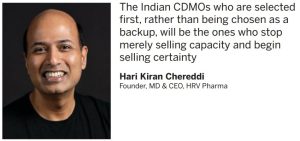
Chereddi asserts, “The Indian CDMOs who are selected first, rather than being chosen as a backup, will be the ones who stop merely selling capacity and begin selling certainty.”
China+1 gave India a strong push. It also delivered a quiet warning: diversification creates options for customers, not loyalty.
India is no longer just competing with China. It is competing with every geography trying to become the next trusted outsourcing destination.
The raw materials for success are already on the table.We have the scale, talent, cost competitiveness, manufacturing experience and a regulatory track record that is gradually maturing.
What’s left is unglamorous but unavoidable. Do what was promised, deliver when promised and get it right, consistently.
India’s CDMO opportunity was helped along by a geopolitical shift. Its future will be decided by something far more basic, whether global pharma can trust an Indian CDMO with its molecule for the next ten years. That’s the real test. And it is how India moves from being the alternative to becoming the choice.
lakshmipriya.nair@expressindia.com
laxmipriyanair@gmail.com
(With inputs from Kalyani Sharma and Neha Aathavale)
The post India’s race for the CDMO crown appeared first on Express Pharma.
Apa Reaksi Anda?
 Suka
0
Suka
0
 Kurang Suka
0
Kurang Suka
0
 Setuju
0
Setuju
0
 Tidak Setuju
0
Tidak Setuju
0
 Bagus
0
Bagus
0
 Berguna
0
Berguna
0
 Hebat
0
Hebat
0