
























































%20and%20Batch%20Production%20Records%20(BPR).png)
















Parkinson’s Disease Medication Monitored with Fingertip Sweat Patch
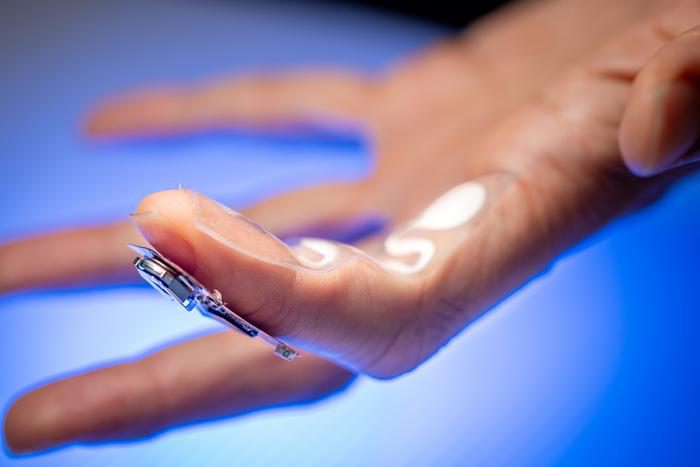
Engineers and neuroscientists at the University of California (UC) San Diego have developed a soft, wearable fingertip patch that continuously tracks a Parkinson’s disease (PD) patient’s levodopa medication levels by measuring chemicals in their sweat, with no batteries required. Tests in healthy volunteers and in Parkinson’s disease patients showed that measurements generated using the device were comparable to those obtained by standard laboratory blood tests.
The wearable device offers a way to continuously track real-time concentrations of levodopa in the body and could enable doctors to precisely customize daily medication schedules for patients at home.
The research was led by Tamoghna Saha, PhD, a postdoctoral researcher in the lab of Joseph Wang, DSc, professor in the Aiiso Yufeng Li Family Department of Chemical and Nano Engineering at the UC San Diego Jacobs School of Engineering. Saha is co-first author of the team’s published paper in PNAS titled “A wearable patch for continuous levodopa monitoring in sweat: Towards exertion and power-free pharmacodynamic assessment in Parkinson’s disease.” In their paper the authors wrote in summary, “Overall, our easy-to-use, energy-efficient wearable supports real-time, stimulation-free monitoring, potentially enabling at-home dosage adjustments and paving the way for future autonomous closed-loop L-dopa therapeutic system development.”
Parkinson’s disease is the second most common and fastest-growing neurodegenerative disorder worldwide, the author wrote. “While no cure for PD exists, levodopa (L-dopa) is the most effective symptomatic treatment, which is typically administered via oral tablets or capsules, and in advanced cases, through inhaled powder or continuous intrajejunal or subcutaneous infusions.” Prescribing the right dose is challenging: reducing levodopa leaves patients unable to move, while too much triggers severe, uncontrollable jerking movements. Initially, the drug’s effects can last several hours.
But as the disease progresses, the therapeutic window narrows down to two hours. Currently, clinicians must rely on subjective patient diaries to adjust treatment. Unfortunately, these methods fail to catch dangerous dosing gaps. “Precision management of Parkinson’s disease (PD) requires frequent levodopa (L-dopa) dose adjustments, yet current monitoring relies on subjective symptom reporting and infrequent blood testing,” the team continued.
![Levodopa monitoring patch showing the assembly of the hydrogel and levodopa sensor with the paper fluidic channel on the fingertip. [Tamoghna Saha.]](https://www.genengnews.com/wp-content/uploads/2026/07/Low-Res_26-10453-2-232x300.jpg)
Worn on the fingertip, which is packed with a high density of sweat glands, the patch is equipped with a specially engineered absorbent gel that acts like a sweat sponge. The gel contains a highly-concentrated mixture of salts and benign solvents—and that draws sweat out of the pores, since water naturally flows toward areas with higher salt concentrations. Collected sweat is drawn into a serpentine fluidic channel with a self-powered levodopa biosensor connected to a wireless transmitter.
When levodopa in the patient’s sweat comes into contact with enzymes embedded in the patch it triggers a chemical reaction, which in turn generates a small, measurable voltage. This chemical reaction is what powers the patch. The amount of voltage generated also serves as an indicator of the patient’s levodopa level, such that lower voltage signals low levels, while higher voltage signals high levels.
![Unassembled integrated levodopa monitoring patch. [David Baillot (University of California, San Diego, San Diego, CA).]](https://www.genengnews.com/wp-content/uploads/2026/07/Low-Res_2026-10453-3-300x200.jpeg)
The data revealed that individuals with Parkinson’s clear levodopa from their systems significantly faster than healthy individuals. This result explains why a patient’s Parkinson’s symptoms can deteriorate so suddenly, the researchers noted.
This technology could lay the groundwork for a closed-loop system, where a levodopa monitoring patch could communicate with a pump to automatically deliver the precise doses of the drug right when the body needs it, the authors suggested. “This approach establishes a foundation for real-time, at-home therapeutic optimization and advances the development of future closed-loop treatment systems for PD.”
The post Parkinson’s Disease Medication Monitored with Fingertip Sweat Patch appeared first on GEN - Genetic Engineering and Biotechnology News.
Apa Reaksi Anda?
 Suka
0
Suka
0
 Kurang Suka
0
Kurang Suka
0
 Setuju
0
Setuju
0
 Tidak Setuju
0
Tidak Setuju
0
 Bagus
0
Bagus
0
 Berguna
0
Berguna
0
 Hebat
0
Hebat
0