

















































%20and%20Batch%20Production%20Records%20(BPR).png)
















Epic API vs HL7 vs FHIR: Choosing the Right Enterprise Integration Strategy

Healthcare IT leaders must decide on an integration standard that determines how systems connect and scale. The choice depends on system complexity, clinical workflows, regulatory requirements, and digital maturity. Without a clear framework, this decision can lead to fragmented integration and limited scalability.
Epic API, HL7 vs FHIR are not competing standards but strategic tools. Each serves a distinct purpose, and the real advantage comes from knowing when and how to use them together to build a resilient healthcare interoperability strategy
Why the Standard You Choose Actually Matters

The wrong integration choice creates operational friction, compliance exposure, and clinical risk. A hospital system that standardizes on HL7 v2 alone for new development will find itself unable to support patient-facing applications, regulatory FHIR mandates, or modern analytics pipelines. An organization that jumps headfirst into FHIR without accounting for its legacy system footprint will face months of costly rework. Getting the Healthcare API vs HL7 vs FHIR decision right from the start is the difference between an EHR integration strategy that scales and one that quietly fails under operational pressure.
Understanding the Three Integration Approaches
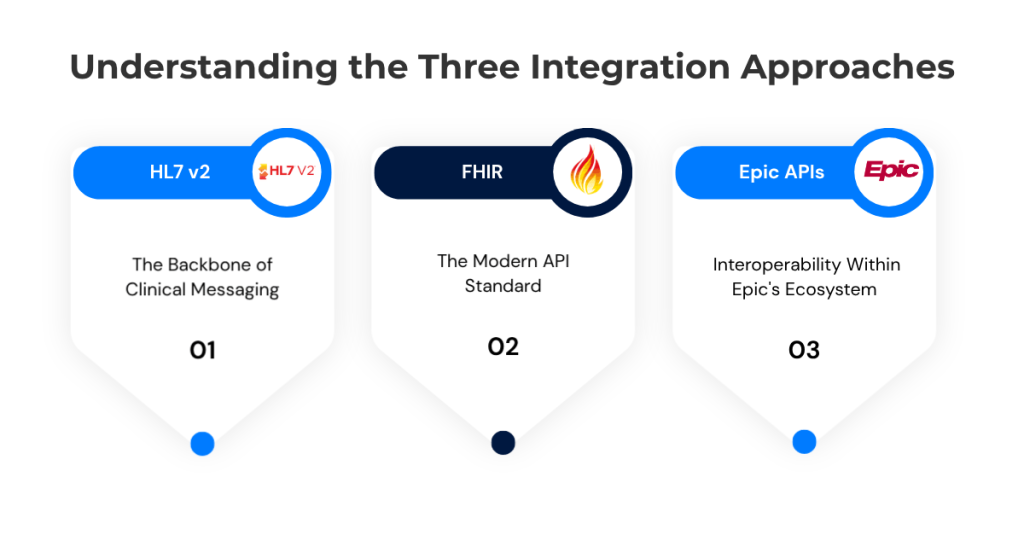
1. HL7 v2: The Backbone of Clinical Messaging
Every major EHR, lab, radiology, and pharmacy system supports HL7 v2 natively—its biggest strength and ongoing challenge. It handles real-time clinical events like admissions, orders, and results in high-volume, legacy-driven environments.
Where it falls short is everything modern: no native query capability, limited security, high vendor variability, and poor fit for mobile or cloud-native use cases. 96% of HIEs routinely receive HL7 v2 ADT messages, showing it remains deeply embedded in U.S. healthcare. For HL7 integration healthcare teams, every new interface is a long-term maintenance commitment.
2. FHIR: The Modern API Standard
FHIR was built to address HL7 v2 limitations. It uses RESTful APIs, JSON payloads, OAuth 2.0, and standard web protocols, making it developer-friendly and scalable. FHIR R4, released in 2019, established a stable foundation for enterprise adoption.
Adoption has accelerated rapidly. The 2025 State of FHIR survey found 73% of countries with health data regulations now mandate or recommend FHIR, up from 56% two years prior. In the U.S., FHIR-based patient access APIs grew from 62% in 2021 to 74% in 2022 (ASTP/ONC).
FHIR is ideal for patient apps, portals, analytics, and compliance-driven use cases. However, implementation complexity and reliance on HL7 v2 in legacy systems mean FHIR vs HL7 is not a replacement decision, but a placement decision.
3. Epic APIs: Interoperability Within Epic’s Ecosystem
Epic dominates the U.S. EHR market, holding 42.3% of hospitals and 54.9% of beds by the end of 2024 and winning nearly 70% of new hospital EHR decisions. This makes Epic integration strategy critical for enterprise healthcare systems.
Epic offers three distinct integration pathways. FHIR APIs enable standardized data access and power App Orchard, making them ideal for modern, patient-facing use cases. Proprietary APIs support scheduling, billing, and workflows but require certification. HL7 interfaces remain in use for ADT and external system connections. Epic API vs FHIR depends entirely on the integration objective.
Head-to-Head: Epic API vs HL7 vs FHIR
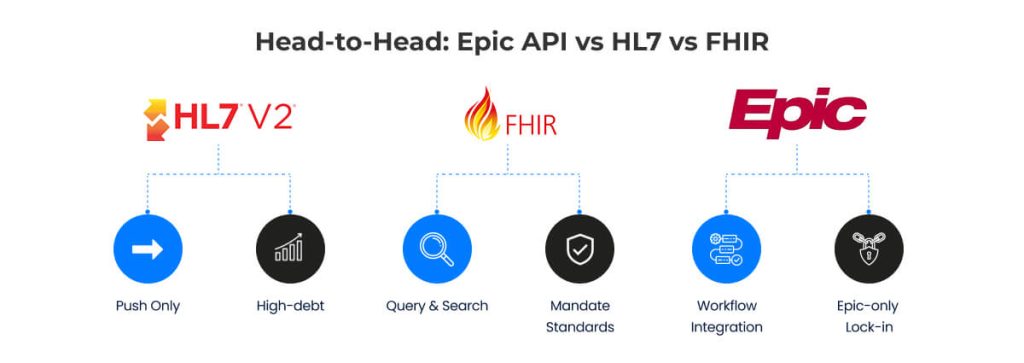
HL7 v2 is a push-only messaging system with no query capability, no native security, and universal legacy support. Its implementation cost is low where infrastructure already exists, but long-term maintenance compounds as every custom field mapping becomes a liability. FHIR transmits data as JSON or XML over REST, supports full search and query, and uses OAuth 2.0 natively, the strongest option for external-facing and patient-access integrations, backed by active regulatory mandates from ONC and CMS. Epic’s proprietary APIs offer the deepest access to Epic-specific workflows but require formal certification, are Epic-only by definition, and carry no portability to other EHR platforms. Their ROI case is narrow: justified only where Epic-native workflow access cannot be served through FHIR.
Common Mistakes When Choosing
Most enterprise EHR integration solutions fail because the decision was made without a full picture of the environment. The five mistakes that surface most consistently are:
- Assuming FHIR replaces HL7 everywhere when the installed base is far too large to displace
- Treating Epic’s FHIR APIs and proprietary APIs as interchangeable when they serve fundamentally different purposes
- Defaulting to HL7 v2 for all new development and accumulating technical debt that only becomes visible when regulatory requirements hit
- Underestimating FHIR implementation guide complexity, the State of FHIR survey found that lack of FHIR knowledge was the single biggest adoption barrier for the second consecutive year, cited by over three-quarters of respondents
- Treating integration as a project with an end date rather than an ongoing operational capability that requires continuous governance.
Do They Coexist or Compete?
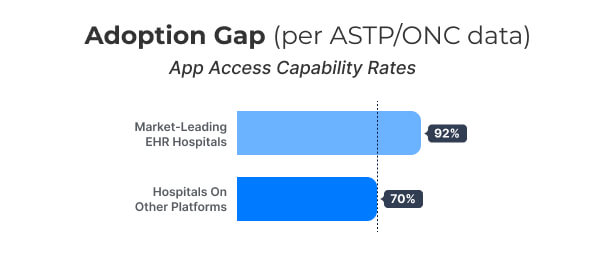
HL7 v2 handles internal clinical event messaging between legacy systems. An integration engine transforms those HL7 messages into FHIR resources loaded onto a FHIR server. Modern applications then consume data through FHIR APIs without ever touching the underlying HL7 infrastructure. This HL7-to-FHIR bridge is now one of the most widely deployed patterns in enterprise healthcare, and the adoption gap it creates is measurable: hospitals on the market-leading EHR platform report app access capability rates of 92%, compared to 70% for those on other platforms, per ASTP/ONC data. In multi-EHR environments running Epic alongside Oracle Health or other systems, FHIR provides the abstraction layer for cross-vendor applications while HL7 v2 handles operational event messaging underneath. Both are necessary. Neither is optional.
Security, Cost, and How to Choose
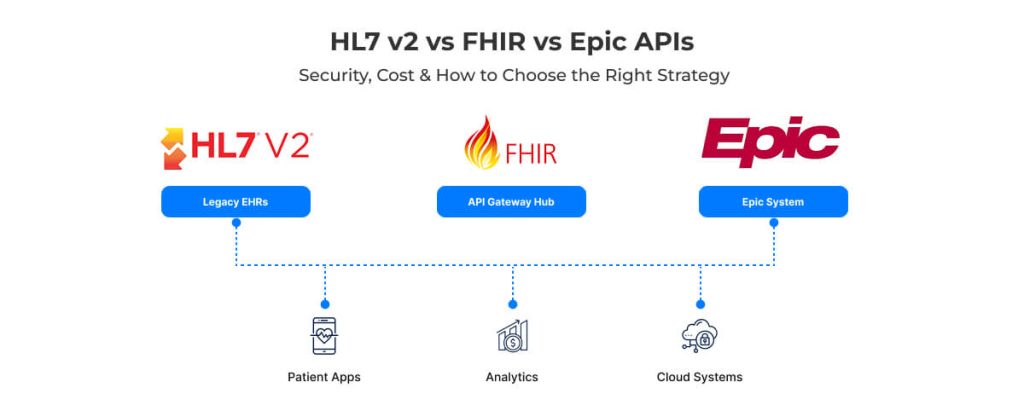
HL7 v2 transmits data in plain text without built-in security, relying solely on network-level controls. In contrast, FHIR natively employs HTTPS, OAuth 2.0, and SMART on FHIR for strong compliance, especially for external and patient-facing integrations. Given that healthcare continues to lead all industries in average data breach costs $9.77 million per incident for 14 consecutive years, security architecture is a crucial business decision for every integration choice.
On the cost side, healthcare integration overhead consumes up to 30% of IT budgets in some organizations, with HL7 interface sprawl being a significant contributor. HL7 v2 has the lowest upfront costs but the highest long-term maintenance burden. Epic HL7 costs tend to rise as integration grows, requiring continual updates. On the other hand, FHIR demands a higher initial platform investment but amortizes future integrations significantly cheaper, making Epic FHIR cost more efficient long-term compared to HL7 interfaces.
Epic proprietary APIs, while crucial for Epic-native workflows, carry the highest per-integration costs due to certification cycles and the need for platform-specific expertise. These APIs are only justifiable where Epic-native functionality cannot be replicated through FHIR.
The decision framework is clear: Maintain stable HL7 v2 interfaces that are already functional; use FHIR for patient-facing, analytical, or new integrations; and opt for Epic proprietary APIs only for Epic-specific workflows that FHIR cannot serve.
What OSP Brings to This Decision

Epic EHR integration consulting is a healthcare consulting service OSP builds enterprise EHR integration solutions designed to last, starting with architecture and governance before a single API call is made. Their Epic API integration services, FHIR API integration services, and HL7 Integration Solutions span the full stack of the Epic API vs HL7 vs FHIR decision, from initial assessment through hybrid integration design, continuous monitoring, and long-term optimization. OSP treats EHR integration as a long-term operational capability, not a one-time project, the mindset that separates integrations that scale from integrations that quietly fail.
Conclusion
HL7 v2 remains the operational backbone of clinical event messaging. FHIR is the required foundation for patient access, compliance, and modern API architectures. Epic APIs unlock Epic-specific workflows that neither standard can reach. In most enterprise environments, all three coexist in a layered architecture where each does what it does best.
The organizations that struggle pick one and force every use case through it. The ones that succeed build a framework, hybrid, monitored, and governed that treats Integrated Healthcare Solutions as an ongoing capability rather than a finished project. That is the difference between an EHR integration strategy built to last and one built to troubleshoot.
References and Additional Resources
- https://emorphis.health/blogs/hl7-integration-vs-fhir-vs-cda/
- https://itirra.com/blog/epic-fhir-vs-traditional-hl7-which-integration-approach-is-best-for-you/
- https://dashtechinc.com/blog/choosing-between-hl7-vs-fhir-for-epic-ehr-emr-integration/
- https://saga-it.com/blog/hl7-vs-fhir
- https://spsoft.com/tech-insights/comparing-hl7-vs-fhir/
- https://www.hl7.org/fhir/
- https://fire.ly/blog/the-state-of-fhir-in-2025/
- https://www.hl7.org
- https://www.healthit.gov
- https://klasresearch.com
- https://fhir.epic.com/
- https://www.healthit.gov/topic/interoperability
- https://www.ibm.com/reports/data-breach
- https://www.cms.gov/Regulations-and-Guidance/Guidance/Interoperability
- https://www.nlm.nih.gov/oet/ed/healthdatastandards/03-300.html
- https://www.enter.health/post/navigating-the-shift-from-legacy-hl7-to-modern-restful-apis-in-healthcare
The post Epic API vs HL7 vs FHIR: Choosing the Right Enterprise Integration Strategy appeared first on Osplabs.
Apa Reaksi Anda?
 Suka
0
Suka
0
 Kurang Suka
0
Kurang Suka
0
 Setuju
0
Setuju
0
 Tidak Setuju
0
Tidak Setuju
0
 Bagus
0
Bagus
0
 Berguna
0
Berguna
0
 Hebat
0
Hebat
0