


















































%20and%20Batch%20Production%20Records%20(BPR).png)













Power, politics and pharma
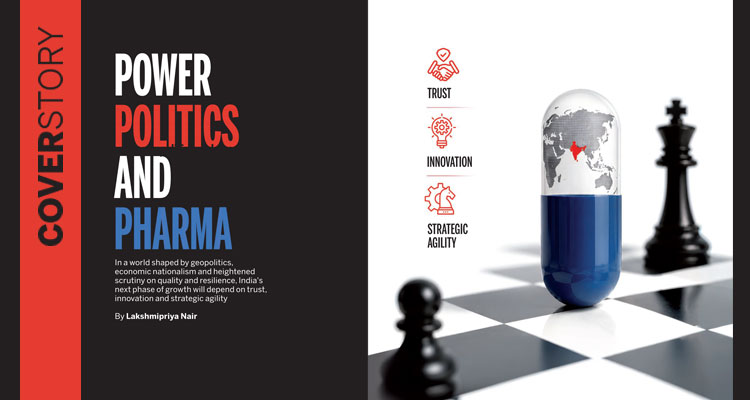
On July 21, 2026, US President Donald Trump announced a three-phase tariff regime on generic medicines entering the US, with zero duty until August 2028, a 100 per cent tariff for the following year, and a 200 per cent tariff from 2029 onwards. The announcement sparked immediate concern across India’s pharma industry. Markets reacted swiftly, with stocks such as Dr Reddy’s and Cipla coming under pressure. SBI Research estimated that, with nearly 40 per cent of India’s pharma exports headed to the US, steep tariffs could dent sector earnings in FY26. Dr Reddy’s CEO Erez Israeli reminded investors that shifting generic manufacturing to the US was “a four-to-seven-year industrial undertaking,” not a quick fix. A day later, India’s External Affairs Minister S Jaishankar met US Secretary of State Marco Rubio in Manila as both countries worked towards an interim trade agreement.
But tariffs are only the trigger. Indian pharma is now operating in a world where geopolitics, trade policy, regulation and supply chain resilience are becoming as important as manufacturing capabilities. The question is no longer whether India can produce medicines at scale. It is whether it can remain competitive in an increasingly volatile global landscape.
This question formed the backdrop to two recent discussions organised by Express Pharma: the inaugural edition of its virtual thought leadership series, Pharma Frontlines, and a panel discussion on Geopolitics, Trade and Trust at the Chandigarh Pharma Summit. Bringing together industry association leaders, manufacturing heads, supply chain experts, quality professionals and regulatory specialists, the discussions explored how Indian pharma is responding to a rapidly changing global environment. While each conversation approached the issue from a different perspective, both pointed to the same conclusion: the industry’s future will depend not just on what it manufactures, but on how well it manages uncertainty.
A trade weapon India has faced before
Pharma and geopolitics have always gone hand in hand, but India has often managed to transform challenges into opportunities. There are several cases in point.
In 2001, Cipla’s Yusuf Hamied changed the conversation around access to medicines. He offered a triple-antiretroviral cocktail to Médecins Sans Frontières for $350 per patient a year, compared to an originator price of more than $10,000. The move challenged the global patent system and helped shape the WTO’s Doha Declaration. More importantly, it established India as a trusted supplier of affordable medicines.
India reinforced that trust during the COVID-19 pandemic through the Vaccine Maitri initiative, launched in January 2021, supplying vaccine doses to 94 countries and two UN agencies. The initiative strengthened India’s reputation as a reliable manufacturing partner for the world.
Today’s challenge, however, is very different. In 2001 and again in 2021, India’s manufacturing strength helped expand access to medicines. Now, that same strength is being tested as countries seek to bring manufacturing closer to home.
Trade policies are shifting, regulations are becoming more complex, and supply chains are increasingly vulnerable to geopolitical shocks.
India can still manufacture at scale. But the next phase of growth will depend on how well the industry adapts to this new reality.
Leadership in an era of uncertainty
Tariffs dominate the headlines, but industry leaders believe they are only one part of a much larger shift. The bigger question is not whether Indian pharma can absorb higher duties, but how it prepares for a world where trade rules, regulations and geopolitical priorities are constantly evolving.
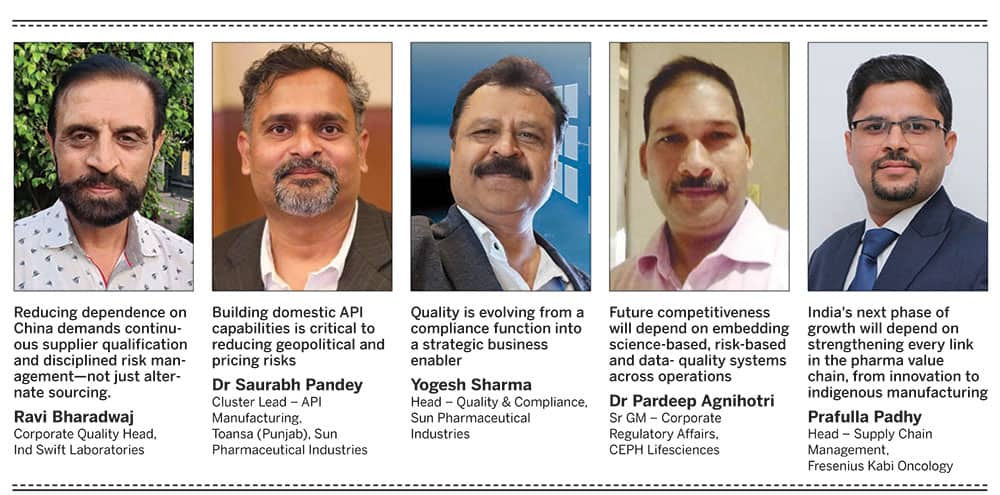
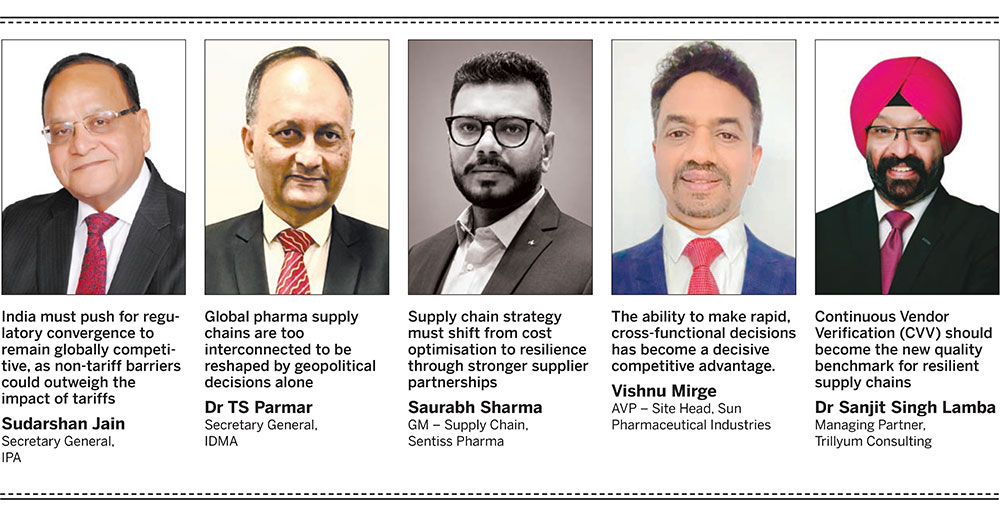
For Sudarshan Jain, Secretary General, Indian Pharmaceutical Alliance (IPA), understanding the India-US pharma relationship is the starting point.
India exports over $12 billion worth of medicines to the US, accounting for nearly one-third of its pharma exports. Indian companies also supply almost half of the generic medicines used by American patients. This dependence, Jain says, is often overlooked. “There is a tremendous reliance on the generic drugs, because they ensure accessibility, affordability, and they have played a very important role to improve healthcare outcomes in the US.”
In other words, the relationship is not one-sided. While India depends on the US as its largest export market, the US healthcare system also depends heavily on Indian manufacturers to keep medicines affordable and accessible.
Jain also pointed out that Indian companies have not waited for policy changes to strengthen their US presence. Companies such as Sun Pharma, Zydus and Lupin already operate more than 40 manufacturing facilities across 12 US states, reflecting a long-term commitment to the market rather than a short-term response to tariffs.
Dr TS Parmar, Secretary General, Indian Drug Manufacturers Association (IDMA), widened the discussion beyond bilateral trade. Healthcare, he argues, cannot be viewed through the lens of one country alone. It is, as he describes it, “a composite partnership.” While governments may seek to bring manufacturing back home, globally integrated pharma supply chains cannot be rebuilt overnight.
For both Jain and Parmar, tariffs are only one part of the challenge. The more significant concern lies in the growing complexity of doing business across multiple regulatory jurisdictions.
Jain believes non-tariff barriers are likely to become a greater obstacle than tariffs themselves. Indian manufacturing sites continue to undergo separate inspections by regulators in the US, Europe, the UK and Africa, even though many of the requirements overlap. Greater regulatory convergence, he argues, would reduce duplication, lower costs and improve the efficiency of global supply chains. He says, “If there is a regulatory convergence, it would become very, very important.”
The discussion points to a broader shift in the industry’s priorities. Competitiveness is no longer determined solely by manufacturing efficiency or cost. It increasingly depends on a company’s ability to navigate a complex web of regulations, trade policies and international partnerships. For today’s pharma leaders, managing uncertainty is becoming as important as managing operations.
When geopolitics reaches the factory floor
Geopolitical events are now influencing day-to-day operations in ways that would have been difficult to imagine a few years ago.
Saurabh Sharma, GM-Supply Chain, Sentiss Pharma, describes the shift and says what was once a purely operational function has been pulled into the centre of business strategy.
He shares how the recent US-Iran conflict disrupted pharma logistics almost overnight. Air cargo operations through Dubai were affected for nearly two weeks, delaying temperature-controlled pharma shipments. He informs that their shipments were stuck for almost two weeks because the flights were not allowed and even a one-degree temperature excursion recorded by data loggers triggered a compliance investigation.
The experience fundamentally changed the way his company evaluates suppliers. He states, “Choosing the partner is also now becoming very critical.”
For Sharma, procurement is no longer about securing the lowest price. Companies are evaluating suppliers on the total cost of ownership. As he explains, “It comprises of many things like quality, cost, of course, one factor, then delivery is another factor. Then the compliance is what is the business continuity? What is the financial strength of the supplier?” Thus, compliance history, delivery reliability, financial stability and operational capability have become key metrics.
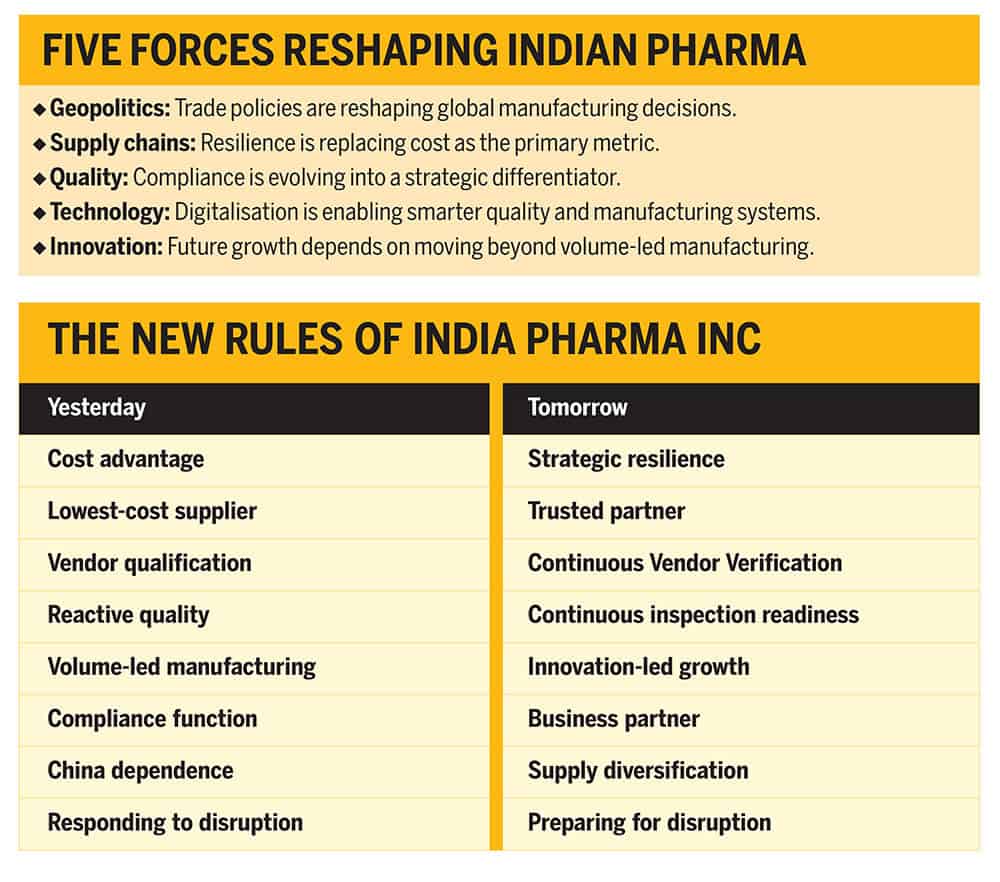
His experience reflects a wider transformation across the industry. Supply chains are no longer just sourcing and logistics functions. They have become vital for business continuity, regulatory compliance and an organisation’s ability to respond to disruption. In an era of geopolitical uncertainty, resilience has become as valuable as efficiency.
The business of being ready
The growing uncertainty in global trade is forcing pharma companies to make decisions faster than ever before. What once unfolded over months now demands action within days, often based on incomplete information and with significant financial implications.
Vishnu Mirge, AVP – Site Head, Sun Pharmaceutical Industries, offers a glimpse into how quickly companies now have to respond. Following the US announcement of a 100 per cent tariff on branded formulations, his team took the unusual decision to double production over three months by securing six months’ worth of input-material inventory instead of the usual three.
This was far more than an operational adjustment. It required rapid financial approvals, close supplier coordination and the confidence to invest ahead of demand.
For Mirge, the experience reinforced a simple lesson. “If you are agile enough to respond to that demand positively, then that is the success mantra.”
His example highlights that competitive advantage is no longer determined solely by manufacturing capacity or cost efficiency. Increasingly, it depends on how quickly organisations can assess risks, align cross-functional teams and respond to changing market conditions.
But responding quickly is only one part of the equation. As supply chains grow more complex and regulatory expectations continue to rise, companies are also rethinking how they approach quality and compliance.
It is in this context that Dr Sanjit Singh Lamba, Managing Partner, Trillyum Consulting, challenges the industry’s traditional approach to vendor qualification. He states, “We don’t need just a vendor qualification. We need something called continuous vendor verification (CVV). This is something I am driving more and more in companies, that they don’t treat vendor qualification as a paper exercise and then remain quiet for two to three years.”
His argument reflects a wider industry reality. Nearly 20 per cent of cold-chain pharma material is wasted every year, while first-timepass rates remain at around 80 per cent, Lamba pointed out. As biologics account for a growing share of the industry’s pipeline, these inefficiencies will become even more critical to address.
Addressing these challenges will require more than stronger processes alone. Technology has an increasingly important role to play but as an enabler rather than a substitute for robust quality systems.
Taken together, these perspectives reveal how leadership priorities are evolving. Companies are no longer preparing only for the next regulatory inspection or market opportunity. They are building organisations that can anticipate disruption, respond with speed and embed quality across every stage of manufacturing and supply chain operations.
Reducing dependence, building resilience
While companies are strengthening agility and quality systems, another strategic priority continues to dominate boardroom discussions, i.e. reducing dependence on China.
Progress is visible, but industry leaders agree that self-reliance remains a longterm journey rather than an immediate destination. Achieving it will require more than identifying alternate suppliers; it demands a systematic approach to qualification, risk management and long-term partnerships.
Ravi Bharadwaj, Corporate Quality Head, Ind Swift Laboratories, believes diversifying away from China is achievable, but only with discipline. He opines that successful diversification requires good planning and change management, with supplier qualification backed by comprehensive audits that evaluate suppliers’ capabilities and compliance levels. He cautions that supplier qualification cannot be treated as a one-time exercise, as a supplier that has successfully completed process validation and stability studies may later receive an FDA warning letter, forcing companies to start the qualification process all over again.
Moreover, supplier qualification is only one part of the challenge. The industry’s continued reliance on China for critical raw materials remains a structural vulnerability with far-reaching implications for cost and supply continuity.
Dr Saurabh Pandey, Cluster Lead-API ManufacturingToansa-Punjab, Sun Pharmaceutical Industries, points to the scale of the challenge and informs, “Currently, we have around 65 per cent to 70 per cent of the APIs getting imported from China based on the cost pricing. With the recent geopolitical changes, we have seen a 40 per cent increase in the pricing of drugs like paracetamol and azithromycin”. He notes the price shocks this dependence has already produced and cautions that prolonged reliance on a single source “will certainly set up a monopoly in the market, and any amount of instability in China will lead to disruptions, not only in the supplies, but to an increase in the pricing.”
Trust becomes the new currency
Yet resilience is not built through supply chain diversification alone. In an increasingly regulated global market, trust is as an equally key differentiator.
If cost and scale defined Indian pharma’s last decade, trust may define its next one, and that trust is often built or broken in the quality function.
As a result, the role of quality leaders are also being reshaped. Yogesh Sharma, Head-Quality & Compliance, Sun Pharmaceutical Industries, describes how the job itself has been redefined. Five years ago, quality was reactive, teams scrambled only when an inspection was announced, pulling together data to prove there was nothing non-compliant. He explains that today, quality leaders are now measured not only on compliance but also on their ability to act as business partners. Their KPIs reflect their contribution to business deliveries and organisational commitments because the cost of a lapse is no longer just a regulatory problem; it is a commercial one.
The shift is being reinforced by a regulatory landscape that is evolving just as rapidly. Dr Dr Pardeep Agnihotri, Sr GM – Corporate Regulatory Affairs, CEPH Lifesciences notes that global regulators have raised the bar considerably over the same period, pushing manufacturers toward “a sciencebased, risk-based, and datacentric approach.” He explains that companies are expected to adopt the ALCOA principles, strengthen data integrity and digitalisation, implement comprehensive contamination control strategies (CCS), and ensure facilities remain inspection-ready at all times rather than preparing only for scheduled audits.
While these expectations have become more demanding, they have also highlighted where India’s strengths and its challenges, lie. Agnihotri argues that India has built genuine strength in costcompetitive manufacturing, API exports, regulatory dossier preparation and CDMO services. At the same time, he points out that gaps remain in data integrity and compliance with evolving regulations. He underscores that quality excellence is an ongoing process, not a one-time milestone.
The road to 2030
As the discussion turned from today’s challenges to tomorrow’s priorities, Prafulla Padhy, Head – Supply Chain Management, Fresenius Kabi Oncology, laid out a vision for where Indian pharma needs to go. He said the industry must move from volume-led manufacturing to innovation, supported by stronger intellectual property protection. He also highlighted the need to strengthen supply chain resilience through indigenous API and KSM manufacturing, improve end-to-end visibility across the supply chain, build quality and compliance so India is recognised as a trusted and reliable partner, adopt more sustainable practices, and make medicines more accessible by reaching tier II and tier III cities as well as rural areas.
“It’s time for India to move forward in its innovation journey,” he said, “and that’s possible only if we fortify each link in this pharma value chain.”
His vision brought together many of the themes that had emerged throughout the discussion. Whether it was building resilient supply chains, strengthening quality systems, embracing innovation or expanding access, the underlying message was clear. The pharma value chain is only as strong as its weakest link.
That is perhaps the defining challenge and opportunity for Indian pharma today. As global trade dynamics shift, the industry’s ability to anticipate change will matter more than ever.
Thus, success by 2030 will not be determined by how companies respond to disruption, but by how well they prepare for it.
lakshmipriya.nair@expressindia.com
lakshmipriyanair@gmail.com
The post Power, politics and pharma appeared first on Express Pharma.
Apa Reaksi Anda?
 Suka
0
Suka
0
 Kurang Suka
0
Kurang Suka
0
 Setuju
0
Setuju
0
 Tidak Setuju
0
Tidak Setuju
0
 Bagus
0
Bagus
0
 Berguna
0
Berguna
0
 Hebat
0
Hebat
0