















































%20and%20Batch%20Production%20Records%20(BPR).png)















Sickle Cell Trait Linked to Distinct Malaria Parasite Variants
Malaria is one of the deadliest infectious diseases on the planet, afflicting people for the entirety of recorded history. In places where malaria is most common, it’s shaped human evolution by driving higher rates of a protective genetic change. Two copies of the genetic change cause sickle cell disease, but one copy helps protect people from malaria. More specifically, sickle cell hemoglobin (HbS) confers protection against symptomatic malaria caused by Plasmodium falciparum.
Now, a new study has found that people with the sickle cell variant are almost exclusively infected by a distinct variety of malaria parasites, which might contribute to their lower rates of disease.
“Sickle cell trait may protect against malaria, not only by changing how the human host responds to infection, but also by shaping which parasites are able to survive and establish infection,” says Sandrine Nsango, PhD, associate professor of molecular biology at the University of Douala and researcher at the Centre Pasteur du Cameroun, Head of the Department of Biomedical Sciences, Faculty of Science, University of Bertoua.
This work is published in Nature Microbiology in the paper, “Sickle cell haemoglobin status shapes malaria parasite genotype in asymptomatic infections.”
Previous work had discovered the unusual strain of malaria by investigating the rare cases where people with the sickle cell variant develop disease symptoms. The new research extends these findings to asymptomatic infections, in which people are infected by the parasite but don’t get sick. While less visible than the disease itself, asymptomatic infections were extremely common, affecting three-quarters of the healthy study population.
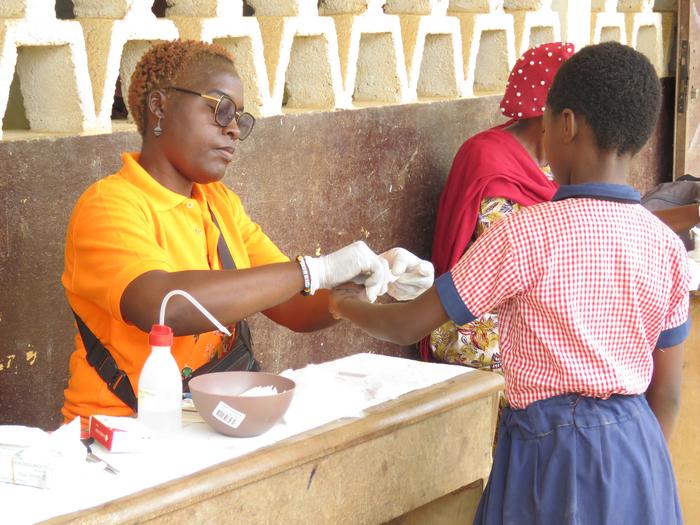
HbS carriers with symptomatic malaria harbor parasites enriched for P. falciparum sickle-associated alleles (Pfsa+). While these may partially overcome HbS-mediated protection, their role in asymptomatic infections is unclear. Researchers analyzed the genetics of over 2,246 healthy schoolchildren in a region of high malaria transmission in Mfou, Cameroon, as well as the malaria parasites infecting them. The team found that people with and without the sickle cell variant tend to be infected by genetically different varieties of malaria parasites.
In addition, specific varieties of the parasite infect people with and without the sickle cell variant at similar overall rates. They write, “analyzing the parasite Pfsa and the human HbS genotypes for 1,701 asymptomatic P. falciparum infections confirmed that heterozygous HbS (HbAS) and homozygous non-HbS (HbAA) genotypes have similar rates of asymptomatic infection.” However, despite being infected at similar rates, people carrying the sickle cell variant are much less likely to develop symptomatic malaria.
The researchers found that which parasites are present in an asymptomatic infection differs based on if the infected person has the sickle cell variant. They write, “the HbS genotype is strongly associated with parasites carrying the Pfsa+ alleles at the Pfsa1 and Pfsa3 loci, indicating a selective advantage for these alleles in HbS carriers.” These findings suggest that the sickle cell variant influences which parasites can infect a person, whether or not they develop disease symptoms.
People with the sickle cell variant are just as likely to become infected—albeit with a different variety of the parasite—but they’re a tenth as likely to develop harmful disease. These observations suggest that the biological characteristics of this parasite variety may contribute, at least in part, to the protection against disease conferred by the sickle cell trait.
To understand why people with sickle cell don’t get disease as often—and use that knowledge to develop better therapies—researchers should not only look at the biology of the sickle cell variant but also investigate the differences in the malaria parasite.
Nsango says that their findings emphasize that malaria is an example of a continued evolutionary interaction between humans and the parasite. “The sickle cell mutation is one of the clearest examples of how infectious diseases can shape human evolution, but our findings suggest that humans also shape the evolution of the parasite in return,” Nsango says. “Understanding these interactions may help us anticipate how malaria parasites adapt in the future and design more effective strategies for malaria control.”
The post Sickle Cell Trait Linked to Distinct Malaria Parasite Variants appeared first on GEN - Genetic Engineering and Biotechnology News.
Apa Reaksi Anda?
 Suka
0
Suka
0
 Kurang Suka
0
Kurang Suka
0
 Setuju
0
Setuju
0
 Tidak Setuju
0
Tidak Setuju
0
 Bagus
0
Bagus
0
 Berguna
0
Berguna
0
 Hebat
0
Hebat
0