

















































%20and%20Batch%20Production%20Records%20(BPR).png)
















Solvent Recovery Gains Ground in Bioprocessing
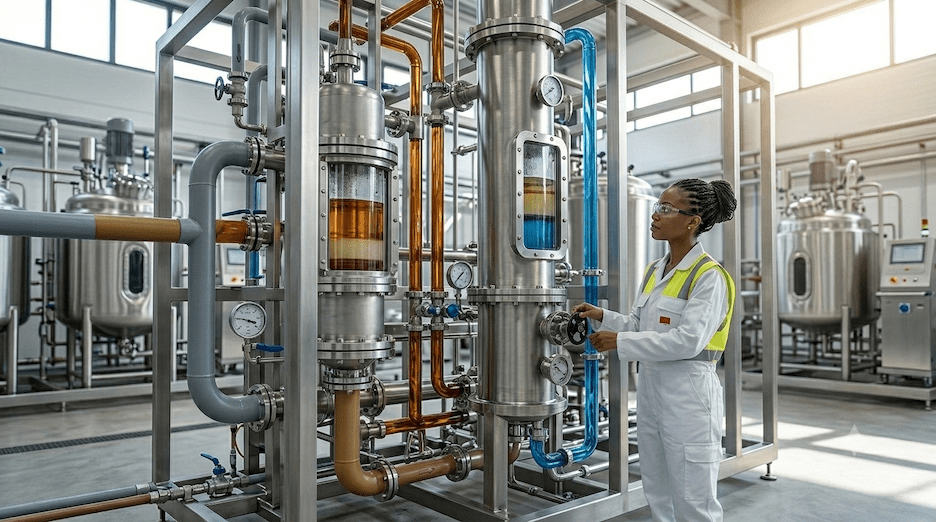
In addition to making products, a bioprocessor should be thinking more about solvents. “Solvent recovery is becoming a critical part of operational resilience and fiscal strategy for bioprocessing companies,” says Rudy Morin, engineering and modular solutions manager at Koch Modular. “It provides three primary benefits: operating expense reductions, supply-chain independence, and corporate sustainability.”
The financial case is especially compelling for bioprocessors that rely on high-purity HPLC- or USP-grade solvents, which are costly to procure and expensive to dispose of properly. By recovering and reusing solvents from waste streams, companies can meaningfully cut virgin-solvent purchases while reducing hazardous waste disposal costs. Morin notes that the economics tend to work in a bioprocessor’s favor. “The payback periods are often attractive given quantities and solvent costs, and the recovery system quickly becomes a predictable long-term asset,” he says.
Supply-chain reliability has become an equally pressing concern. Geopolitical tensions, severe weather, and transportation disruptions have laid bare the vulnerabilities in chemical sourcing. Solvent recovery addresses this by creating a closed-loop supply within the facility itself. “A solvent-recovery system gives bioprocessing facilities total control over their solvent supply and business continuity,” Morin says.
Implementation, however, is rarely straightforward. Bioprocessing waste streams typically contain multiple solvents, water, and solids. Such mixtures often demand sophisticated separation technologies, such as pressure-swing distillation, extractive distillation, vacuum distillation, or liquid-liquid extraction. “Each additional unit operation adds intricate controls and operational variables, making the initial design phase absolutely critical,” Morin says.
Capital costs present another barrier. Automated systems generally start in the low seven-figure range, with complexity driving costs higher. To manage risk, Morin recommends combining pilot testing, process simulation, and modular construction. Pilot testing clarifies feed characteristics and yields critical process data; simulation software optimizes designs before a dollar is spent on construction; and modular fabrication reduces project risk by moving work off-site, compressing schedules, and tightening quality control.
Looking ahead, Morin sees meaningful opportunities in advanced extraction technologies and modular deployment. Liquid-liquid extraction, for instance, can recover products directly from fermentation broths while enabling downstream solvent recycling. For facilities considering the leap, his advice is practical: start with a clear design basis, conduct a rigorous economic analysis, and engage experienced process-engineering partners early. “Any solvent-recovery stream is worth a conversation with an experienced process engineering company, given the multiple potential benefits,” he says.
As cost pressures and sustainability commitments converge, solvent recovery is increasingly positioned not as a compliance measure but as a strategic investment—one capable of delivering measurable value across operations, supply chains, and environmental performance.
The post Solvent Recovery Gains Ground in Bioprocessing appeared first on GEN - Genetic Engineering and Biotechnology News.
Apa Reaksi Anda?
 Suka
0
Suka
0
 Kurang Suka
0
Kurang Suka
0
 Setuju
0
Setuju
0
 Tidak Setuju
0
Tidak Setuju
0
 Bagus
0
Bagus
0
 Berguna
0
Berguna
0
 Hebat
0
Hebat
0







