



















































%20and%20Batch%20Production%20Records%20(BPR).png)














Watching Cancer Proteins in Real Time, with Help from Rare Earth Elements
A long-duration single-molecule imaging platform from the Broad Institute and MIT has revealed unexpected stability in homodimers of HER3, one of the most enigmatic members of the ErbB receptor family. The research, published in Cell, shows wild-type HER3 forms unexpectedly stable homodimers, and that cancer mutations destabilize these homodimers. The findings could hopefully help shape new cancer therapies. Their paper is entitled, “ErbB family receptor dimerization dynamics and dysregulation via long-term single-molecule imaging.”
But the tool that delivered it matters just as much: an upconverting nanoparticle (UCNP) probe, doped with heavy rare earth elements, that simply doesn’t photobleach.
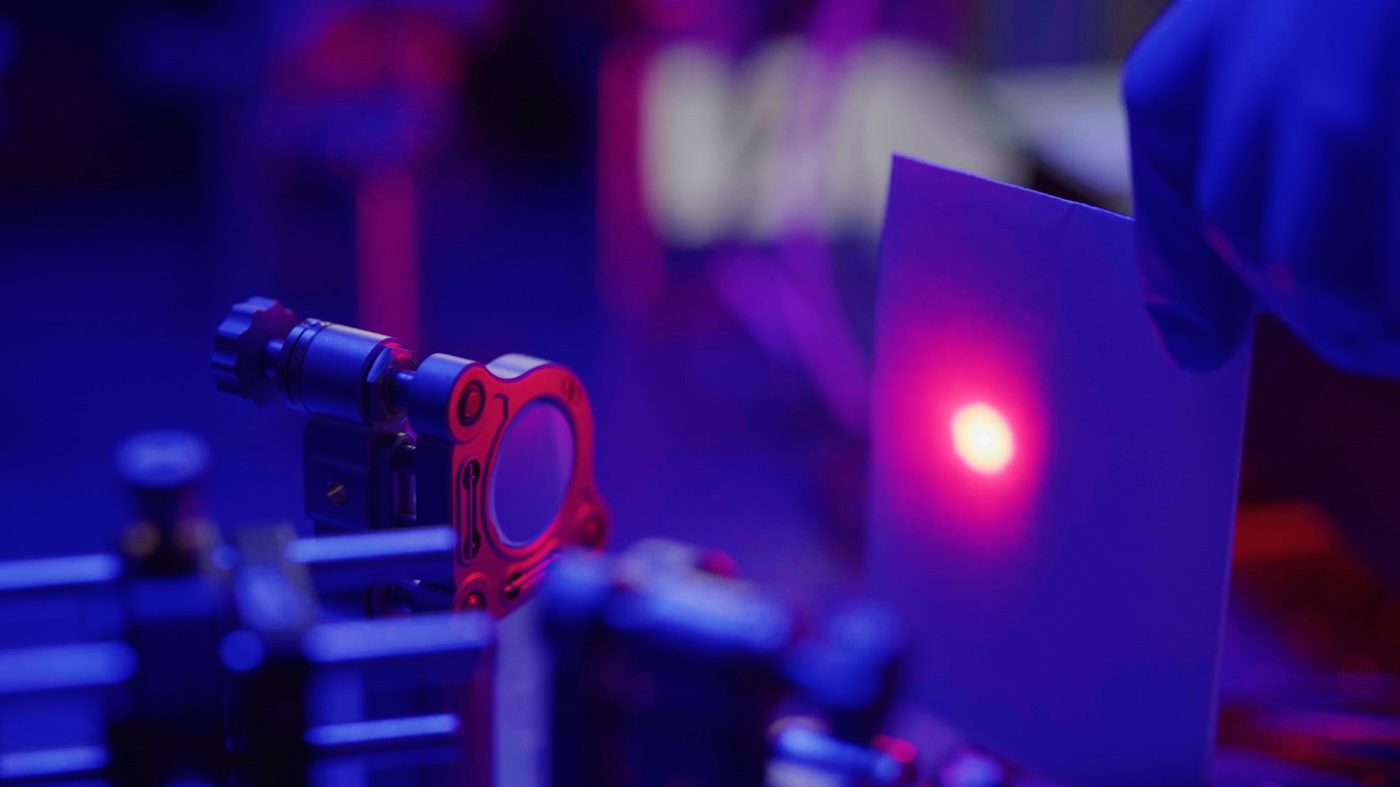
In one corner of Sam Peng’s lab, the imaging rig looks almost improvised. Cameras, lenses, and lasers are bolted directly onto a metal breadboard, like an enormous sheet of Legos built by hand rather than bought off a shelf.
Peng’s team engineered UCNPs doped with ytterbium, erbium, and thulium to track EGFR, HER2, and HER3 at the single-molecule level on live cells simultaneously, in three colors. The new imaging platform holds 100-millisecond resolution and runs for over 16 minutes straight. Conventional dyes lose signal within seconds. These UCNP probes do not photobleach.
Peng compares short-duration imaging to eavesdropping on a conversation that gets cut short: “If you’re trying to understand a conversation between two people… if all of a sudden I just cut off this conversation, then you have to guess my answer based on our previous two-minute interaction, which is often impossible to do.”
The real advantage isn’t a fixed window. Peng said the probe can run for hours. His team stopped at 16 minutes because they’d already captured the long EGFR homodimers they were after.
HER3’s stable pairing
The surprising finding was the unexpected stability of HER3 homodimers and the effects of cancer-associated mutations on these pairings.
“The first time we saw HER3 homodimers, we were really puzzled,” Peng told GEN. “We thought that maybe this was some experimental artifact.”
HER3’s kinase domain is too weak to signal on its own, so the prevailing model treated it as a heterodimer partner—something that pairs with other receptors. This does not rule out its forming homodimers. Peng’s team expected HER3 to serve as a negative control for dimer detection. It should have come back empty.
The team reran the experiment with different labels and probes. The result held every time: wild-type HER3 homodimers proved remarkably stable, far outlasting unstimulated EGFR homodimers.
The group’s working model is that these homodimers form a signaling-inactive pool. In this model, they sequester HER3, limiting its availability to pair with other receptors and trigger cancer signaling.
Cancer mutations support the model, but EGFR and HER3 moved in opposite directions. Mutations like the exon-19 deletion make EGFR homodimers more stable, driving signaling that tracks with clinical aggressiveness. The more stable the dimer, Peng said, the more signaling it triggers. The HER3 mutations studied do the opposite, destabilizing the homodimer, potentially freeing HER3 to form signaling-active heterodimers.
HER2 rounds out a third pattern. The HER2 mutations studied only modestly enhance the stability of its homodimers. That tracks with the clinic: HER2 cancers are typically driven by gene amplification.
Sourcing the materials
Ytterbium and erbium are heavy rare earth elements. Unlike light rare earth elements such as neodymium, mined at industrial scale for electric vehicle (EV) motors and consumer electronics, heavy rare earth elements are produced in far smaller volumes, for a narrow set of high-performance uses where few substitutes exist. Peng’s imaging platform is one of them.
The supply chain for these materials is highly concentrated. China dominates global rare-earth separation and refining, and its share of the heavy subset is larger still. According to Benchmark Mineral Intelligence, China controlled 85% of total rare earth oxide production in 2025, including an estimated 99% of dysprosium oxide and terbium oxide. That concentration has shown up in prices for those magnet metals: in 2025, dysprosium oxide in North America on average cost 4.4 times the Chinese price.
China introduced export controls on seven rare earth elements in April 2025: samarium, gadolinium, terbium, dysprosium, lutetium, scandium, and yttrium. An October 2025 expansion added ytterbium, erbium, holmium, thulium, and europium, including the elements used in Peng’s probes. That expansion is currently suspended under a U.S.–China trade truce.
At bench scale, Peng’s lab works in milligrams to grams, small enough that global supply pressure doesn’t immediately register. His lab buys rare earth salts in vials from a U.S. distributor. “They come in as a form of powder, like salt, just like your kitchen salt,” he said. Erbium salts arrive in pink. “Pretty beautiful,” he noted.
An expertise gap, not a supply gap
Heavy rare earth elements aren’t especially scarce in the earth’s crust. They’re just rarely found in concentrations worth mining—and separating them is difficult. While Peng’s lab doesn’t track where the material was mined, it likely comes from China.
Peng’s lab buys these salts the way other labs buy antibodies. Rare earth elements are used in TR-FRET, some forms of NIR-II imaging, mass cytometry, and UCNP tracking, although these methods use different elements and probe chemistries.
As Xi Jinping was recently in Washington for his first state visit in more than a decade, U.S. officials said the two sides had agreed to extend their trade truce, and with it the pause on China’s expanded rare earth controls, from November to January.
Currently, the bottleneck is expertise, not supply. Peng estimates roughly a dozen groups worldwide work at this intersection of UCNP imaging and single-molecule biology. It’s a small overlap, since the work demands nanomaterial chemistry, molecular labeling, advanced optics, and computation, all in one lab. “It’s the integration of this entire pipeline that makes it challenging,” Peng said.
The research of nanoparticle optics has lasted for years. For now, the rare earth salts are the easy part. The optics, and the people who can build them, are what’s scarce.
References
1. Broad Institute. Single-molecule tracker illuminates workings of cancer-related proteins. Broad Institute of MIT and Harvard. Published May 1, 2026. Accessed September 24, 2026. https://www.broadinstitute.org/news/single-molecule-tracker-illuminates-workings-cancer-related-proteins
2. Shida JF, Ma K, Toll HW, et al. Multicolor long-term single-particle tracking using 10 nm upconverting nanoparticles. Nano Lett. 2024;24(14):4194-4201. doi:10.1021/acs.nanolett.4c00207
3. Peng Lab, Broad Institute of MIT and Harvard. Accessed September 24, 2026. https://www.sampenglab.org/publications
4. Ingall G, Mukherjee N. Ex-China rare earths premium to grow, especially for heavies. Benchmark Mineral Intelligence. Published March 24, 2026. Accessed September 24, 2026. https://source.benchmarkminerals.com/article/ex-china-rare-earths-premium-to-grow-especially-for-heavies
5. Shalal A. US, China agree to extend trade truce by two months, work on bigger deal, Bessent says. Reuters. Published September 23, 2026. Accessed September 24, 2026. https://www.reuters.com/world/asia-pacific/us-treasurys-bessent-chinas-he-meet-unfinished-business-before-trump-xi-summit-2026-09-23/
The post Watching Cancer Proteins in Real Time, with Help from Rare Earth Elements appeared first on GEN - Genetic Engineering and Biotechnology News.
Apa Reaksi Anda?
 Suka
0
Suka
0
 Kurang Suka
0
Kurang Suka
0
 Setuju
0
Setuju
0
 Tidak Setuju
0
Tidak Setuju
0
 Bagus
0
Bagus
0
 Berguna
0
Berguna
0
 Hebat
0
Hebat
0