




















High vaccine takes don’t happen by accident
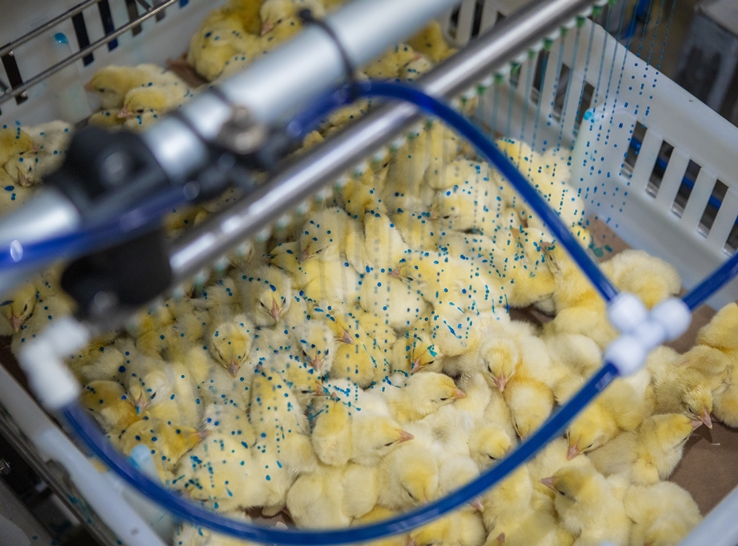
Main photo credit: Ceva Animal Health
For poultry companies, a successful infectious bronchitis (IB) vaccination program depends on more than choosing the right vaccine for the challenge at hand. According to Jose Linares, DVM, diagnostician and technical services veterinarian with Ceva Animal Health, consistently high vaccine takes depend just as much on the quality of vaccine application.
“High vaccine takes don’t happen by accident,” Linares said. “They’re the result of the specific vaccine, precise application, good equipment and consistent attention to detail.”
Protection starts with biology
The reason is rooted in how live infectious bronchitis virus (IBV) vaccines work.
Unlike inactivated vaccines, live IB vaccines must successfully replicate in the bird before they can stimulate the relevant, local mucosal immunity that protects the respiratory tract.
“The vaccine has to reach the bird, remain viable and successfully replicate,” Linares said. “Only then can it stimulate the protective immune response we’re trying to achieve.”
Successful replication not only provides early local protection but also helps prime the bird’s broader immune system. Any factor that reduces vaccine viability or prevents birds from receiving an adequate dose can therefore limit immunity before it even begins.
For Linares, that’s why hatchery vaccination deserves the same level of attention producers devote to vaccine selection.
Precision starts in the hatchery
Nearly all commercial broiler chicks receive their first IB vaccination in the hatchery using either coarse spray or gel. Regardless of the delivery method, Linares said success begins long before chicks are vaccinated.
Proper vaccine storage and handling help preserve vaccine viability, while careful preparation and equipment calibration ensure consistent droplet size, distribution and coverage from the first chick box to the last.
“The equipment has to deliver consistent droplet size and distribution while providing complete coverage of the chicks,” he said. “Attention to detail throughout the vaccination process is critical.”
For spray systems, that means producing a uniform spray pattern that evenly covers chicks throughout each transport box. Gel systems likewise depend on consistent droplet distribution, adequate lighting and sufficient time for chicks to preen and consume the vaccine.
“The goal isn’t simply to apply vaccine,” Linares said. “The goal is to create the conditions that allow every bird to develop protection.”
Good hatcheries don’t guess – they measure
Presenting data at the 2026 American Association of Avian Pathologists (AAAP) annual meeting, Linares said successful hatcheries don’t rely on assumptions – they routinely verify that vaccination worked.1
For IB vaccines, vaccine takes are typically evaluated about five days after hatchery vaccination using RT-qPCR performed on choanal swabs collected from individual birds to confirm that vaccine virus successfully replicated following administration.
More than 75% positive is generally considered an acceptable result. Linares reported that Ceva’s variant GA08 vaccine routinely achieves vaccine takes exceeding 80% and often approaches 100% when application quality is optimized.
The industry’s highest-performing hatcheries take that quality assurance philosophy even further. Drawing on data collected from hatcheries in multiple states and countries, Linares showed that leading operations consistently achieve vaccine takes of at least 97%. Rather than viewing vaccination as a single event, these hatcheries monitor performance, validate equipment and continually refine application procedures to maintain consistent results.
Monitoring also helps identify problems before they become flock-level issues. If vaccine takes fall below expectations, hatchery managers can investigate equipment performance, vaccine handling or application procedures before protection is compromised.
“We help their efforts via structured vaccination process audits as needed,” Linares said.
More than spray or gel
While Linares stressed that application quality is ultimately more important than the delivery method itself, he also presented evidence suggesting gel vaccination may offer practical advantages under commercial conditions.
In one comparison, gel-vaccinated chicks experienced less thermal stress, showed no huddling after vaccination and demonstrated improved livability after placement than spray-vaccinated birds. Thermal imaging showed that gel-vaccinated chicks maintained crate temperatures approximately 5°F higher than spray-vaccinated chicks, while adjusted feed conversion significantly improved.
Even so, Linares emphasized that both spray and gel application can produce excellent IB protection when performed correctly.
“Whether you’re using spray or gel, the goal is the same,” he said. “Aim to deliver the vaccine consistently so every bird has the opportunity to develop protection.”
Consistency creates confidence
For Linares, the common thread linking successful hatcheries isn’t a particular vaccine or delivery system. It’s a commitment to treating vaccination as a quality-controlled process.
That means maintaining equipment, standardizing application procedures, monitoring vaccine performance and continually looking for opportunities to improve consistency. Even seemingly small details – from vaccine handling to chick behavior immediately after vaccination – can influence whether birds receive a viable dose and develop a relevant and protective immune response.
“Top-performing hatcheries consistently achieve high vaccination delivery because they combine precise application, standardized monitoring and a strong understanding of vaccine biology,” Linares said. “When you get those things right consistently, you give every bird the best opportunity to develop protection.”
Want to learn more?
Explore Ceva’s Infectious Bronchitis Knowledge Hub for additional technical resources, practical guidance and expert insights on infectious bronchitis vaccination. [Knowledge Hub]
1 Linares J. Precision matters: Maximizing infectious bronchitis vaccine performance through hatchery application and monitoring. Presented at: American Association of Avian Pathologists Annual Meeting; July 2026; St. Louis, MO.
The post High vaccine takes don’t happen by accident appeared first on Modern Poultry.
Apa Reaksi Anda?
 Suka
0
Suka
0
 Kurang Suka
0
Kurang Suka
0
 Setuju
0
Setuju
0
 Tidak Setuju
0
Tidak Setuju
0
 Bagus
0
Bagus
0
 Berguna
0
Berguna
0
 Hebat
0
Hebat
0