













































%20and%20Batch%20Production%20Records%20(BPR).png)
















‘A profession with amnesia’: why dentistry must rediscover its purpose
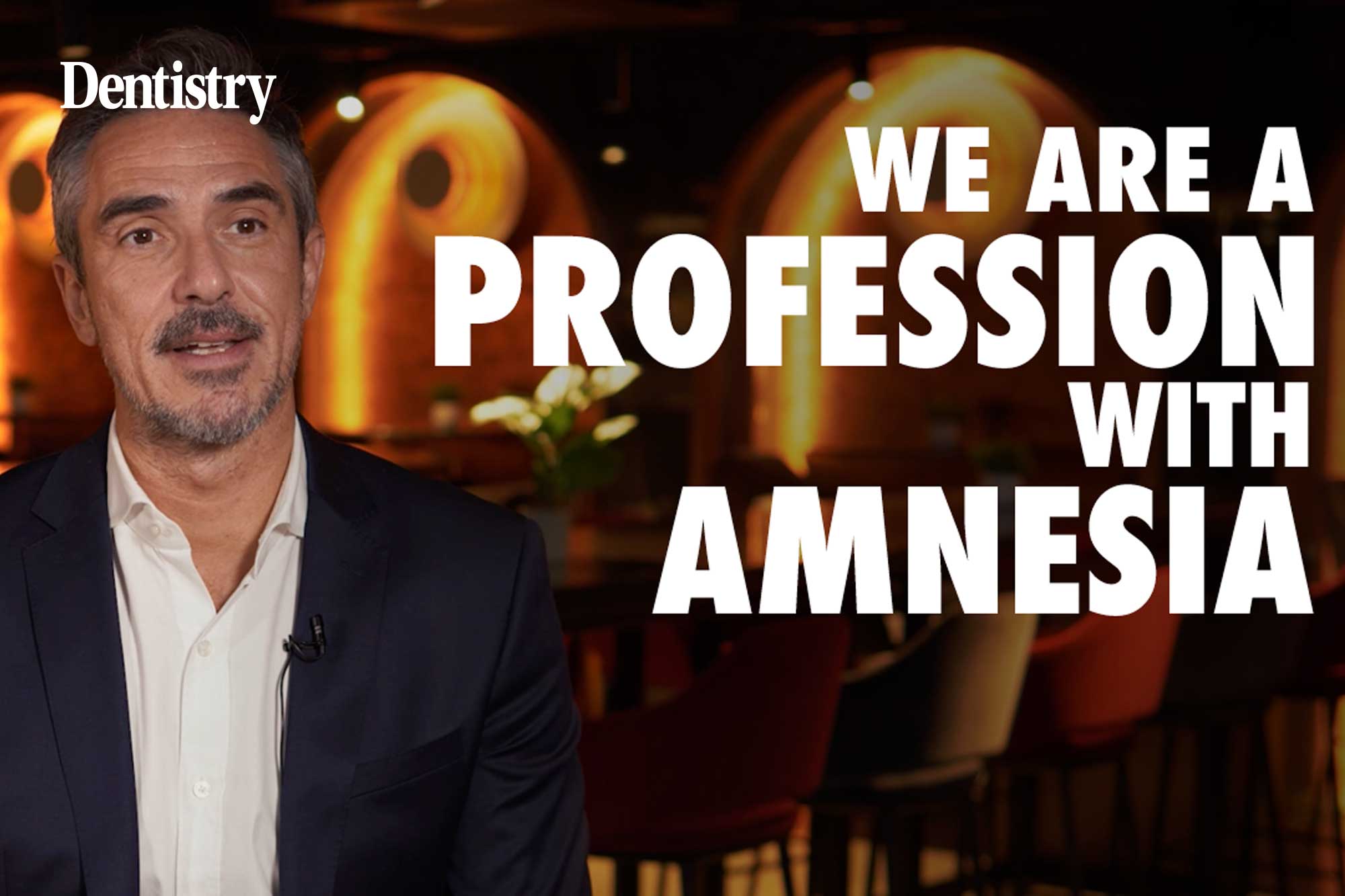
Miguel Stanley tells Guy Hiscott why dentistry has to find its purpose again – and why the future is bright if it can.
Sitting down to discuss the future of dentistry with someone like Dr Miguel Stanley, you expect strong views. The trailblazing clinician behind Lisbon’s world-renowned White Clinic and founder of the Slow Dentistry movement has built a reputation for saying what others won’t.
But even with that expectation, it’s clear from the outset that this is a conversation about something deeper than trends or technology.
‘We are a profession with amnesia,’ he says. ‘We’ve forgotten many times the importance of our craft.’
It is a line that underpins his whole ethos. A belief that dentistry has, over time, lost sight of what it is supposed to be – and, in doing so, limited what it could become.
At the centre of his argument is a shift in identity.
He asks: ‘When did we stop thinking as physicians of the oral cavity? When did we stop thinking about immunology and limit our intervention on the human anatomy to mechanics?
‘We’ve been trained to look at dentistry as mechanics of the mouth. We don’t really think about subclinical, low-grade, chronic infection or inflammation above and beyond simple periodontal disease.’
The consequence, Miguel argues, is a profession that has become disconnected – from wider healthcare, from its own clinical potential, and from the biological realities that underpin oral disease.
A profession shaped by compromise
For Miguel, that disconnect isn’t accidental – it’s the product of the environment dentistry operates within.
‘I like that challenge,’ he says. ‘But when you’re thrust into business thinking and life, business difficulties filter out what our profession truly can be. You don’t find that in cardiology or orthopaedic surgery – but you do find it in dentistry, where things get filtered to fit a budget.’
That tension between ‘ideal’ care and ‘deliverable’ care is one of the defining characteristics of modern dentistry, shaping clinical decisions as much as patient expectations.
At White Clinic, his response has been to push in the opposite direction.
‘It’s a very high-end tech hub,’ he explains. ‘I’m trying to connect all of that science, technology and know-how with my team to improve what dentistry should be in the future, and to establish some form of benchmark for future generations.’
It’s an ambitious aim, but one grounded in a simple, uncomfortable question that Miguel poses:
‘Why do patients in first-world countries have so much tooth decay and then complain that dentistry is expensive?’
Resetting the conversation
Part of the answer, he suggests, lies in what he sees every day in practice.
‘Most of my work today is revision dentistry – treating the results of outdated legacy work.’
He estimates that ‘half a billion patients’ across developed countries are living with dental work that is no longer fit for purpose. Not because it was poorly done, but because all dentistry has a lifespan – something the profession has never fully acknowledged.
‘There’s a lot of guilt and shame… somehow allowing our patients to believe that the filling you did 20 years ago has to last you a lifetime. And that’s crazy. Find me one other profession; one other thing you can acquire that’s supposed to last that long.
‘I think we need to revisit that conversation and perhaps help dentists understand that there’s no guilt or shame in your work not lasting.’
The result is a growing backlog of ageing work that fails gradually, often silently, before presenting as complex, costly problems.
And, as Miguel puts it, that is a conversation the profession needs to reset.
Minding the gap
Much of this can be traced back to dentistry’s focus on the visible and immediate – ‘mechanics and aesthetics’ – at the expense of deeper biological understanding.
‘We don’t really think about subclinical, low-grade, chronic infection or inflammation,’ he says. ‘Our tools to diagnose are the probe and the X-ray. Why is that still okay?’
These are tools that no longer suffice on their own. Advances in saliva testing, biomarkers and genetic screening offer a far more detailed understanding of disease. They are increasingly accessible — and increasingly expected, to the point where failing to adopt them risks obsolescence.
‘You need to upgrade, or you won’t have a place in the future of healthcare,’ he says bluntly.
Because patients, he argues, are changing faster than the profession.
‘When they are attracted by marketing, they will immediately jump onto an AI and ask: is this true?’
Patient trust is no longer a given. It is being interrogated – often in real time – and for practices that don’t keep up, the gap between what is possible and what is delivered is only becoming more visible.
Systemic strain
Miguel’s critique extends beyond the clinic to the system itself, where the reality of running a dental practice brings challenges that other areas of healthcare don’t even need to consider.
‘We have to invest in our clinics; we have to invest in this economy. We don’t have the luxury, like a heart surgeon or orthopaedic surgeon, of having the ecosystem built for us.’
That reality shapes difficult but necessary decisions.
‘You have to say no to patients more than yes,’ he says. ‘You win by exclusion, not by inclusion.’
It is a challenging idea in a profession built around access and care. But it reflects a practical truth: comprehensive, high-quality dentistry requires time, resource and, inevitably, funding.
‘Inclusivity is a big word, but if you’ve got a lot of problems in your mouth, you have to have money to pay for it. I hate to say it, but it’s wealth care, in some cases, not healthcare.’
That tension sits at the heart of many of the profession’s challenges, and feeds into the ‘guilt and shame’ he sees among clinicians.
‘Dentists are not responsible for their patients’ problems,’ he says. ‘If it’s a new patient, you didn’t create that situation: you’re the solution.
‘Like a good lawyer, you are hired to be effective. You’re not hired to be nice, kind, cool, fun, cheap or sweet. It’s great if you can be those things, but you’re hired to solve problems – and that requires arsenal, team, firepower and knowledge.
‘It’s an expensive ecosystem.’
Taking it slow
If there is a single principle that runs through Miguel’s thinking, it is this: slow down.
‘Dentists need to stop seeing too many patients a day… doing everything at speed creates a lot of stress.’
That stress is as much about compromise as it is workload, he argues: ‘I don’t know a dentist who doesn’t love challenging cases. We just don’t like doing them at speed, when we can’t do the right thing.’
From that thinking came Slow Dentistry; a model built on thorough diagnosis, careful planning and deliberate execution.
‘Stop rushing straight into treatment before being the architect of that treatment,’ he says.
‘Say no more; do the right thing. Always understand you’re a physician, not just a mechanic.’
A profession rediscovered
Yet for all its challenges, Miguel is buoyant about where the profession is heading.
‘I think there’s a beautiful phase of dentistry coming,’ he says. ‘One where we are put front and centre in the longevity conversation.
‘That’s one of the biggest markets in the world right now. As soon as people understand that well-done dentistry impacts longevity, the conversation changes. This isn’t about beauty. It’s about lifespan and healthspan.’
For Miguel, that shift – from cosmetic perception to medical relevance – will redefine dentistry’s role to what it should have been all along. As evidence continues to build linking oral inflammation with systemic disease, it represents the healing of a divide between dentistry and general medicine that he has been trying to bridge for almost three decades.
With diagnostics as the foundation of a more integrated model of care, new technology and rising patient expectations point to opportunity.
‘I think it’s a really exciting time to be a dentist,’ he says. ‘If we join these things up, everybody wins.’
The tools are there. The evidence is there. The only question is whether dentistry is willing to remember what it’s supposed to be.
Follow Dentistry.co.uk on Instagram to keep up with all the latest dental news and trends.
Apa Reaksi Anda?
 Suka
0
Suka
0
 Kurang Suka
0
Kurang Suka
0
 Setuju
0
Setuju
0
 Tidak Setuju
0
Tidak Setuju
0
 Bagus
0
Bagus
0
 Berguna
0
Berguna
0
 Hebat
0
Hebat
0