
















































%20and%20Batch%20Production%20Records%20(BPR).png)













AI-powered trial at Toronto General aims to improve accuracy of lung cancer biopsies

HN Summary
• University Health Network and Hamilton-based NodeAI have launched a clinical trial testing an AI platform designed to improve the accuracy of EBUS lung cancer biopsies in real time.
• The AI system analyzes ultrasound imaging during procedures to identify lymph nodes and predict malignancy, with the goal of reducing inconclusive biopsy results caused by operator variability.
• The trial is being conducted at Toronto General Hospital with involvement from Dr. Kazuhiro Yasufuku, the surgeon who pioneered the EBUS procedure that transformed lung cancer diagnosis worldwide.
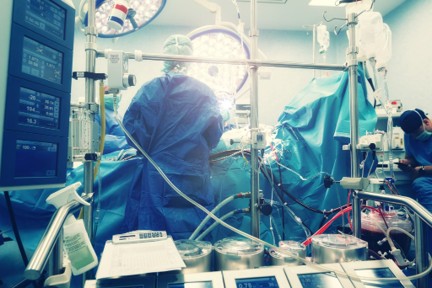
Every year, more than 270,000 patients in North America alone undergo an endobronchial ultrasound procedure, a minimally invasive biopsy that transformed lung cancer diagnosis when it was pioneered at Toronto General Hospital in the late 1990s. The technique, known as EBUS-TBNA, made open-chest surgery largely unnecessary for determining whether lung cancer has spread to the lymph nodes. It is now the global standard of care.
There is one persistent problem: in roughly 40 per cent of cases, the procedure produces inconclusive results. The reason is human variability. EBUS is technically demanding, and performance depends heavily on an operator’s experience and training. Inconclusive findings mean delayed diagnoses, repeat biopsies, and, in a disease where timing is everything, worse outcomes for patients.
NodeAI, a Hamilton-based medical AI startup, was built to solve this. Today the company announced the launch of a clinical trial at University Health Network (UHN) to validate its AI algorithm for real-time lymph node malignancy prediction during EBUS procedures. The trial takes place at Toronto General Hospital, the institution where, in 2011, EBUS was first validated in a landmark clinical trial. The current trial is also being conducted with the involvement of Dr. Kazuhiro (Kazu) Yasufuku, the thoracic surgeon who developed the technique and who sits on NodeAI’s Advisory Board.
THE FULL-CIRCLE MOMENT
Dr. Yasufuku pioneered EBUS-TBNA at Toronto General, where it replaced mediastinoscopy, a procedure requiring general anesthetic, a neck incision, and a rigid steel instrument to reach the chest. EBUS cut procedure time to less than 15 minutes, let patients go home the same day, and within a decade became the global gold standard. By 2020, an estimated 650,000 lung cancer cases had been diagnosed using the technique. Dr. Yasufuku received Japan’s Medical Research and Development Grand Prize from Prime Minister Shinzō Abe for the work.
That same surgeon is now helping validate the AI system designed to take EBUS to its next stage.
”As the co-developer of EBUS-TBNA, it is exciting to see AI helping unlock the next generation of precision diagnostics. The NodeAI approach is scientifically credible because it is built upon validated procedural anatomy, real imaging data, and clinically meaningful patterns that experienced bronchoscopists recognize every day. NodeAI has the potential to improve the diagnostic yield, accelerate expertise, and ultimately benefit patient care worldwide.”
– Dr. Kazuhiro Yasufuku, Co-developer of EBUS-TBNA; Director of Endoscopy and Interventional Thoracic, UHN; Advisory Board, NodeAI
WHAT NODEAI DOES
NodeAI’s platform integrates directly into existing EBUS clinical workflows via a cloud-based interface. During the procedure, the AI analyzes ultrasound video in real time, detecting lymph node anatomy, identifying stations, and generating a malignancy prediction before the biopsy needle is even deployed. The system is vendor-agnostic and requires no hardware changes.
The practical effect is to give a less experienced operator access to expert-level pattern recognition at the moment it matters most. Backed by more than seven years of clinical research and one of the largest EBUS video datasets in the world, the algorithm was co-developed by Dr. Waël Hanna, a thoracic surgeon, and Dr. Anthony Gatti, an AI scientist, both co-founders of NodeAI.
“EBUS changed everything about how we stage lung cancer,” says Dr. Hanna. “But the procedure is only as good as the person performing it, and that creates an equity problem. A patient at a major academic centre with a highly experienced bronchoscopist gets a different outcome than a patient at a community hospital. AI can close that gap. This trial is about proving it.”
CLINICAL TRIAL
The trial will enroll 100 patients over 3 months at Toronto General Hospital. The Primary endpoint is NodeAI’s ability to successfully process EBUS imaging and return real-time predictions at a rate exceeding 90 per cent of all images captured during the procedure.
The trial will assess whether NodeAI’s real-time AI guidance improves diagnostic yield compared to standard EBUS practice, with a focus on reducing inconclusive results and reducing operator-to-operator variability.
Conducting the validation at UHN is deliberate. “There is no more credible place in the world to validate an EBUS technology than Toronto General,” said Dr. Hanna. “This is where the procedure was born. Running this trial here, with Dr. Yasufuku’s leadership is the scientific foundation that we need to ensure that we are creating a technology that helps every patient who is battling lung cancer.”
WHY IT MATTERS BEYOND THE TRIAL
Lung cancer kills more Canadians than any other cancer — an estimated 33,000 diagnoses are expected in Canada in 2025. Globally it is the leading cause of cancer-related death. Accurate, timely staging determines whether a patient receives surgery, chemotherapy, radiation, or palliative care. A missed or delayed staging result is not a minor inefficiency. It changes treatment trajectories.
NodeAI’s larger ambition is to make expert-level EBUS accessible everywhere — not just at academic medical centres with subspecialty-trained bronchoscopists. The company’s subscription-based model is designed for deployment across both high-volume hospitals and smaller community sites where EBUS is increasingly performed but expertise is limited.
The post AI-powered trial at Toronto General aims to improve accuracy of lung cancer biopsies appeared first on Hospital News.
Apa Reaksi Anda?
 Suka
0
Suka
0
 Kurang Suka
0
Kurang Suka
0
 Setuju
0
Setuju
0
 Tidak Setuju
0
Tidak Setuju
0
 Bagus
0
Bagus
0
 Berguna
0
Berguna
0
 Hebat
0
Hebat
0









