




















































%20and%20Batch%20Production%20Records%20(BPR).png)















ApexGO: AI-Driven Approach to Faster Antibiotic Discovery
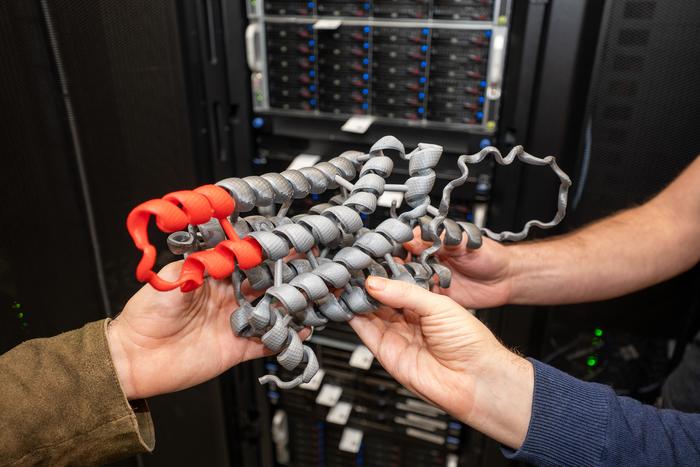
Antibiotic resistance is on the rise around the world, creating an urgent need for faster and more dependable approaches to design antimicrobial candidates. While AI-driven methods have accelerated antimicrobial discovery, most have focused on screening fixed libraries or generating broad candidate sets.
Now, researchers at the University of Pennsylvania have developed ApexGO—a novel, AI-powered method that starts with a small number of candidates and improves them, using a predictive algorithm to evaluate each modification and guide the next.
“Antibiotic discovery is fundamentally a search problem across an enormous molecular space. ApexGO gives us a way to navigate that space with far more direction,” says César de la Fuente, PhD, presidential associate professor in the School of Engineering and Applied Science at UPenn.
This work is published Nature Machine Intelligence in the paper, “A generative artificial intelligence approach for peptide antibiotic optimization.”
“What is striking is that ApexGO’s predictions held up in the real world,” says Jacob R. Gardner, PhD, assistant professor in computer and information science (CIS) at UPenn. “ApexGO was optimizing against another computer model, so one concern was that it might find molecules that looked good to the model but failed in the lab. Instead, the majority of the molecules it designed actually worked.”
indeed, 85% of the AI-generated molecules halted bacterial growth, while 72% outperformed the peptides from which they were derived. In mice, two antimicrobial peptides created by ApexGO reduced bacterial counts at levels comparable to the antibiotic polymyxin B.
“This result points toward a future in which we can optimize molecules for a desired function in a fraction of the time,” adds de la Fuente, “using machines to guide discovery through chemical spaces too vast for humans to explore by trial and error.”
For years, the de la Fuente lab has looked for antibiotic candidates in unlikely places, from frog secretions to ancient microbes. Two years ago, the group released APEX, an AI model that predicts whether or not a given peptide is likely to have antimicrobial properties.
“APEX helped us find promising antibiotic candidates in enormous biological datasets,” says Marcelo Torres, PhD, research assistant professor of psychiatry in the Perelman School of Medicine. “ApexGO takes the next step: once we have a promising molecule, it helps us ask how to make it better.”
One part of ApexGO (short for APEX Generative Optimization) suggests molecular tweaks, while the previously published APEX model predicts whether those changes are likely to increase antimicrobial activity. ApexGO then uses those predictions to guide the next round of proposed edits.
While some of the molecules proposed by ApexGO showed promising antibiotic activity, the researchers emphasize that even the best-performing peptides are still early-stage candidates. Before any could be used to treat infections in humans, they would need to be further optimized for safety, stability, and how long they remain active in the body.
Still, the study suggests that AI can help researchers decide which molecules are worth making and testing in the first place. For de la Fuente, the approach could eventually extend beyond antibiotics. “In this case, we wanted to optimize peptides for antimicrobial activity,” he says. “But you could imagine applying the same idea to peptides with other biological functions, like modulating the immune system or targeting tumors.”
“ApexGO shows that AI can do more than predict which molecules might work: it can help us improve them,” adds de la Fuente. “At a time when antibiotic resistance is rising worldwide, we need technologies that help us move faster from an idea to a real therapeutic candidate. ApexGO is an important step toward that future.”
The post ApexGO: AI-Driven Approach to Faster Antibiotic Discovery appeared first on GEN - Genetic Engineering and Biotechnology News.
Apa Reaksi Anda?
 Suka
0
Suka
0
 Kurang Suka
0
Kurang Suka
0
 Setuju
0
Setuju
0
 Tidak Setuju
0
Tidak Setuju
0
 Bagus
0
Bagus
0
 Berguna
0
Berguna
0
 Hebat
0
Hebat
0