








































%20and%20Batch%20Production%20Records%20(BPR).png)















“It Was Not a Cure”: Musunuru Cautions ASGCT on Baby KJ Promise
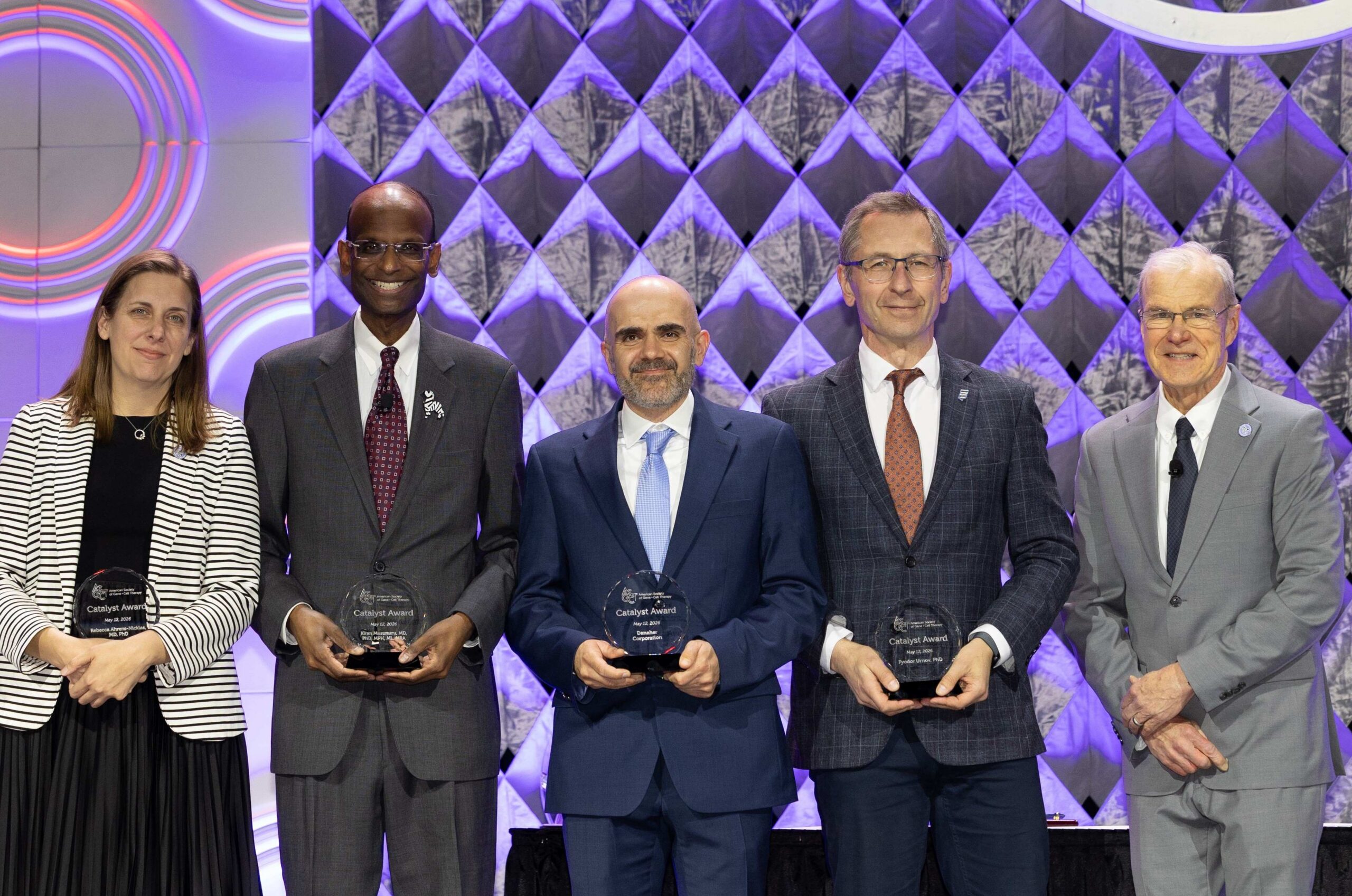
BOSTON – When Kiran Musunuru, MD, PhD, walked to the microphone to deliver remarks on behalf of the team that won the American Society of Gene and Cell Therapy (ASGCT) 2026 Catalyst Award, most of the thousands of attendees surely expected a feel-good speech.
After all, it was 12 months ago that Musunuru, addressing the same convention in New Orleans, shared the exciting news regarding the delivery of a bespoke base editor to an infant, Baby KJ, with a rare urea cycle disorder. Musunuru and his colleague, Rebecca Ahrens-Niklas, MD, PhD, were recently named to the TIME 100 Most Influential People of 2026. “A decade from now,” stated Nobel laureate Jennifer Doudna, PhD, “their names will be in medical textbooks, not only for Baby KJ, but for opening the door to personalized genetic medicine for thousands of children after him.”
Musunuru and Ahrens-Niklas, from the University of Pennsylvania and Children’s Hospital of Philadelphia (CHOP), respectively, were honored alongside Doudna’s colleague Fyodor Urnov, PhD (Innovative Genomics Institute) and Danaher Corporation, for building the remarkable academia-industry consortium that designed and delivered the gene editing therapy, resulting in Baby KJ’s discharge from CHOP and a wave of national television appearances.
Indeed, Musunuru opened his ASGCT remarks in upbeat mood. “The potential is there to [deliver personalized therapies] over and over again for hundreds of diseases centered in the liver.” But halfway through his speech, Musunuru’s tone changed. While most grateful for the recognition from ASGCT, he said it was important to always “be your own worst critic.”
“I’ll be brutally honest,” Musunuru said. Despite the unquestionable “enthusiasm and excitement” surrounding the Baby KJ story, “there are some profound limitations. It was not really science at all!” Musunuru continued. “It was not a clinical trial. It was not clinical research. It was not a cure.”
“The best we can say is we hope we’ve turned a devastating disease into a milder, manageable condition. But it’s too early to say that… This was a personalized N-of-1 therapy—we can’t say what this means for anyone.”
Drawing applause from the audience, Musunuru pushed on: “We mustn’t be snake oil salesmen or give false hope… We have a profound ethical responsibility not to mislead families over what is possible.”
“We don’t actually know anything,” Musunuru said. “We need to do clinical trials—scientifically and ethically.”
The path forward
Musunuru set the Baby KJ story in the broader context of his group’s work on phenylketonuria (PKU), one of the classic inborn errors of metabolism. A few years ago, Musunuru and Ahrens-Niklas set about designing gene editing therapies targeting the first and sixth most common PKU mutations using adenine base editors. (There are more than 1,000 known mutations that cause PKU.)
After testing in humanized mouse models, the researchers were delighted to see the phenylalanine levels rapidly drop to normal, sustained for the lifetime of the mice. Flush with funding from the Somatic Cell Genome Editing program at NIH, Musunuru and Ahrens-Niklas began talks with the U.S. Food and Drug Administration in February 2024 to settle the question: Do we need separate Investigational New Drug applications (INDs) for each PKU variant?
“It is basically the same drug, the same gene, the same disease, the same clinical endpoints. Can’t we cover both variants in a single IND and a single ‘umbrella’ clinical trial?” summarized Musunuru. The answer was “maybe”—the agency needed to consider the full implications of the proposal.
The Philadelphia team began to develop workflows for four more PKU mutations, leading them to propose an umbrella trial for a revised total of six variants. Following another meeting with FDA officials in early 2025, the response was extremely positive: a single IND application would be appropriate, with a single toxicology study conducted in a single species. The FDA also agreed to consider additional variants.
In parallel, Ahrens-Niklas and Musunuru were studying sick patients with urea cycle disorders. Although these are liver disorders, “the real harm happens in the brain,” Musunuru said, resulting from toxic levels of ammonia. Enter Baby KJ’s diagnosis with CPS1 deficiency, and the notion that there was chance to design a personalized therapy.
In the Fall of 2024, Musunuru and Ahrens-Niklas held a pre-IND meeting with FDA officials. The idea was to streamline applications for a group of urea cycle disorders caused by mutations in seven different genes.
The FDA judged that all seven therapies could be evaluated in a single Phase I/II trial, but separate INDs would be required for each gene. “We’d have to do it piece by piece,” Musunuru said. First, file a master protocol for urea cycle disorders; after that IND clears, then file additional gene-specific INDs and amend the original IND.
“This is how we can make the trial accessible to all UCD patients across the country,” he said.
Back to the future
Coming back to the present, Musunuru stated that although the primary IND had been filed, “this does not mean the trial is open or we can enroll patients.” Musunuru listed three major issues:
- The team has not yet manufactured any gene therapy product.
- As seven INDs are needed to fully open the clinical trial, it will be well into 2027 until all INDs are submitted.
- In February 2026, the FDA issued a draft Plausible Mechanism Framework. Musunuru’s team held another pre-IND meeting with the FDA to advocate for the use of prime editing for urea cycle disorders. After all, Musunuru reasoned, why should therapies be restricted to base editing approaches (G-to-A substitutions) but not patients who harbor a G-to-C mutation? The FDA indicated that a separate IND/BLA would be needed for each gene, and that process validation should be finalized before any dosing of Phase II subjects.
The path forward, Musunuru said, was to adopt an adaptive, real-time clinical trial design. That involves testing therapies, then advancing therapies from proof-of-concept to the validation phase. At that point, if all goes well, they can submit a BLA. Ahrens-Niklas and Musunuru laid out more details of their approach and dealings to date with the FDA in a commentary published late last year entitled: “How to create personalized gene editing platforms.”
With that, Musunuru hastily closed and exited stage left to give a keynote address at another conference across the road.
The post “It Was Not a Cure”: Musunuru Cautions ASGCT on Baby KJ Promise appeared first on GEN - Genetic Engineering and Biotechnology News.
Apa Reaksi Anda?
 Suka
0
Suka
0
 Kurang Suka
0
Kurang Suka
0
 Setuju
0
Setuju
0
 Tidak Setuju
0
Tidak Setuju
0
 Bagus
0
Bagus
0
 Berguna
0
Berguna
0
 Hebat
0
Hebat
0