





























%20and%20Batch%20Production%20Records%20(BPR).png)







Bio-IT World Celebrates 25 Years with Opening Plenary on Rare Disease Challenges and Opportunities
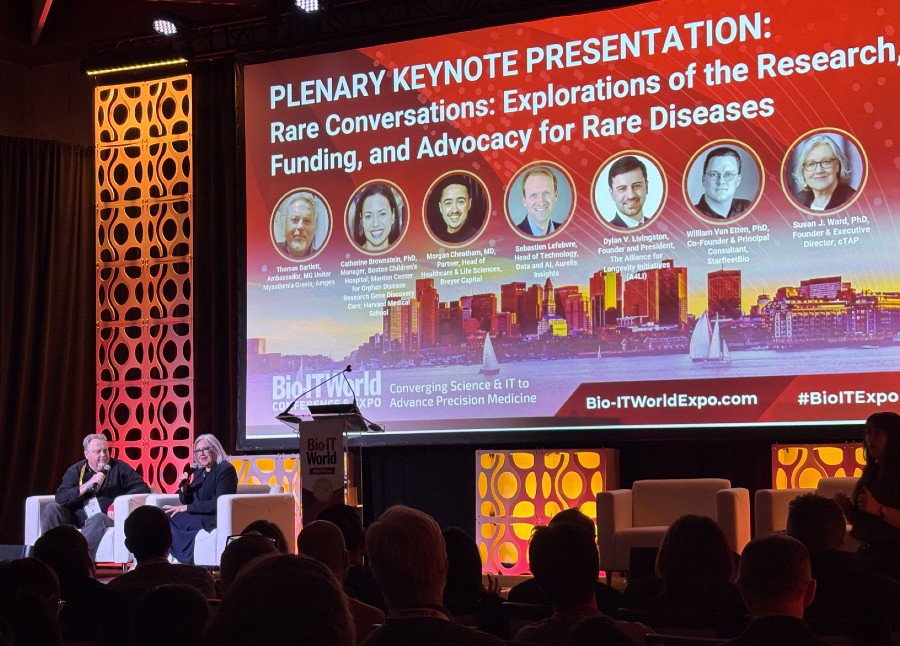
BOSTON — Thomas Bartlett’s life changed in 2019 when he was diagnosed with late-onset myasthenia gravis (MG). The 15-year veteran of the Bio-IT World Conference and Expo took to the stage on Tuesday as one of seven speakers in the opening plenary session of this year’s conference, which focused on various aspects of rare disease research and treatment.
The session offered a poignant, but often uplifting, launch to the annual conference, which celebrated 25 years from its inception in 2002, when the event was produced by the IDG World Expo Group.
Speaking with Susan Ward, PhD, founder and executive director of the Collaborative Trajectory Analysis Project (cTAP), Bartlett described an active life and fulfilling work prior to his diagnosis, and some of the debilitating physical and emotional impact of his disease. “I have to plan everything. If I’m going to go out, I plan ahead of time where I’m going to go [and] the amount of time,” he said. “I have to plan recovery.” Bartlett’s MG has prevented him from working a full-time job, as he would need a full day of rest just to recover from each day. “The math doesn’t work.”
Bartlett is now an ambassador for MG Uniter Myasthenia Gravis, an online platform designed to support some 70,000 patients living with the disease in the United States alone. Though there are some treatments that alleviate disease symptoms, there currently is no cure. Bartlett’s disease was diagnosed early thanks to a quick-thinking primary care provider. A recurring theme in the session was the stark reality that many in the rare disease community wait many years for a diagnosis.
Of the estimated 7–8,000 rare genetic diseases, many not well understood. About one in 10 people in the U.S. “either has or will have a rare disease at some point,” Ward noted. In a conference of about 2,700 attendees, “there are going to be about 270 people on average who might have a rare disease. So the magnitude of the problem is huge, even though the numbers of people are quite small.”
Given the computational nature of the Bio-IT conference, Bartlett and Ward soon turned to data and the challenges with collecting and aggregating information from rare disease populations. Ward noted that centers of excellence in rare disease may have several patients but “no one center that has enough data for anybody to really learn much.” Aggregating data from multiple centers and across geographies is one possibility but due to the differences that exist between centers across states and countries, “you need a really rich and deep ontology” as well as “context for what those data mean,” she said.
And that’s not the only challenge. In many cases, rare diseases can present and progress differently in patients with the same condition. “Imagine you’re trying to design a clinical trial. You’ve got patients who are fluctuating [while] you’re really looking for patients who are slowly declining” and “patients who have intermittent remissions,” Ward noted. With that mix, “you’re going to have a very noisy trial.”
There are also other data sources that could provide value. Bartlett noted that wearable devices such as the Apple watch capture useful health-related data, but as it is not clinical data, physicians cannot use it. As someone with decades of tech experience—including a stint at Apple—Bartlett asked: “How do we change that?” How do we prove the patient’s experience with the data that we can collect, and work with companies and legislation” to “include real world data and evidence and compare that … with the clinical data and get a much broader picture.”
Bartlett’s closing comments focused on hope for people living with rare diseases. And with good reason given recent successes in development of gene therapies and other therapeutics. As a patient, “you need to have something that you can look forward to today,” he said. For now, MG is incurable but “we will find ways to get to that end game and ultimately have a cure or at least a high level of quality of life.”
Shortening the rare disease diagnostic journey
Sebastien Lefebvre, head of technology, data and AI at Aurelis Insights, has spent 10 years in the rare disease space in different capacities including developing platforms for digital decision support or “data-driven and AI-assisted support decisions.” Speaking with William Van Etten, PhD, co-founder, CEO and principal scientist, StarfleetBio, Lefebvre described Rare Answers, a clinical decision support platform for rare disease diagnostics that he worked on while at Alexion Pharmaceuticals. The platform was designed in collaboration with two children’s hospitals as well as a number of technology and data science companies.
![An image showing Sebastien Lefebvre, head of technology, data and AI, Aurelis Insights (right) and William Van Etten, PhD, co-founder, CEO & Principal Scientist, StarfleetBio (left) in conversation at Bio-IT World 2026. [Uduak Thomas]](https://www.genengnews.com/wp-content/uploads/2026/05/Seb-Bill-300x233.jpg)
Van Etten is focused on making individual genomes truly private. The emergence of commercial personal genomics companies created a data privacy problem. Customers pay for their genomes to be sequenced by a company that holds the data, reads it, and sends periodic reports. He has developed an app called DNAVault that lets people host their genomes on their smartphones, putting data control back into their hands.
Van Etten’s new company, StarfleetBio, is partnering with his former consulting firm, BioTeam, and the Hubbard Center for Genomic Studies at the University of New Hampshire, to provide sequencing services.
“It used to be that we needed to centralize all the human genome data because you need a lot of compute to perform the analysis, but it’s really not required anymore,” he said. “We decided to decentralize it, where your genome is on your phone, you can generate your own reports, and nobody has access to it but you.”
Each encrypted genome is only accessible with a key unique to the individual’s phone. This way, only they individual can download their data and read it. Some audience members clearly approved of Van Etten’s app, with shouts of “Bravo!” from the back of the hall. (The app was later named one of three “Best of Show” winners at this year’s meeting.)
Among the features in the app is a fun kinship feature, which lets two people determine if they are related by placing their phones in close proximity as if sharing a Wi-Fi password. Another feature dubbed “origins” lets people track their ancestry over thousands of years via their Y-chromosome or mitochondrial DNA. Van Etten was particularly moved by the kind of insights this feature revealed about human relationships. “We found that all humans are far more closely related than we thought,” he said. “We all really [came from] the same 5,000–10,000 people from 50,000–70,000 years ago.”
Another app feature screens for the 81 ACMG medically actionable genes to provide health reports, while a final feature lets people ask questions about their genome and get answers much the same way one might enter a question into Google or ChatGPT.
Tying this to rare diseases, Van Etten is working on ways for app users to opt into participating in relevant research studies and clinical trials. The idea is that users could “toggle a switch” that would let alert the relevant researchers and then answer questions to help gauge eligibility. Importantly, this would all be done without people having to share their primary information.
Learning from rare diseases to treat common conditions
Another plenary conversation took place between Morgan Cheatham, MD, partner, head of healthcare & life sciences, Breyer Capital, and Catherine Brownstein, PhD, manager of the Molecular Genomics Core Facility at Boston Children’s Hospital and scientific director of the Manton Center for Orphan Disease Research Gene Discovery Core.
![Morgan Cheatham, MD, Partner, Head of Healthcare & Life Sciences, Breyer Capital (left), and Catherine Brownstein, PhD, Manager of the Molecular Genomics Core Facility at Boston Children's Hospital and Scientific Director of the Manton Center for Orphan Disease Research Gene Discovery Core (right). [Uduak Thomas]](https://www.genengnews.com/wp-content/uploads/2026/05/Cheatham-Bownstein-300x232.jpg)
He also acknowledged the contributions of people living with rare diseases to many major drug modalities including CAR Ts and RNA medicines. “Many of those modalities were actually validated” with “the help of rare patients who were willing to participate in trials that allowed us to show the efficacy, the safety, and the durability of these modalities.”
According to Brownstein, a deeper understanding of rare conditions often has implications for more common conditions. “As someone who spent six years studying hypophosphatemic rickets … it’s these extreme cases, these rare presentations of disorders where you don’t know the underlying etiology [that] inform the common diseases,” she said. Understand the biology behind hypophosphatemic rickets “has implications for bone density and osteoporosis that affects a ton of us in this room.”
Many opportunities were highlighted where some form of AI is already being used or could be applied. One company that Cheatham mentioned is applying AI to colonoscopies to characterize inflammation levels in the bowel in a standardized way with an eye towards connecting patients with ulcerative colitis and Crohn’s disease to relevant clinical trials. There are also opportunities in cardiology, neurology, pathology and more.
Giving more patients the right to try
In the closing conversation, Van Etten spoke with Dylan Livingston, founder and president of The Alliance for Longevity Initiatives (A4LI). Livingston is at the forefront of efforts aimed at implementing policies in different states that allow patients with rare diseases to try treatments that may benefit before they have been approved.
The story of how Livingston, still in his 20s, got involved in healthcare policy is interesting. As a college senior during the Covid-19 lockdowns, “I started thinking about COVID as it relates to age [and] why … [I] would be pretty much completely unaffected by COVID and why my grandfather at 92 would most likely die,” he recalled. “It all comes back to aging, your immune response to these diseases and your immune response to chronic diseases overall.” That got him interested in the field of aging and longevity more broadly.
![Dylan Livingston, founder and president of The Alliance for Longevity Initiatives (A4LI) (left) and William Van Etten, PhD (right) in conversation at Bio-IT World 2026 [Uduak Thomas]](https://www.genengnews.com/wp-content/uploads/2026/05/Livingstone-Van-Etten-300x225.jpg)
Expanding the Right to Try provides a possible pathway to those treatments without requiring approval from the U.S. Food and Drug Administration, which may be years away.
Livingston and his team have been successful in expanding the law in Montana to cover people with age-related ailments as well as people with rare diseases, people recently diagnosed with terminal diseases, and people with disease that will eventually become terminal. Now he and his team are working on getting similar changes in place in New Hampshire. There are safeguards in place: the proposed treatment has to be prescribed by two physicians, pass through IRB review, and the therapy must have passed a Phase I testing. “What we’re trying to do is create a system that is safe enough to prevent as many tragedies as possible while also opening up access to as many people as possible,” Livingston said.
As an example of the benefit of changing the law, Livingston shared a story of a father whose son had died from a rare mitochondrial disease. The father has since had the genomes of his two other children sequenced, only to discover that they carry the same mitochondrial mutation. In this scenario, Montana’s model would allow the father in this instance to bypass the strict requirements of a drug trial and access treatments that could potentially help his children.
“Maybe it’s not as great in terms of a data collection standpoint for companies, but what we’re offering here [are] options for people that don’t have any other options.”
*Bio-IT World Conference & Expo, Boston; May 19-21, 2026.
The post Bio-IT World Celebrates 25 Years with Opening Plenary on Rare Disease Challenges and Opportunities appeared first on GEN - Genetic Engineering and Biotechnology News.
Apa Reaksi Anda?
 Suka
0
Suka
0
 Kurang Suka
0
Kurang Suka
0
 Setuju
0
Setuju
0
 Tidak Setuju
0
Tidak Setuju
0
 Bagus
0
Bagus
0
 Berguna
0
Berguna
0
 Hebat
0
Hebat
0