









































%20and%20Batch%20Production%20Records%20(BPR).png)















BIO on the American Road tours gene therapy hub in Ohio
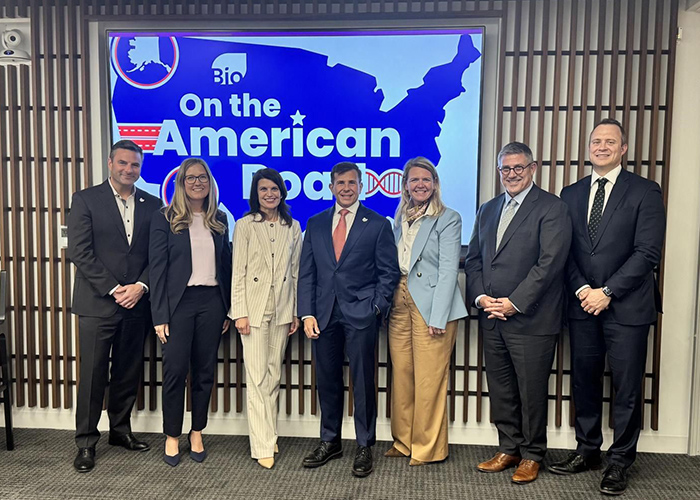
Ohio’s diverse biotech sector provides the state with employment for 65,000 and provides the world with medical breakthroughs.
Of the first eight gene therapies approved by the Food and Drug Administration, two—for Duchenne Muscular Dystrophy and Spinal Muscular Atrophy Type 1 (SMA1)—were developed by researchers at Nationwide Children’s Hospital in Columbus, a city that’s driving gene editing research and production.
A group from the Biotechnology Innovation Organization (BIO) learned more about that work during a BIO on the American Road tour, led by BIO President & CEO John F. Crowley on April 28.
“Every state wants to be a leader in biotech. It takes people, capital, great universities, facilities—and a vision,” Crowley said, during the tour. In roundtables and presentations at various locations, BIO and local leaders in the sector discussed strategies for building on Ohio’s advantages and increasing the state’s leadership.
BIO’s visit to Columbus focused on the capital city’s biotech ecosystem, where collaboration between major institutions has created a nationally recognized hub for gene therapy.
Nationwide Children’s influence
“We talk about the so-called ‘Columbus way’—this deep sense of partnership between the public sector, the private sector, and the academic community,” said Dennis Durbin, President of the Abigail Wexner Research Institute at Nationwide Children’s Hospital—the first stop on BIO’s tour. “Columbus has become a leading destination for manufacturing of gene therapies, because of our early success at Nationwide Children’s.”
He emphasized that, beyond hosting research, Nationwide Children’s technology transfer work ensured the resulting innovations became commercial products.
“That process by which we go from laboratory discovery to a globalized product is something that we developed for our gene therapy program and are now replicating beyond the gene therapy space,” Durbin said.
Speeding clinical trials
The journey from lab to product includes clinical trials, an area where lawmakers and biotech companies urge improvement. As a BIO Board Member testified in Congress, China is taking American leadership in clinical trials, because bottlenecks delay trials in the U.S.
“Nationwide Children’s prides itself on expediting first-in-human clinical trials,” Durbin said. “We have developed a series of resources to facilitate the translation from an early-stage laboratory discovery to a clinical trial.”
As a research hospital, Nationwide Children’s attracts scientists interested in accessing facilities for care and clinical trials, and patients interested in accessing leading-edge therapies, he said.
Ohio State University (OSU), who also hosted BIO’s team, is doing its own work to expedite clinical trials. OSU is involved in organizing a Big Ten Neurosurgery Consortium BTNC, which would see a network of universities collaborate to speed clinical trial starts by centralizing the work of Institutional Review Boards (IRBs) and contracting. OSU hosted a conference convening BTNC stakeholders in January.
OSU’s Gene Therapy Institute

OSU’s groundbreaking work in neurosurgery also involves gene therapy. A researcher at OSU’s Wexner Medical Center developed a gene therapy that is delivered by surgery to treat a rare genetic condition known as AADC deficiency. Researchers say the treatment has potential to treat additional conditions, such as Alzheimer’s and Parkinson’s. Other OSU research in this area includes a center for non viral-gene delivery.
During the visit to OSU’s Gene Therapy Institute, Office of Research, Wexner Medical Center and James Comprehensive Cancer Center, BIO engaged in a round table discussion with members of the biotech ecosystem.
“We were pleased to welcome John Crowley and the Biotechnology Innovation Organization (BIO) team to Ohio State,” said John M. Horack, Vice President for Research at OSU. “His visit underscored the importance of collaboration between academia and industry and reinforced our shared commitment to advancing biomedical research that translates discovery into real‑world impact.”
Sarepta expands its footprint
Crowley participated in a fireside chat with Louise Rodino-Klapac, President, R&D and Technical Operations at Sarepta Therapeutics, during a visit to Sarepta’s Genetic Therapies Center of Excellence (GTCOE).
“The Ohio biotech ecosystem is what I dreamt of when I came here 26 years ago. What Sarepta has built, what Nationwide and Ohio State have built—it’s a great community, and there’s no limit to what we can do in Ohio,” Rodino-Klapac said during the panel.
Sarepta’s gene therapy work in Columbus led the Massachusetts-based firm to invest in the 140,000-square-foot GTCOE, which opened in 2021 and houses both gene therapy research and manufacturing.
“Our growing presence in Ohio will help us strengthen our close working relationships with long-standing local partners such as Nationwide Children’s Hospital, while we work with the greatest urgency to advance our pipeline, further the science of genetic medicine, and create an environment where future generations of scientific talent will thrive,” Rodino-Klapac said during the launch of the GTCOE .
The full value chain
“Ohio is unique in that we truly represent the entire life science value chain right here within our borders,” said Eddie Pauline, President and CEO of Ohio Life Sciences (OLS), a BIO affiliate with a mission to grow Ohio’s life sciences market and ensure patients can access the latest innovations. “If you’re coming in as an investor or entrepreneur, you know Ohio’s opening up a lot of different entry points to the life science ecosystem.”
Pauline noted Ohio’s long-time leadership in life sciences distribution, with headquarters of DHL Life Sciences and Cardinal Health, and McKesson’s Jeffersonville, OH distribution center. Manufacturing includes Amgen’s New Albany plant, where a $900 million expansion is planned.
Institutions like Cleveland Clinic, Case Western Reserve University, and Cincinnati Children’s Hospital drive research specialties in their city’s ecosystems, Pauline said. Cleveland, Cincinnati, and Columbus are the “innovation districts” that make up the Ohio Discovery Corridor, an initiative to connect innovative life sciences firms with the state’s innovation infrastructure and talent.
Attracting talent is key to growing Ohio’s biotech, according to Pauline. The public-private initiative Jobs Ohio has invested $300 million in the life sciences innovation districts. Meanwhile, OLS is looking to develop wet lab space and funding to support biotech, he said.
“We want to make sure that the great IP that is being developed in our institutions stays in Ohio,” Pauline explained. “So as something spins out, they can find the right people, capital and wet lab space to grow.”
At top is a photo taken at Sarepta Therapeutics, where Louise Rodino-Klapac, President, R&D and Technical Operations at Sarepta, hosted a fireside chat with BIO President & CEO John F. Crowley.
The post BIO on the American Road tours gene therapy hub in Ohio appeared first on Bio.News.
Apa Reaksi Anda?
 Suka
0
Suka
0
 Kurang Suka
0
Kurang Suka
0
 Setuju
0
Setuju
0
 Tidak Setuju
0
Tidak Setuju
0
 Bagus
0
Bagus
0
 Berguna
0
Berguna
0
 Hebat
0
Hebat
0