








































%20and%20Batch%20Production%20Records%20(BPR).png)















Conserved Protein May Transform Anti-Inflammatory Strategies
Inflammation is at the core of many diseases. Yet, although many therapeutics have been developed to treat inflammatory diseases, they typically are designed to suppress the immune system, which uses inflammation as a tool to fight infection. Often, this inflammatory process gets out of control. That is the case with acute respiratory distress syndrome (ARDS), a complex condition that currently lacks any effective, approved treatments.
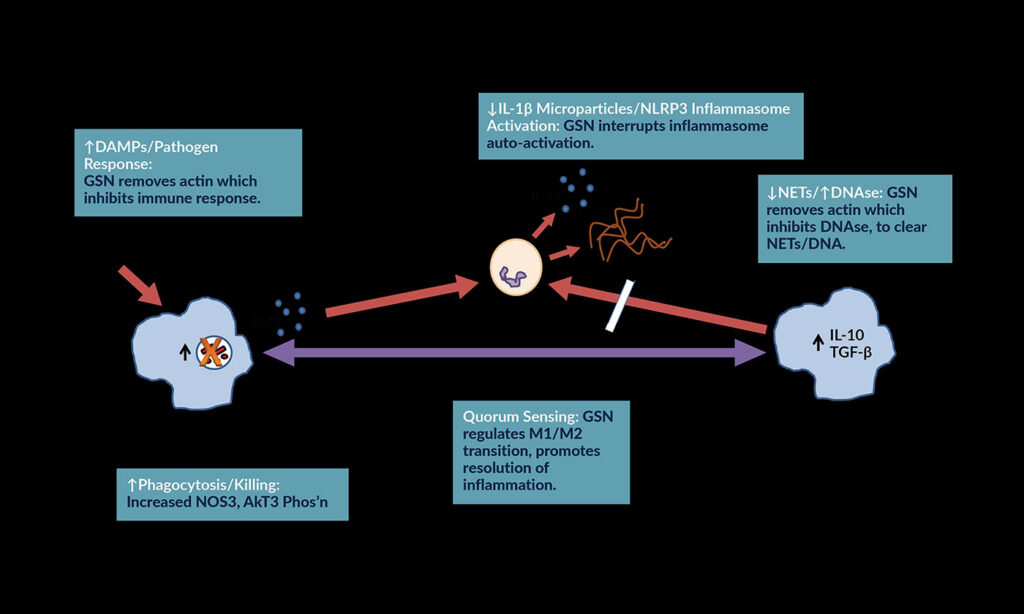
BioAegis Therapeutics is flipping that paradigm by supplementing the body’s natural supplies of plasma gelsolin (pGSN) and enabling precision modulation of the inflammatory process. Unlike existing therapies for inflammatory diseases, pGSN works without suppressing the immune system. This highly conserved protein is largely overlooked by researchers but is at the core of immune functions, helping regulate innate immunity and localize inflammation, as well as helping clear pathogen and cellular debris. “It’s [routinely] circulating in our blood and can go to the points where it’s needed,” Susan Levinson, PhD, CEO, says.
“But there’s a catch,” she adds, pGSN is quickly depleted during the inflammatory process. “If the levels fall too low, the human or animal is at risk of severe morbidity or mortality.” Therefore, BioAegis restores pGSN levels with the identical recombinant protein to bring inflammation under control.
BioAegis is the only company pursuing pGSN supplementation as a treatment for inflammation, although some others are investigating a target within the overall mechanism that pGSN interacts with.
Human studies dosed healthy individuals with recombinant human pGSN (rhu-pGSN) levels “that were 10-fold higher than baseline with no concerning safety findings,” Levinson notes. It works by interrupting the activity of the NLRP3 inflammasome, acting directly on neutrophils and macrophages, which are responsible for countering threats like bacterial infection or injury.
“I think of pGSN as a rheostat that can use the tools of the immune system to regulate inflammation up or down,” Levinson says.
What most intrigues her, she says, is that while “rhu-pGSN is not an antibiotic, it has some antibiotic properties.” In animal trials involving severe bacterial infections such as gram-negative, gram-positive, and antimicrobial-resistant bacteria, flu, and pneumonia, it also helped cells kill the bacteria. In contrast, “The other anti-inflammatories suppress the immune system.”
ARDS and decompression sickness
BioAegis has an FDA Fast Track designation for clinical trials for two indications: ARDS and decompression syndrome. “These Fast Track designations acknowledge that we’re pursuing diseases of great importance and that have no alternative options currently available,” Levinson says. Fast Track designation increases the company’s access to the FDA “and is the first step in seeking a Breakthrough Designation, once we have clinical proof of concept,” she elaborates, which may then speed potential approval.
“ARDS is the moonshot for us,” and is the focus of most of the company’s efforts, Levinson says. This life-threatening lung condition can lead to organ damage, organ failure and even death.
Its fifth clinical study using pGSN, a global, 600-patient Phase II trial for ARDS, pGSN’s primary indication. “pGSN gives us precise modulation of the inflammatory process, and that’s what’s needed for ARDS,” Levinson says. Many cases of ARDS “are caused by infection. One of the drawbacks of all the anti-inflammatories is that they lower inflammation by suppressing the immune system, which is the last thing you want when you have an infection!” In contrast, pGSN does not suppress the immune system.
Trial participants are severely ill. “Most of these patients are in the ICU, and most are on ventilators, which is similar to what happened during the COVID pandemic,” Levinson says. This trial is focused on the lung condition rather than any particular threat or infection. It compares outcomes of severely ill patients who are receiving standard of care with those who are additionally receiving pGSN.
“We expect to have the first hints about its progress by the end of the year,” Levinson says.
Another Phase II trial is underway to treat decompression syndrome. The work is based on research from a principal investigator at the University of Maryland that shows a connection to the inflammatory process. Specifically, levels of endogenous pGSN drop after dives, similar to what is seen in inflammatory diseases.
By blocking activation of the NLRP3 inflammasome in neutrophils, rhu-pGSN “leads to decreased expression of those inflammatory nitrogen-containing particles…and the bubbles!” Levinson explains. Importantly, preclinical research suggests pGSN can prevent decompression syndrome when it is administered before a dive, and also can reverse it when administered after a dive.
“We’ve completed one study that we did in a what I call a controlled environment, basically, we recreated some of the conditions of diving in a hyperbaric chamber,” Levinson reports, to establish relevant biomarkers. A field study is being designed, supported by the U.S. Office of Naval Research, involving divers who encounter enhanced risks (such as commercial or military divers).
BioAegis also is working with the Divers Alert Network to support sport divers—particularly cave divers in Florida. “It’s still early days. We’re still figuring out exactly how to do this,” she cautions.
Early days
BioAegis evolved from research conducted by Thomas Stossel, MD, professor of medicine (now deceased), at Harvard Medical School. “He discovered gelsolin and built a technology estate around it.”
“When I heard about his technology, I was fascinated with the science and, in particular, the concept of this normal human protein that, when reduced, causes morbidity and mortality. It seemed like something that really needed to be brought to patients,” Levinson recalls.
After working with Stossel to further refine the concept, Levinson and her co-founders created the company in 2011 and licensed the technology. Operations moved from Massachusetts to New Jersey—home to two of the four co-founders—to access some of that state’s business incentives.
As the company matured, the challenges evolved from establishing the company to focusing on the most promising opportunities. “The science has provided many wins, but the opportunities far outweigh our ability to fund them, Levinson says. While the company maintains its tight focus on ARDS and, to a lesser extent, decompression syndrome, “We are continually looking for funders with the vision to reimagine the treatment of inflammatory disease!”
Part of its strategy is to maximize effectiveness by outsourcing key portions of the work. BioAegis is a small company, she points out. As such, “We feel the best [approach] is to work with someone with great expertise in whatever is needed rather than scaling up…” personnel and infrastructure to support them.
That approach led the team to a major biologics manufacturer to produce and lyophilize the protein, Levinson says. As a powder, pGSN is stable and easier to handle in a hospital environment, she adds.
Once BioAegis gets preliminary data from its Phase II ARDS trial, it may expand into chronic diseases where, she says, “there are many opportunities…in autoimmune and neuroinflammatory diseases.” BioAegis also looks to expand beyond intravenous administration to make administration easier for patients with chronic conditions.
“We see rhu-pGSN as an opportunity to completely change the way inflammatory disease is managed in the future,” Levinson says.
The post Conserved Protein May Transform Anti-Inflammatory Strategies appeared first on GEN - Genetic Engineering and Biotechnology News.
Apa Reaksi Anda?
 Suka
0
Suka
0
 Kurang Suka
0
Kurang Suka
0
 Setuju
0
Setuju
0
 Tidak Setuju
0
Tidak Setuju
0
 Bagus
0
Bagus
0
 Berguna
0
Berguna
0
 Hebat
0
Hebat
0