













































%20and%20Batch%20Production%20Records%20(BPR).png)












Inside All-ScaleFlow: Continuous End-to-End RNA-LNP Manufacturing
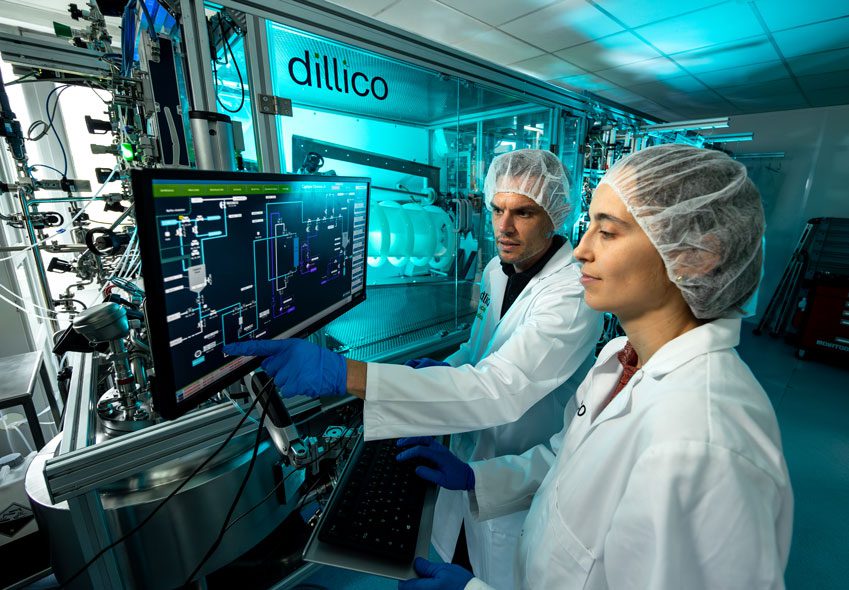
Sponsored content brought to you by

Messenger RNA (mRNA) is expanding from pandemic-scale vaccines toward a wider therapeutic portfolio. Recent Phase 3 success for an individualized neoantigen therapy from Moderna reinforces the clinical relevance of the lower-volume end of that spectrum, while COVID-19 established the opposite extreme. Clinical success is encouraging emerging and established developers to advance RNA medicines either through CDMOs or by building internal capacities. For increased development and production efficiency, CDMOs and drug developers need fast changeovers and flexibility across sequences and scales. All-ScaleFlow integrates RNA synthesis, purification, buffer exchange, and LNP formation to help democratize development.
A patented semi-continuous IVT core
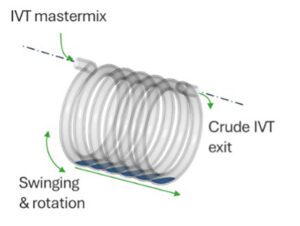
RNA synthesis begins with fixed IVT unit volumes injected into Dillico’s patented, spiral-shaped semi-continuous reactor (Fig 1). The reactor is held in a temperature-controlled environment. Each unitary volume (UnV) advances by one loop periodically and the mature IVT crude UnV exits for optional enzymatic treatment and quenching. This design preserves defined batch reaction conditions without relying on progressively larger batch vessels.
Continuous purification and RNA-LNP formulation
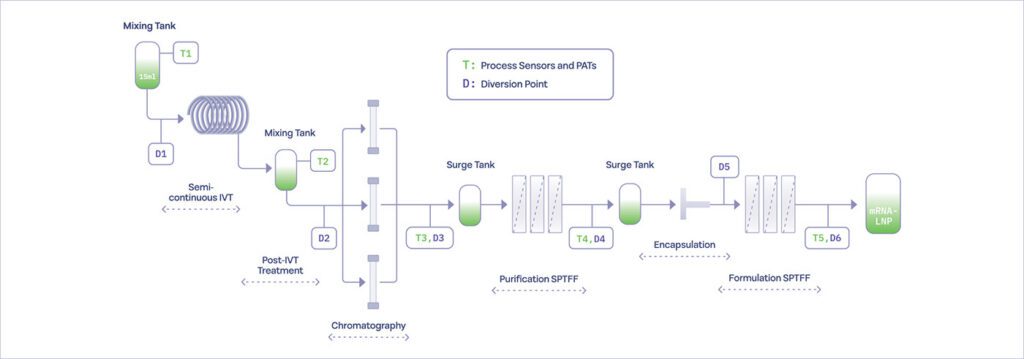
As illustrated in the process flow diagram (Fig 2), All-ScaleFlow integrates alternating multi-column chromatography (dT Oligo resin or monolith) and multi-stage SPTFF for RNA purification, concentration, and buffer exchange. Surge tanks buffer cyclic chromatography eluate and maintain controlled flow into continuous purification SPTFF and LNP mixing. After encapsulation, a second multi-stage SPTFF step removes ethanol and performs final buffer exchange before in-line dilution or excipient addition and sterile filtration. By coordinating flow rates and interfaces, the platform maintains continuous production from IVT crude to formulated mRNA-LNP while minimizing intermediate holds.
Automated cleaning and sterilization onboard
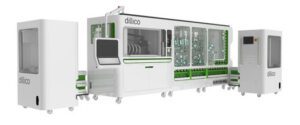
To reduce supply chain risks and achieve long-term sustainability, an automated clean-in-place and sterilization-in-place (CIP/SIP) station is integrated on the system. It uses common cleanroom utilities to clean and sanitize the stainless-steel process path. This could save up to 450 kg of single-use plastic (~200 k$) for a large-scale batch IVT production.
Demonstrated across RNA sequence types
The synthesis approach has been successfully demonstrated with multiple mRNA and self-amplifying RNA (saRNA) sequences with length ranging from 400 bp to 12,000 bp. Working across different sequences is important for a platform intended to serve diverse vaccines and therapeutics.
The Process Simulator turns a sequence into a master recipe
Dillico’s Process Simulator embeds mechanistic process models built from an empirical knowledge base generated through experiments with mainstream, off-the-shelf process components. From product and process requirements, it calculates the global constraints needed to operate the continuous process as a coordinated system and identifies robust conditions that meet quality attributes and throughput targets. This reduces the physical experiments required during process development and supports right-first-time execution, avoiding costly trial-and-error with production materials and analytical testing. Thanks to the Process Simulator, users will be guided through a structured, step-by-step workflow that facilitates technology transfer and lowers the entry barrier for teams new to continuous processing. As part of the digital infrastructure, real process data are contextualized, making them data-lake-ready.

Explore All-ScaleFlowTM and request the Evidence Package
The post Inside All-ScaleFlow: Continuous End-to-End RNA-LNP Manufacturing appeared first on GEN - Genetic Engineering and Biotechnology News.
Apa Reaksi Anda?
 Suka
0
Suka
0
 Kurang Suka
0
Kurang Suka
0
 Setuju
0
Setuju
0
 Tidak Setuju
0
Tidak Setuju
0
 Bagus
0
Bagus
0
 Berguna
0
Berguna
0
 Hebat
0
Hebat
0