












































%20and%20Batch%20Production%20Records%20(BPR).png)














BIO on the American Road visits pioneering NC biotech hub
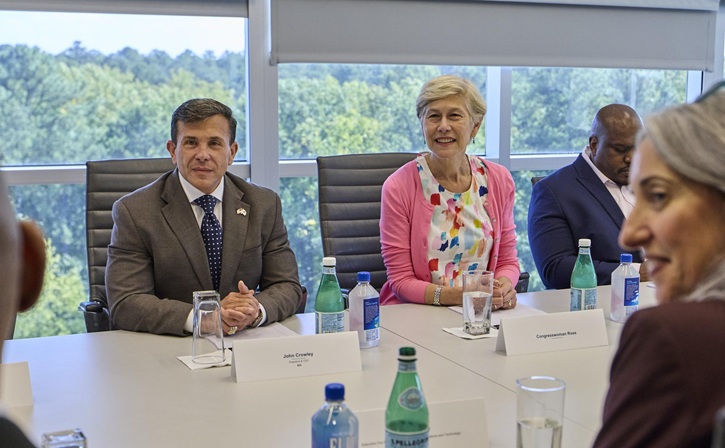
Research Triangle Park resurgent with billions in investment in biotechnology manufacturing.
With a famous biotech cluster in Research Triangle Park (RTP) established almost 70 years ago, North Carolina is already a powerhouse of pharmaceutical R&D and manufacturing, and recent expansion plans worth billions of dollars will continue growth into the future.
A delegation from the Biotechnology Innovation Organization (BIO), led by BIO President & CEO John F. Crowley, learned about North Carolina’s biotech industry on an Oct. 2 visit to RTP, a 7,000-acre complex spread across the three cities of Raleigh, Durham, and Chapel Hill, N.C. It was the latest stop of the BIO on the American Road learning and networking tour of America’s biotech ecosystems.
BIO’s delegation met local members of industry, patient advocates, and Rep. Deborah Ross (D-NC), a champion of IP rights and biotech (pictured at top, with Crowley). The BIO delegation also toured the RTP facilities of Biogen, which are currently undergoing a $2 billion expansion.
“Companies come to North Carolina and RTP because of the investments, talent, partnerships and strong support from elected leaders, like Rep. Ross, that make innovation possible,” said Crowley. “RTP has built an ecosystem where biotechnology companies can develop medical breakthroughs and manufacture them right here in America. The U.S. must continue to lead in biotechnology, and that requires building a stronger American biotech industry. North Carolina and RTP are demonstrating the power of bringing innovation, investment and manufacturing together.”
Biotech R&D, manufacturing, and distribution are all well represented in North Carolina, where the life sciences employed 103,107 as of 2024, according to a TEConomy NCBiotech report. These workers belonged to nearly 6,700 state businesses working in biotech, the report said.
BIO’s delegation met with several innovation leaders at an industry roundtable hosted at the offices of the North Carolina Biotech Center (NCBiotech). Founded in 1984, NCBiotech was the first state-sponsored initiative of its kind to support the biotech industry. They seek to “create North Carolina’s competitive advantage in the life sciences by engaging partners, maximizing opportunities, and delivering solutions to accelerate innovation, investment, and job creation.”
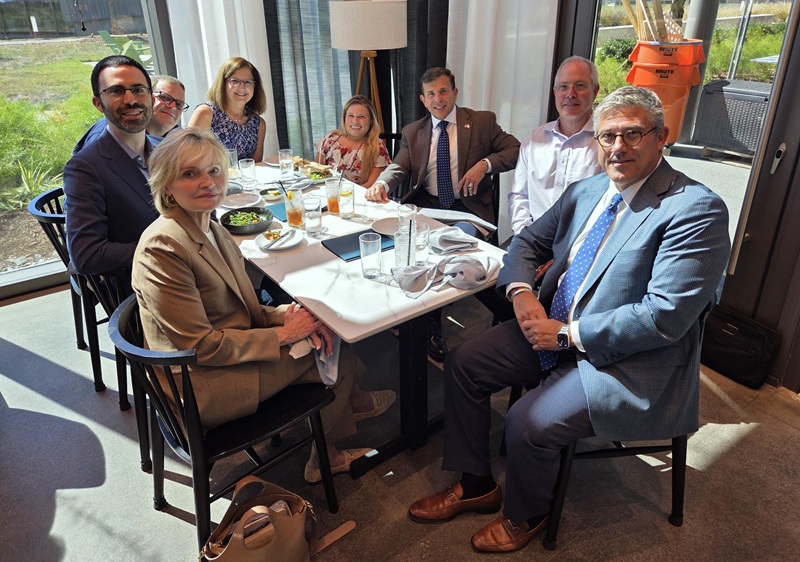
BIO also hosted a luncheon with patient advocates from across the state and met with Rep. Ross, who represents the RTP area, at Biogen’s impressive manufacturing campus, which has roots dating back 30 years in the area.
Rep. Ross sits on the House Judiciary Committee and has authored and supported several bills promoting IP and biotech.
Ross recently cosponsored H.R. 6089, the Biomanufacturing Excellence Act of 2025 which would establish a public-private partnership to allow innovators to scale their products in the U.S. with smarter, faster, more efficient manufacturing practices. The bill was inspired by recommendations from the National Security Commission on Emerging Biotechnology’s April 2025 Action Plan for Congress.
“I’m proud to represent North Carolina’s Research Triangle, where universities, startups, and major institutions are constantly pushing the boundaries of what’s possible,” Rep. Ross said. “That’s why I was grateful to visit Biogen’s RTP campus in Morrisville for an important discussion about the future of biomanufacturing in North Carolina. Biomanufacturing is a pillar of our economy and workforce, creating good-paying jobs and attracting some of the brightest minds to our community. It’s more important than ever that we develop new medications here at home that are accessible and affordable.”
‘Bipartisan support for biotech’
In her work on IP, Rep. Ross has collaborated with another North Carolina legislator, Sen. Thom Tillis (R-NC), according to Laura Gunter, President of NCLifeSci, BIO’s affiliate in the state.
Gunter praised the pro-biotech work of North Carolina’s federal delegation in general. Reps. Gregory Murphy, M.D. (R-NC), Don Davis (D-NC), and Richard Hudson (R-NC) introduced the EPIC Act, designed to give small molecules the same protection from drug price negotiations as biologics. Tillis and Sen. Ted Budd (R-NC) co-sponsored EPIC in the Senate.
“Given the high level of biotech employment, the importance of the industry’s supply chain and research activities around the state, we see a lot of good bipartisan support for biotech from our federal delegation,” said Gunter.
She said NCLifeSci receives assistance and guidance from BIO when addressing federal issues that matter for North Carolina. These include: federal funding for the state’s top-tier research (R1) universities; SBIR federal seed funding for early-stage research; and national security priorities outlined by the NSCEB, Gunter said.
Founded in the early 1990s, NCLifeSci has focused on state policy affecting biotech.
“We’ve been able to have a real impact on the industry overall on the state level,” said Gunter. This has included “being one of the first states to really incorporate a matching fund for federal SBIR dollars,” getting state support for workforce development training programs, and tax incentives.
NCLifeSci was instrumental in establishing the NC Life Sciences Caucus, made up of lawmakers from both parties in both the state House and state Senate. Among its pro-biotech efforts, the Life Sciences Caucus supported the introduction of the first omnibus life sciences appropriation bill for inclusion in the state budget, NCLifeSci helped write the bill.
“Measures that matter to the industry were grouped in an omnibus package with the goal of saying, here’s a number of areas where the state can contribute to North Carolina’s life sciences,” Gunter said.
The pro-biotech policy environment and the existence of institutions like NCBiotech help North Carolina build one of the country’s leading biotech ecosystems, according to Gunter. Other attributes of that ecosystem include five R1 research universities, a broad range of small biotechs, a large concentration of clinical research organizations, and manufacturers—from major pharma firms to contract development manufacturing organizations.
“So we have the full soup-to-nuts of the biotech ecosystem, and it really works well together,” Gunter said.
Biogen’s growth
BIO’s team joined Rep. Ross for a tour of the RTP facilities of BIO member Biogen, a leading biotech company developing innovative treatments in neurology, immunology, and rare diseases. With more than 1,500 manufacturing and technical employees and more than 400 skilled contractors, Biogen is the largest biotech employer in North Carolina, and they’re still growing.
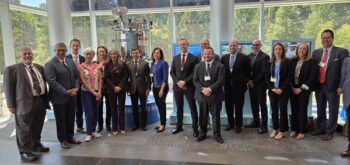
“Biogen announced a $2 billion investment in our existing Research Triangle Park (RTP), North Carolina manufacturing footprint in July 2025, and we’ve continued to progress this multi-project strategic investment plan since our announcement,” said Nicole Murphy, Biogen Executive Vice President and Head of Pharmaceutical Operations and Technology. “This year, Biogen’s facility in RTP has executed approximately $200 million year-to-date, supporting progress across multiple modality expansions, including a new ASO (antisense oligonucleotide) purification factory and additional synthesis capabilities.”
The expansion will also add new clinical product assembly and packaging capabilities, utility, environmental, and infrastructure improvements, continued digitalization and AI-enabled roadmap deployment, and initial engineering work for future biologics, fill-finish, lyophilization, and oral solid dose capabilities.
“The work happening here is helping Biogen reliably produce medicines for patients today while also building the capabilities we will need for the future,” Murphy said. “Given recent acquisitions, we are also evaluating additional potential investment opportunities based on our late-stage portfolio.”
While Biogen is headquartered in Kendall Square in Cambridge, MA, and has a new facility in San Francisco, it mainly conducts its U.S. manufacturing in North Carolina.
“RTP has become our largest manufacturing footprint because it offers the right environment for advanced biomanufacturing,” Murphy said. “You have leading universities, research institutions, life sciences companies and a deep technical workforce all in one region.”
Biogen is not just a beneficiary of the biotech expertise in RTP, it is also a major contributor to the ecosystem, Murphy noted.
“Biogen brings a large, established, and advanced manufacturing presence to RTP, along with continued investment in high-quality jobs, technical capabilities, and infrastructure. Our presence helps strengthen the broader life sciences ecosystem by creating opportunities for collaboration, training, and workforce development,” Murphy said. “We also work with local institutions and programs to help build pathways into biotech manufacturing careers, which is important both for Biogen and for the region’s long-term growth.”
Biogen’s North Carolina expansion is just one of several announced recently. Others include:
- BIO member Genentech said it is planning to invest $2 billion in its first East Coast manufacturing facility in Holly Springs, NC.
- BIO member Novartis said in November it will build a flagship manufacturing hub in North Carolina, which will create an additional 700 jobs.
- AbbVie announced plans for a $1.4 billion manufacturing facility in North Carolina in April.
“North Carolina’s biotech sector is rooted in a long tradition of innovation, and its momentum continues to grow,” Crowley observed.
The post BIO on the American Road visits pioneering NC biotech hub appeared first on Bio.News.
Apa Reaksi Anda?
 Suka
0
Suka
0
 Kurang Suka
0
Kurang Suka
0
 Setuju
0
Setuju
0
 Tidak Setuju
0
Tidak Setuju
0
 Bagus
0
Bagus
0
 Berguna
0
Berguna
0
 Hebat
0
Hebat
0