





















































%20and%20Batch%20Production%20Records%20(BPR).png)
















Targeted Lentiviral Delivery Without Vector Reengineering
Sponsored content brought to you by

VSV-G is the surface glycoprotein of the vesicular stomatitis virus. VSV-G-pseudotyped lentiviral vectors are widely used for gene delivery, offering broad tropism, substantial transgene cargo capacity, and ease of production. But broad native tropism presents a challenge for targeted delivery, which has traditionally required engineering the viral envelope itself.
Vyriad’s novel G-Link targeting platform takes a different approach. Rather than requiring genetic modification of the viral glycoprotein, G-Link uses a modular protein adaptor to blind native VSV-G tropism and redirect delivery after vector production.
A modular protein adaptor
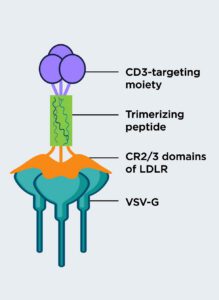
- G-Link comprises three functional elements (see Fig. 1):
- Cysteine-rich (CR) domains derived from the low-density lipoprotein receptor (LDLR) interact with the receptor-binding domain of VSV-G, masking its native LDLR tropism.
- A trimerizing peptide positions these domains to complement the trimeric architecture of VSV-G on the vector surface, significantly improving blinding compared with a monomeric adaptor.
- Finally, a CD3-targeting moiety redirects vector binding toward T cells.
Together, these elements effectively cap VSV-G, simultaneously suppressing its native tropism and introducing new cell specificity without genetically modifying the glycoprotein. G-Link is compatible with VSV-G-pseudotyped lentiviral and gamma-retroviral vectors as well as virus-like particles, providing a flexible platform for post-production retargeting.
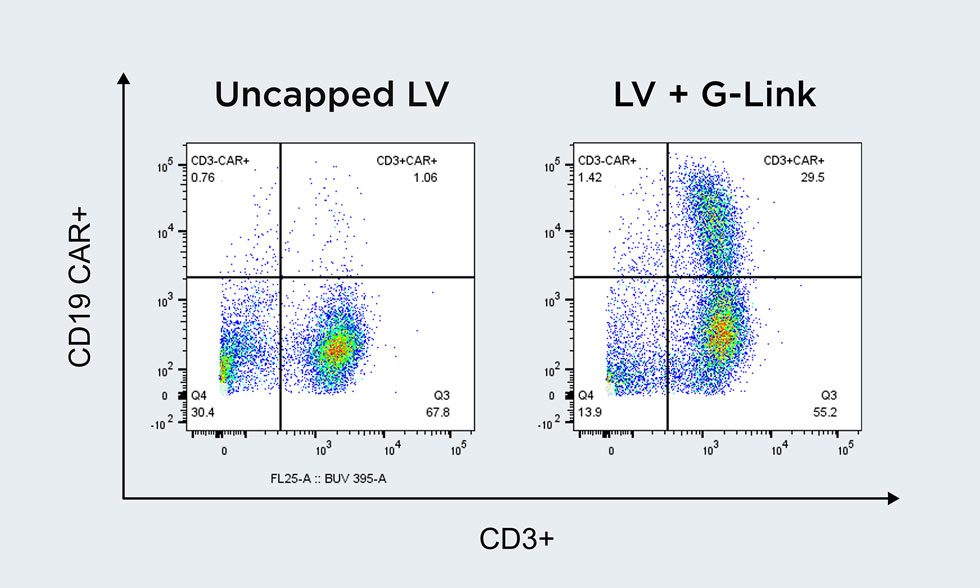
When VSV-G-pseudotyped lentiviral vectors carrying a CD19 chimeric antigen receptor (CAR) were pre-mixed with G-Link and applied directly to peripheral blood mononuclear cells (PBMCs), CAR delivery in T cells was dramatically improved (Fig. 2). This reflects G-Link’s ability to both target and activate these cells, supporting efficient transduction without prior isolation or bead-based stimulation. T-cell-specific delivery is also maintained in human whole blood, an important requirement for systemic in vivo administration.
Stable retargeting for systemic delivery
For systemic applications, G-Link must remain bound to VSV-G after administration, as dissociation could restore the vector’s broad native tropism and increase the potential for off-target transduction. At physiological calcium concentrations, the interaction between G-Link and VSV-G is remarkably stable. G-Link remains associated with the vector through multiple freeze-thaw cycles and tangential flow filtration, as well as following intravenous administration and systemic circulation in mice.
At the same time, G-Link binding is reversible under low-calcium conditions, allowing release as the vector enters the endosomal environment.
This combination of blinding and retargeting has translated into preclinical in vivo safety and efficacy. In a mouse model of multiple myeloma, G-Link-capped lentiviral vectors encoding a B-cell maturation antigen (BCMA) CAR generated CAR T cells in vivo and produced complete tumor clearance in treated animals without notable signs of toxicity. In contrast, uncapped vectors and G-Link alone failed to control tumor burden or substantially prolong survival.
One platform, multiple opportunities
G-Link can simplify ex vivo T-cell engineering by combining targeting, activation and transduction, while also enabling targeted T-cell delivery in vivo through a simple post-production mixing step.
While the current G-Link adaptor targets CD3, its modular architecture provides a foundation for future adaptors directed toward additional cell types—without requiring each new targeting strategy to begin with glycoprotein reengineering.
 Interested in testing G-Link in your research?
G-Link is available for research use only. Vyriad is currently offering free evaluations to qualified researchers.
Scan the QR code to explore additional technical data and request an evaluation for your lab.
www.vyriad.com/g-link-proteins/
The post Targeted Lentiviral Delivery Without Vector Reengineering appeared first on GEN - Genetic Engineering and Biotechnology News.
Apa Reaksi Anda?
 Suka
0
Suka
0
 Kurang Suka
0
Kurang Suka
0
 Setuju
0
Setuju
0
 Tidak Setuju
0
Tidak Setuju
0
 Bagus
0
Bagus
0
 Berguna
0
Berguna
0
 Hebat
0
Hebat
0