





























Fear in laying hens: causes, consequences and management strategies
By Cloude Shao, Ruth Demree, Richard Blatchford, PhD, University of California, Davis
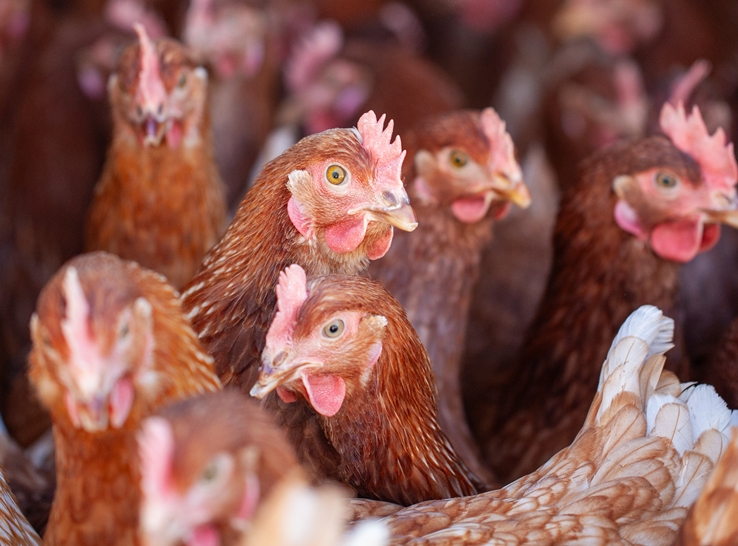
In nature, fear protects animals from danger. In commercial settings, domestic laying hens are shielded from most fear-inducing stimuli, such as predators and unfamiliar situations. Therefore, fear serves as an aversive experience for the hens themselves and leads to undesired behaviors for producers.
Fear tests can provide information on how hens perceive their environment, allowing farmers and researchers to better understand these animals and provide the proper management to improve their welfare (see Poultry Press Vol. 33). This article discusses what we know about fear and its impact on laying hen behavior and welfare.
What is Fear?
Fear is a negative emotional state. In the wild, the aversive experience of fear prepares an animal to respond to perceived dangers by either engaging or escaping (fight or flight response) (Carli & Farabollini, 2022). While domesticated animals tend to show a reduced fear response due to selection for tameness, they can still experience fear similar to their wild ancestors (Jensen et al., 2005).
Even though domestic laying hens are protected from predation, they can still perceive humans or objects in the environment as dangers (Ferreira et al., 2025). The experience of fear is negative and although fear can still help birds respond to perceived threats in their environment, frequent or intense fear in captivity can reduce welfare and create management problems. Being fearful can also lead to behavioral issues that harm individual hens or their flock mates. For example, injurious feather pecking is associated with fearfulness. Chicks that are more fearful are slower to explore a novel environment or a novel object and more likely to develop injurious feather pecking as adults (Jensen et al., 2005; Rodenburg et al., 2004).
Fearful hens are also prone to panic and will try to escape or move away from the perceived danger. During escape attempts, fractures can happen when the hens collide with structures in their housing system or each other. This can be especially dangerous when the birds are housed in large flocks. When fear triggers the movement of a large flock, smothering can occur due to piling of the startled hens (Barrett et al., 2014; Gray et al., 2020). For more information about piling and smothering, see PEC Vol. 30. Lastly, experiencing fear can increase distress in laying hens, which can impact their growth, production and mortality (Barnett et al., 1994; Cockrem, 2007).
Development and Early Life Experience
Since the late 1950s, behavioral researchers have been studying the development of the fear response in laying hens. Tonic immobility (a fear response where the bird lies stationary; Figure 1), can be induced in chicks as early as 1-day post-hatch, which implies that fear is innate (Andrew & Brennan, 1983; Jaynes, 1958; Salzen, 1963; 1966).
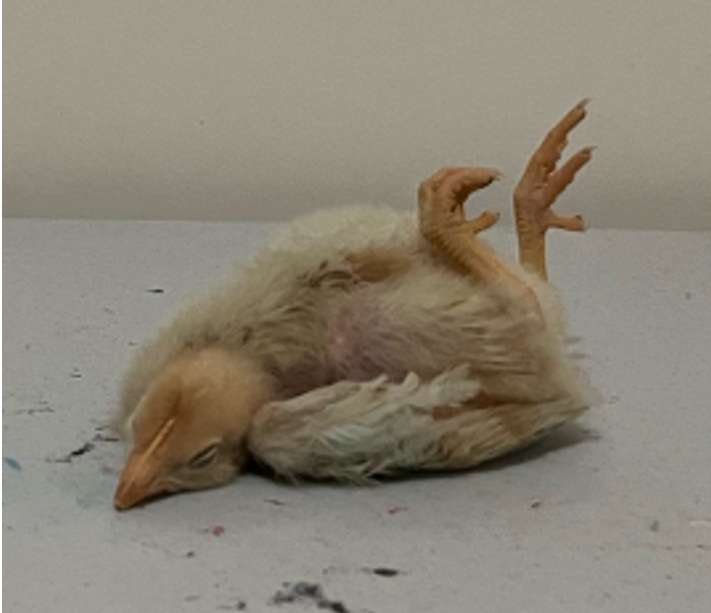
Figure 1: Laying hen pullet in tonic immobility at 4 weeks old. Photo credit: Cloude Shao.
The fear response is also shaped by the environment. For example, a hen’s fear response can be reduced over time if exposed repeatedly to a fear-inducing stimulus, such as loud noise. This process is called habituation and has been observed in both layers and broilers (Ratner & Thompson, 1960; Jones, 1977; Jackson et al., 2025).
Strain Differences
Domestication has generally resulted in reduced fear in laying hens. If physically restrained by a rope around their feet, the ancestral red junglefowl will engage in more active fear responses than domestic hens, such as increased pecking at the restraining rope and vocalizing more (Schütz et al., 2001).
Fear responses are influenced by genetics. In general, white-feathered strains display more fear-related behavior than brown-feathered strains. White-feathered birds will remain in tonic immobility for longer periods of time (Albentosa et al., 2003), flee from an approaching human sooner, and take longer to approach a novel object or emerge from a shelter (Nelson et al., 2020). Overall, white and brown-feathered layers seem to adopt differing strategies in response to threats. Brown layers engage in more active responses, such as fighting back or attempting to escape, while white layers engage in more passive responses, such as freezing or remaining in tonic immobility longer (Brown et al., 2022).
There are also differences within similarly colored strains. For example, Tetra layers, a brown-feathered hen, will develop a progressively shorter tonic immobility response over time, but ISA Browns will not (Hocking et al., 2001).
Individual Differences
Differences in fear responses can also be observed at the individual level (Figure 2). During field observations on free-range farms, some hens ran away from an aerial predator while others approached and attacked. There were even instances of hens approaching the bird of prey (coming within 1 meter) and foraging nearby while it was consuming the kill (Bestman & Bikker-Ouwejan, 2020).
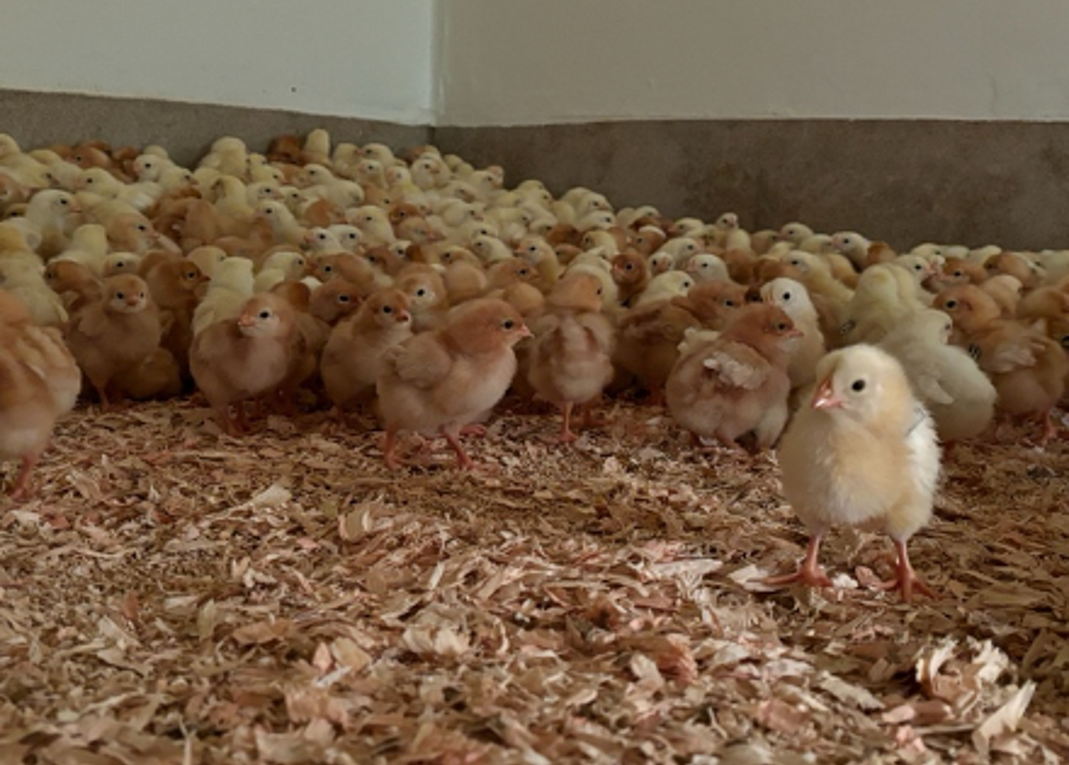
Figure 2: Laying hen pullets demonstrate an avoidance of humans from an early age. Strain and individual differences shape the fear response. Photo credit: Ruth Demree.
In standardized fear tests like the tonic immobility test, individual hens will differ in their response, and these differences persist over time. Further, an individual’s response to tonic immobility tests is associated with other behavioral responses, such as their response when isolated from the flock. This indicates that individual hens differ in their coping strategies (Ghareeb & Bohm, 2008), which has management implications.
Strategies to Reduce Fear
Fear behavior can be reduced in a domestic environment. Several strategies for reducing fear are listed below. As fear can be influenced by environment, individuals, and genetics generally, reduction often requires a combination of strategies.
Early-life environment:
- Provide environmental complexity from an early age, such as environmental enrichment, perches, dustbathing and foraging areas.
- Maintain a predictable routine to encourage habituation.
Stockmanship:
- Maintain a calm demeanor when engaging with the hens.
- Limit the use of physical restraint.
- Use panels to guide/separate hens without chasing them.
Housing Design:
- Provide a consistent environment, for instance by minimizing loud noises, avoiding drastic lighting changes, and by knocking or calling before entry.
- Be aware of potential risk factors within enclosures. For example, multi-tier aviary structures can be the source of collisions, leading to injury.
Strain selection:
- Work with breeder companies to find the right strain and temperament for your housing and management style.
Summary
- Laying hens can experience fear from an early age.
- Fear negatively affects hen welfare.
- Early life experience, strain, and individual differences impact the development of fear in laying hens.
- Fear behavior can be reduced, but often requires a multi-pronged strategy.
References
Albentosa, M. J., Kjaer, J. B., & Nicol, C. J. (2003). Strain and age differences in behaviour, fear response and pecking tendency in laying hens. British Poultry Science, 44(3), 333–344. https://doi.org/10.1080/00071660310001598085
Barnett, J. L., Hemsworth, P. H., Hennessy, D. P., McCallum, T. H., & Newman, E. A. (1994). The effects of modifying the amount of human contact on behavioural, physiological and production responses of laying hens. Applied Animal Behaviour Science, 41(1), 87–100. https://doi.org/https://doi.org/10.1016/0168-1591(94)90054-X
Barrett, J., Rayner, A. C., Gill, R., Willings, T. H., & Bright, A. (2014). Smothering in UK free‐range flocks. Part 1: Incidence, location, timing and management. Veterinary Record, 175(1), 19–19. https://doi.org/10.1136/vr.102327
Bestman, M., Verwer, C., Van Niekerk, T., Leenstra, F., Reuvekamp, B., Amsler-Kepalaite, Z., & Maurer, V. (2019). Factors related to free-range use in commercial laying hens. Applied Animal Behaviour Science, 214, 57–63. https://doi.org/10.1016/j.applanim.2019.02.015
Brown, A. A., Sobotik, E. B., House, G. M., Nelson, J. R., & Archer, G. S. (2022). Differences in fear response strategy and stress susceptibility amongst four different commercial layer strains reared cage free. Frontiers in Physiology, 13. https://doi.org/10.3389/fphys.2022.943471
Carli, G., & Farabollini, F. (2022). Introduction to defensive behavior in vertebrates. In Progress in Brain Research (Vol. 271, Issue 1, pp. 37–49). Elsevier. https://doi.org/10.1016/bs.pbr.2022.02.002
Cockrem, J. F. (2007). Stress, corticosterone responses and avian personalities. Journal of Ornithology, 148(S2), 169–178. https://doi.org/10.1007/s10336-007-0175-8
Ferreira, V. H. B., Lansade, L., & Calandreau, L. (2025). How do domestic chickens perceive humans—And why does it matter? World’s Poultry Science Journal, 0(0), 1–22. https://doi.org/10.1080/00439339.2025.2597741
Ghareeb, K., & Bohm, J. (2008). Fear Behaviour, Ease of Capture and PerformanceTraits of Growing Meat Type Chickens. International Journal of Poultry Science, 7(12), 1185–1189. https://doi.org/10.3923/ijps.2008.1185.1189
Gray, H., Davies, R., Bright, A., Rayner, A., & Asher, L. (2020). Why Do Hens Pile? Hypothesizing the Causes and Consequences. Frontiers in Veterinary Science, 7, 616836. https://doi.org/10.3389/fvets.2020.616836
Hocking, P. M., Channing, C. E., Waddington, D., & Jones, R. B. (2001). Age-related changes in fear, sociality and pecking behaviours in two strains of laying hen. British Poultry Science, 42(4), 414–423. https://doi.org/10.1080/00071660120070686
Jackson, A., Quino, M., Gautam, A., Gilpin, M., Still, K., Landers, D., & Baker-Cook, B. (2025). The impact of multiple exposures and movement on the fear response of poultry. Poultry Science, 104(1), 104594. https://doi.org/https://doi.org/10.1016/j.psj.2024.104594
Jensen, P., Keeling, L., Schütz, K., Andersson, L., Mormède, P., Brändström, H., Forkman, B., Kerje, S., Fredriksson, R., Ohlsson, C., Larsson, S., Mallmin, H., & Kindmark, A. (2005). Feather pecking in chickens is genetically related to behavioural and developmental traits. Physiology & Behavior, 86(1–2), 52–60. https://doi.org/10.1016/j.physbeh.2005.06.029
Jones, R. B. (1977). Repeated exposure of the domestic chick to a novel environment: Effects on behavioural responses. Behavioural Processes, 2(2), 163–173. https://doi.org/https://doi.org/10.1016/0376-6357(77)90018-3
Nelson, J. R., Settar, P., Berger, E., Wolc, A., O’Sullivan, N., & Archer, G. S. (2020). Brown and white egg-layer strain differences in fearfulness and stress measures. Applied Animal Behaviour Science, 231, 105087. https://doi.org/10.1016/j.applanim.2020.105087
Ratner, S. C. (1967). Annelids and Learning: A Critical Review. In W. C. Corning & S. C. Ratner (Eds.), Chemistry of Learning (pp. 391–406). Springer US. https://doi.org/10.1007/978-1-4899-6565-3_24
Rodenburg, T. B., Buitenhuis, A. J., Ask, B., Uitdehaag, K. A., Koene, P., Van Der Poel, J. J., Van Arendonk, J. A. M., & Bovenhuis, H. (2004). Genetic and Phenotypic Correlations Between Feather Pecking and Open-Field Response in Laying Hens at Two Different Ages. Behavior Genetics, 34(4), 407–415. https://doi.org/10.1023/B:BEGE.0000023646.46940.2d
Schütz, K. E., Forkman, B., & Jensen, P. (2001). Domestication effects on foraging strategy, social behaviour and different fear responses: A comparison between the red junglefowl (Gallus gallus) and a modern layer strain. Applied Animal Behaviour Science, 74(1), 1–14. https://doi.org/10.1016/S0168-1591(01)00156-3
To view all issues of Poultry Press, click here.
Editor’s note: Content on Modern Poultry’s Industry Insights pages is provided and/or commissioned by our sponsors, who assume full responsibility for its accuracy and compliance.
The post Fear in laying hens: causes, consequences and management strategies appeared first on Modern Poultry.
Apa Reaksi Anda?
 Suka
0
Suka
0
 Kurang Suka
0
Kurang Suka
0
 Setuju
0
Setuju
0
 Tidak Setuju
0
Tidak Setuju
0
 Bagus
0
Bagus
0
 Berguna
0
Berguna
0
 Hebat
0
Hebat
0