

































Study suggests H5N1 D1.1 circulated before its first detection in North America

By the time the H5N1 D1.1 genotype was first detected in the Pacific Flyway during the autumn of 2024, it had probably already been circulating in North American wild birds before it was identified through routine surveillance.
That is the conclusion of a new study published in Emerging Infectious Diseases, in which researchers reconstructed the early expansion of the virus using genomic data from wild birds across the United States. Their findings suggest that D1.1 became established during the summer of 2024 before it was identified through routine surveillance.
D1.1 subsequently became the predominant clade 2.3.4.4b genotype detected in wild birds and domestic poultry in the United States. The genotype has also been responsible for several confirmed human infections in the country, including a fatal case reported in Louisiana.
To investigate how the genotype emerged, the researchers combined wildlife surveillance carried out in Arizona with publicly available H5N1 genome sequences from across the United States. Their analyses estimated that the common ancestor of the circulating D1.1 viruses dates to late June or mid-July 2024, while divergence from its closest known ancestor likely occurred several months earlier. According to the authors, this timeline is consistent with a period of undetected circulation before the virus entered routine surveillance.
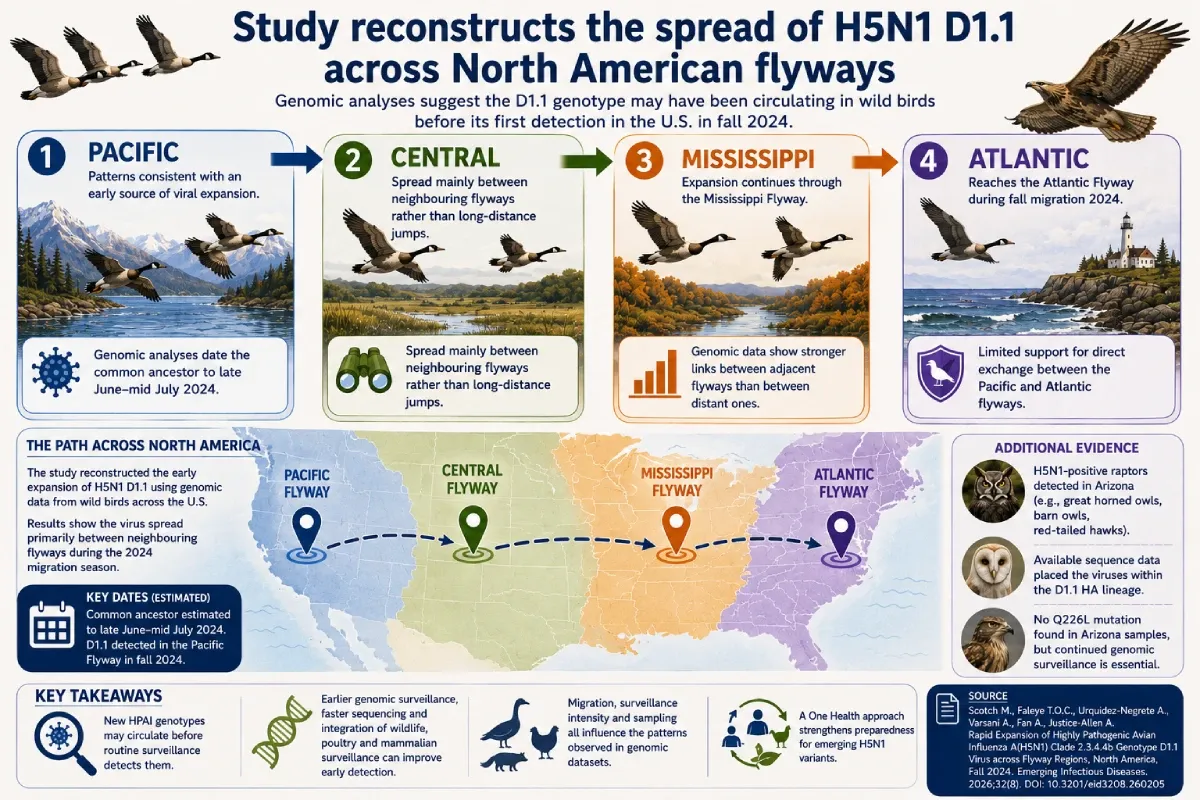 The genomic reconstruction also provides a clearer picture of how the virus spread across North America. Rather than moving directly between distant regions, D1.1 appears to have expanded mainly between neighbouring migratory bird flyways. The Pacific Flyway showed patterns consistent with an early source of viral expansion, followed by movement into the Central and Mississippi flyways before the genotype reached the Atlantic Flyway later in the 2024 autumn migration season. The analyses found only limited support for direct exchange between the Pacific and Atlantic flyways.
The authors caution that flyways should not be interpreted as transmission routes in themselves. Instead, they provide a geographical framework for describing broad patterns of virus movement. Migration, surveillance intensity and sampling all contribute to the distribution observed in genomic datasets. Even so, the analyses consistently showed stronger links between neighbouring flyways than between those separated by greater distances.
Wildlife surveillance in Arizona provided additional evidence consistent with the broader genomic reconstruction. H5N1-positive birds included several raptor species, among them great horned owls, barn owls and red-tailed hawks. Although incomplete genome coverage prevented definitive genotype assignment, the available sequence data placed these viruses within the same haemagglutinin lineage as D1.1.
The researchers also examined mutations in the haemagglutinin (HA) protein. None of the Arizona samples carried the Q226L substitution, a mutation that experimental studies have associated with altered binding to human-type receptors. Nevertheless, the authors emphasise that continued genomic surveillance remains essential to detect genetic changes that could influence the biological characteristics of emerging H5N1 viruses.
Beyond reconstructing the emergence of a single genotype, the study highlights a broader surveillance challenge. New HPAI variants may circulate for a period before they are recognised through routine monitoring. The authors conclude that earlier genomic surveillance, faster sequencing and closer integration of wildlife, poultry and mammalian surveillance within a One Health framework could improve the early detection of newly emerging H5N1 genotypes.
Source: Scotch M., Faleye T.O.C., Urquidez-Negrete A., Varsani A., Fan A., Justice-Allen A. Rapid Expansion of Highly Pathogenic Avian Influenza A(H5N1) Clade 2.3.4.4b Genotype D1.1 Virus across Flyway Regions, North America, Fall 2024. Emerging Infectious Diseases, Vol. 32, No. 8, August 2026.
Apa Reaksi Anda?
 Suka
0
Suka
0
 Kurang Suka
0
Kurang Suka
0
 Setuju
0
Setuju
0
 Tidak Setuju
0
Tidak Setuju
0
 Bagus
0
Bagus
0
 Berguna
0
Berguna
0
 Hebat
0
Hebat
0