
































The Role of Functional Feed Additives in Enhancing Aquaculture Sustainability
By Aquaculture Magazine Editorial Team
Beyond every successful harvest lies a delicate equilibrium between high productivity and… ecological integrity. Functional feed additives like probiotics and prebiotics are currently redefining the industry by significantly enhancing growth, immunity, and feed efficiency. Adopting these “superfoods” allows producers to reduce reliance on wildcaught fish meal and antibiotics, securing a breakthrough for both longterm profitability and global environmentalstewardship.
Aquaculture is the fastestgrowing sector in global food production and plays a crucial role in food security protein supply, and livelihoods while reducing pressure on wild fisheries. However, its sustainability is increasingly questioned due to environmental, economic, and biological challenges. Sustainable aquaculture requires efficient management of resources to ensure longterm productivity while maintaining ecological balance.
One major issue is the heavy dependence on fish meal and fish oil in feed, much of which is derived from wildcaught fish. This not only increases production costs, with feed accounting for 40-60% of expenses, but also contradicts the goal of reducing pressure on natural ecosystems. Additionally, disease outbreaks caused by pathogens such as viruses, bacteria, and parasites pose serious threats to productivity and profitability. Environmental concerns also arise from the discharge of nutrient-rich effluents, which can damage aquatic ecosystems.
To address these challenges, several strategies have been explored. Alternative protein sources, such as plant-and insect-based ingredients, aim to reduce reliance on fish meal, although they may affect growth and nutrient stability.
Technologies like integrated multitrophic aquaculture (IMTA), recirculating aquaculture systems (RAS), and aquaponics help reduce environmental impact by recycling nutrients and treating wastewater. However, these approaches also face limitations, including technical complexity and inconsistent results.
Functional feed additives (FFAs) have emerged as a promising solution. These include prebiotics, probiotics, microalgae, and enzymes that enhance growth, immunity, and feed efficiency while reducing stress and disease susceptibility. Despite their potential, their application remains underdeveloped, and further research is needed to optimize their use and fully integrate them into sustainable aquaculture systems.
Functional feed additives (FFAs) like probiotics and phytogenics improve weight gain and nutrient utilization. Lowering feed conversion ratios (FCR) reduces production costs and nutrient waste, directly enhancing aquaculture’s economic and environmental sustainability.
Objectives and Methodology
The specific objectives of this study were:
a) Itemize some common FFAs and their contribution to aquaculture sustainability; and
b) Identify challenges associated with the use of FFAs.
Materials for this study were sourced from print books and different scholarly sites using various web browsers, including Google Chrome, Mozilla Firefox, Opera Browser, and Microsoft Edge. However, the literature used in this study was more webbased. The databases from which the literature was sourced include Science Direct, Research Gate, Wiley Oline Library, SABINET, and SpringerLink.
This review did not restrict literature reports on FFAs to specific locations/regions to obtain detailed information on the subject area.
Probiotics, prebiotics, and phytogenics boost immune parameters, including lysozyme activity and phagocytosis. These additives increase survival rates after pathogen exposure, offering a safe, preventive alternative to traditional antibiotics in intensive systems.
Some Common FFAs in Aquaculture
FFAs play a key role in improving aquaculture sustainability by enhancing growth, health, and feed efficiency in aquatic organisms. Among the most common additives are probiotics, prebiotics, and phytogenics, each contributing differently to host performance and environmental balance.
Probiotics
Probiotics are live microorganisms that benefit aquatic animals by improving microbial balance, nutrient utilization, disease resistance, and environmental quality. Unlike terrestrial systems, their interaction with aquatic species occurs both in the gut and in the surrounding water. They can be administered through feed or directly into the water and must be nonpathogenic, resistant to digestive conditions, and capable of colonizing the host.
Probiotics enhance immune response, growth, digestion, and nutrient production such as vitamins. They include bacteria, microalgae, and yeasts and can be classified based on origin, composition, and function.
Prebiotics
Prebiotics are non-digestible compounds, mainly oligosaccharides, that stimulate beneficial gut microorganisms. They function as energy sources for probiotics and must resist digestion to reach the colon. Their benefits arise from fermentation by gut bacteria, improving immunity and overall health. However, their effectiveness depends on the presence of compatible microbiota, making mixed formulations preferable.
Common prebiotics include mannan oligosaccharide (MOS), fructooligo-saccharides (FOS), galactooligosaccharide (GOS), arabinoxylan oligosaccharide (AXOS), inulin, and β-glucan. They are widely found in natural sources such as plants and microalgae and face fewer regulatory restrictions than probiotics.
Phytogenics
Phytogenics are plant-derived additives used in various forms, including extracts and essential oils. They stimulate appetite, improve gut health, and provide antimicrobial, antioxidant, and antiparasitic effects. Their bioactive compounds, such as phenols and flavonoids, contribute to these benefits. Examples include garlic, thyme, oregano, and neem. However, their effectiveness varies depending on plant source, extraction method, and dosage, requiring careful application to avoid toxicity.
FFAs enable the replacement of wild-caught fish meal with alternative proteins like soybean meal. Improving digestibility and nutrient absorption reduces dependence on natural ecosystems, promoting a circular and sustainable protein supply.
Aquaculture and Its Sustainability Issues
Aquaculture sustainability includes economic, environmental, and social dimensions. Challenges include high production costs, disease outbreaks, environmental pollution, and resource overexploitation. Additionally, habitat conversion and ecosystem disruption raise social concerns. Addressing these issues is essential for ensuring long-term viability and responsible aquaculture development.
FFA and Their Sustainability Roles
FFA contributes significantly to aquaculture sustainability by improving feed efficiency, supporting resource utilization, enhancing immunity, controlling parasites, and improving water quality. These roles collectively reduce environmental impact and increase productivity.
Feed efficiency improvement
Feed efficiency, measured by feed conversion ratio (FCR), reflects how effectively feed is converted into biomass. Lower FCR values indicate better performance. FFAs such as probiotics, prebiotics, and phytogenics improve growth, weight gain, and nutrient utilization. Studies show that probiotic supplementation enhances growth performance, although results depend on dosage, species, and strain.
In some case, symbiotics (probiotics + prebiotics) provide greater benefits than individual additives. Similarly, phytogenics like garlic and essential oils improve growth indicators. These improvements occur through enhanced digestion, enzyme production, appetite stimulation, and immune support. Better feed efficiency reduces production costs and minimizes nutrient waste, lowering environmental impact.
Sustainable resource utilization
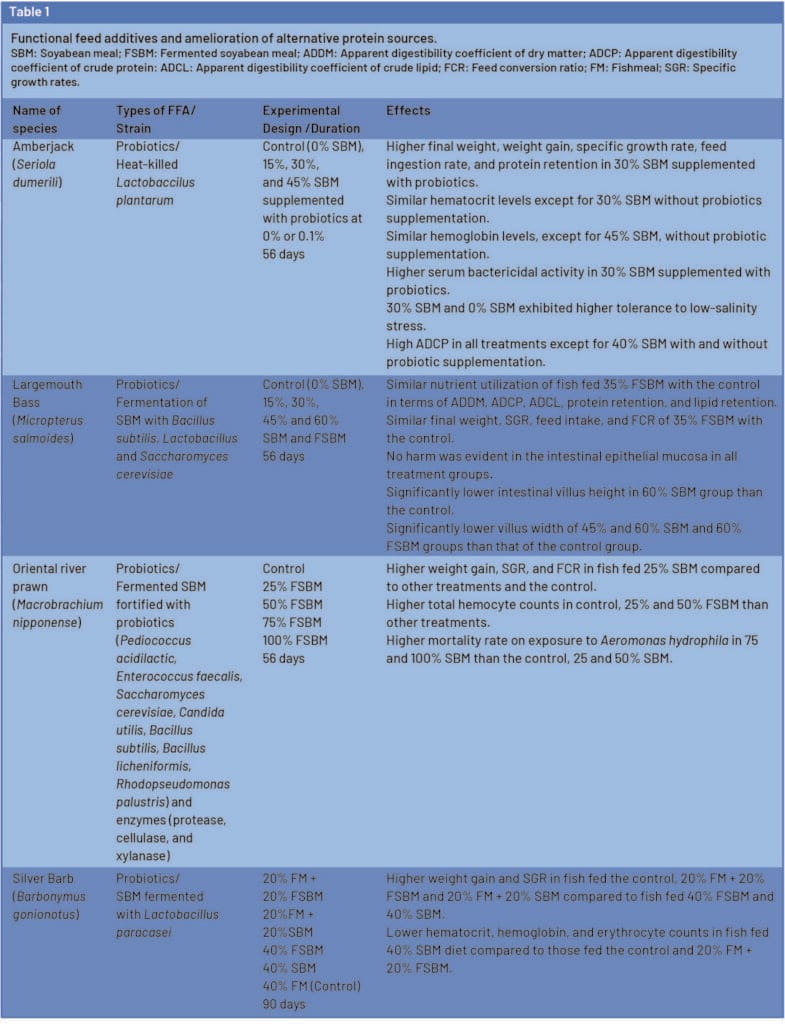
Aquaculture heavily depends on fishmeal and fish oil, which are sourced from wild fish, creating sustainability concerns. FFAs enable the use of alternative protein sources, such as soybean meal (SBM), by improving digestibility and reducing antinutritional effects. Studies show that SBM supplemented with FFAs can replace fishmeal at higher levels without compromising growth (Table 1). In some cases, total fishmeal replacement is possible, though immune function may be affected. Overall, FFAs enhance nutrient utilization, reduce dependence on wild resources, and lower feed costs, promoting sustainability.
Enhanced disease resistance/ immunity
Disease outbreaks are a major challenge in aquaculture, often intensified by high stocking densities and environmental risks. Probiotics, prebiotics, and phytogenics enhance immune parameters such as lysozyme activity and phagocytosis, increasing survival after pathogen exposure. Symbiotics often provide the strongest immune benefits, although effectiveness depends on dosage and combinations (Table 1).
Antiparasitic
Parasite infestations reduce growth and increase mortality. Phytogenic additives provide natural antiparasitic effects, reducing infection rates and offering environmentally friendly alternatives to chemical treatments. Their effectiveness depends on dosage and duration of application.
Improved water quality
Aquaculture systems accumulate nutrients such as nitrogen and phosphorus, negatively affecting water quality. FFAs help reduce waste outputs and improve water parameters, including ammonia and nitrogen compounds. Probiotic supplementation has been shown to lower nutrient concentrations in water, improving environmental conditions and animal health. This leads to reduced stress, better growth, and more sustainable systems.
FFAs help lower nutrient concentrations, such as nitrogen and phosphorus, in aquaculture effluents. Probiotic supplementation improves water parameters and reduces animal stress, leading to cleaner production and minimized environmental footprints.
Adoption of FFAs
FFAs emerged to government restrictions on antibiotics, driving the need for safe and effective alternatives in aquaculture. Their development has progressed from research to field trials, followed by regulatory approval and commercialization. Today, numerous commercial products are available for different species and life stages, supporting growth, health and disease resistance.
The adoption of FFA has increased due to awareness among aquaculture practitioners through scientific research and industry outreach. Demand continues to grow, with projections indicating a steady annual increase driven by the need to improve productivity, profitability, and sustainability. These additives are widely used across species such as shrimp, carp, and catfish.
Geographically, FFA adoption is strongest in Asia, Europe, and North America, where aquaculture is well established. In countries like China, functional feeds are classified based on their purpose, including disease prevention and growth enhancement. Despite their benefits, high costs may limit adoption in developing regions.

Challenges Associated with FFAs
FFAs improve growth, health, and immunity in aquaculture but present several challenges. They increase production costs and require technical expertise for proper formulation and application. Regulatory approval for new additives can be complex and time-consuming. Stability issues due to environmental factors may affect effectiveness, though techniques like microencapsulation can help.
FFAs are mainly preventive, not curative, requiring continuous use. Palatability can also be affected, reducing feed intake if not properly balanced. Additionally, consumer perception and potential impacts on product taste may influence market acceptance. Concerns about antimicrobial resistance and overall effectiveness remain areas for further research.
Global demand for functional feeds is growing, driven by a need for productivity and profitability. Future research focuses on optimizing additive combinations and microencapsulation to overcome stability challenges and ensure consistent field performance.
Conclusions and Recommendations
This study expounds on the benefits of FFAs to aquaculture and how they help minimize the sustainability challenges associated with aquaculture. The various literature examined showed that the application of FFAs in aquaculture reduces stress, aids digestion, improves growth and water quality, increases the chances of survival of aquatic animals after exposure to infections, reduces parasitic infestation, and reduces the footprint of aquaculture on the environment.
Feed additives, which provide all these benefits, are a plus to the farmer as they increase profitability, reduce reliance on antibiotics, and mitigate the cost of purchasing antibiotics, together with other effects associated with their use.
All these benefits derived from FFAs make them superfoods. The initiative of FFAs remains a significant breakthrough for aquaculture; however, further research should be performed to determine the best FFA combination and quantity that would result in more benefits than those attained presently. FFAs are promising but not a complete solution.
Future research should explore natural disease treatments, optimize combinations, dosages, and application duration, and identify cost-effective options. Collaboration among researchers, industry, and regulators is essential to improve effectiveness and support sustainable adoption in aquaculture.
This is a summarized version developed by the editorial team of Aquaculture Magazine based on the review article titled “THE ROLE OF FUNCTIONAL FEED ADDITIVES IN ENHANCING AQUACULTURE SUSTAINABILIT)” developed by: Abigail John Onomu and Grace Emily Okuthe – Department of Biological & Environmental Sciences, Walter Sisulu University. The original article was published on MAY, 2024, through FISHES. The full version, including tables and figures, can be accessed online through this link: 167. https://doi.org/10.3390/fishes9050167
Apa Reaksi Anda?
 Suka
0
Suka
0
 Kurang Suka
0
Kurang Suka
0
 Setuju
0
Setuju
0
 Tidak Setuju
0
Tidak Setuju
0
 Bagus
0
Bagus
0
 Berguna
0
Berguna
0
 Hebat
0
Hebat
0