







































Using compost thermometers to improve compost efficiency, safety
By Zac Williams, PhD
Extension specialist – Poultry Husbandry and Management
University of Arkansas
Composting is a biological process that transforms organic materials such as manure, food waste and animal mortalities into a nutrient-rich soil amendment. On the outside, composting may appear like a simple process. However, successful composting depends on careful management of several factors, including, but not limited to, carbon, porosity and moisture.
Among these, temperature is perhaps the most crucial indicator of compost activity; we’ll look at why later in the article. A compost thermometer is a simple yet effective tool to monitor temperature and make informed management decisions.
Why compost temperature matters
You may find yourself asking, “Why does temperature matter in composting?” Temperature is an indicator of compost activity, telling you how well the bacteria inside the compost are performing.
As microorganisms break down organic matter, they generate heat as a byproduct of metabolism. When conditions are favorable, this heat builds up, raising the compost pile’s internal temperature.
Monitoring this temperature helps determine if the composting process is progressing efficiently. High temperatures indicate microbial activity and matter breakdown, extremely high temperatures indicate a potential fire hazard and low temperatures indicate that something is inhibiting the composting process.
For these reasons, compost temperatures must be maintained within an optimal range: about 120˚ F to 140˚ F (49˚ C to 60˚ C). This is the range at which organic matter breakdown is most efficient.
Compost thermometers
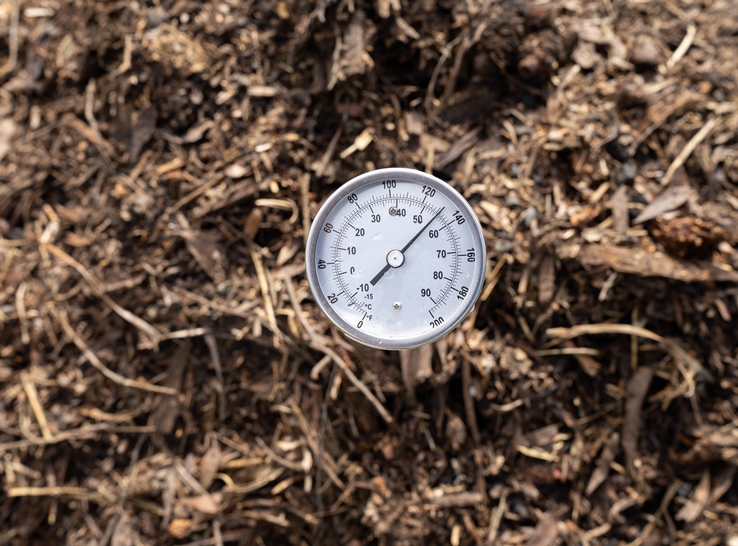
So, how do you know the temperature of the compost? You need a compost thermometer. Compost thermometers are designed to measure internal compost pile temperatures. Most compost thermometers consist of a long probe, 18 to 36 inches long, attached to a dial or digital display, with the very tip of the thermometer being the actual probe that measures temperature. This design allows users to measure temperatures deep within the pile without disturbing it.
Using a compost thermometer is incredibly simple. The probe should be inserted into the compost pile at a height and angle that reach the center of the pile, where temperatures are typically highest. Care should be taken to avoid accidentally putting the thermometer into the base, where temperatures will be low.
Compost piles go through several phases of activity: heating, cooling and curing. Without a thermometer to measure temperatures, there is no way of telling what phase a pile is in.
Temperature readings, when properly interpreted, can give valuable insight into compost conditions and overall performance. When temperatures rise into the thermophilic range, microbial activity is strong and decomposition is proceeding efficiently. Sustaining temperatures in this range is crucial for effective pathogen reduction.
If temperature never increases, increases slowly or stops increasing before reaching the thermophilic range, this indicates potential problems, such as improper moisture content, nutrient imbalance or poor aeration. Fortunately, these problems are fixable. But if you don’t measure temperature, you will have no way of knowing if there is a problem and what that problem might be.
Temperature trends
Temperature trends are equally as important as high or low temperatures. A decline in temperature after a thermophilic period indicates that readily available materials and oxygen have been consumed and that turning is needed to reinvigorate the process. Temperature trends are critical to the overall composting process and the final product, but that information would not be available without monitoring temperature.
Temperature monitoring is important when composting materials that may contain pathogens, such as manure, poultry litter and carcasses. Many state and federal guidelines specify exact temperatures and times that must be met to be considered safe. Without a compost thermometer, you would never know.
Not only is it crucial to have a compost thermometer and use it correctly, but it must also be calibrated regularly to ensure accuracy. Fortunately, calibration is quick and simple, requiring only a container, ice and water. The University of Arkansas poultry science Extension team has a quick instructional video on how to perform a calibration.
A compost thermometer is a simple, low-cost tool that provides valuable insight into the performance of a compost pile. Regular temperature monitoring and response to temperature changes give producers the opportunity to improve compost performance, enhance end-product quality and help control pathogens. Consistent use of temperature data supports sound decision-making and helps achieve reliable and repeatable compost outcomes across a wide range of operations.
The post Using compost thermometers to improve compost efficiency, safety appeared first on Modern Poultry.
Apa Reaksi Anda?
 Suka
0
Suka
0
 Kurang Suka
0
Kurang Suka
0
 Setuju
0
Setuju
0
 Tidak Setuju
0
Tidak Setuju
0
 Bagus
0
Bagus
0
 Berguna
0
Berguna
0
 Hebat
0
Hebat
0