






































































2026 report on biotech’s economic impact portrays a vast ecosystem
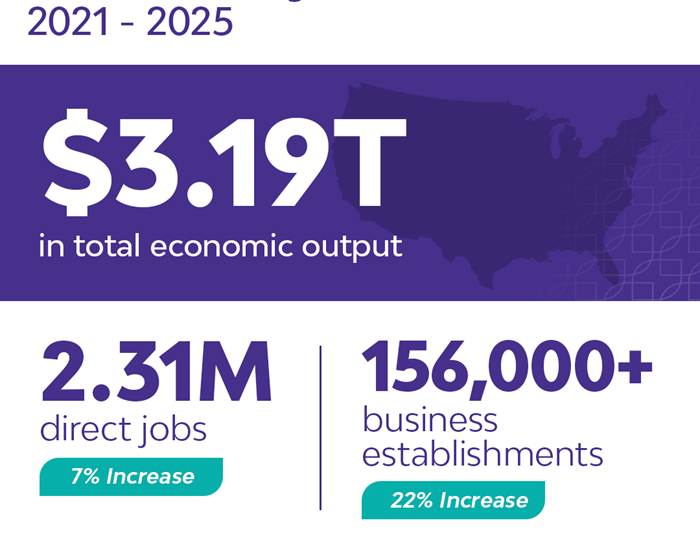
The latest portrait of America’s biotech industry describes a growing economic force responsible for $3.19 trillion in total U.S. economic output and employment of 2.31 million workers.
But the BIO/CSBA/TEConomy 2026 report, released Oct. 28, also details important, perhaps less-noticed trends. For example: Biomanufacturing employment grew at nearly 16% nationwide in 2021-25, with 26 states adding jobs and 16 of them growing by more than 20%. The report also includes eye-opening data on the broad geographic expansion of the clinical trial subsector, vital for innovators and patients.
This is the 12th edition of this overview of the biotech industry on the national, state and local levels. Produced every two years since 2004 by TEConomy Partners for the Biotechnology Innovation Organization (BIO), the BIO/CSBA/TEConomy report includes individual reports for 50 states, Puerto Rico and the District of Columbia.
The new report indicates biotech remains strong in the U.S., says Peter Pellerito, a Senior policy Advisor for BIO who has worked on the reports since the beginning.
“U.S. industry continues to be the leader in global biotechnology competitiveness and biosecurity because of a strategic history of sustained cutting-edge, biology-based research and workforce development partnerships at all levels of industry activity,” he says.
“Just as drug and pharmaceutical basic and applied research efforts have identified new therapies for patients, so too has the economic impact footprint of our industry grown,” says Pellerito. “While innovation and capacity in biomanufacturing remain substantial in national hubs like California and Massachusetts, the industry continues to expand across all 50 states, Puerto Rico, and the District of Columbia, helping diversify local economies through the creation of quality jobs.”
Employment: Booming growth plateaus
The report shows rapid expansion in biotech from 2021 through 2025: employment in the industry grew 7% and the number of biotech business establishments reached 156,000 by 2025. But the strong growth occurred in the post-pandemic years of 2022 and 2023 and has eventually slowed and leveled off in the last two years.
“The overall employment gain masks two distinct periods. Industry employment rose 5.7 percent in 2022 and increased another 1.2 percent in 2023 before declining 0.3 percent in 2024 and growing just 0.4 percent in 2025. Employment in 2025 was essentially unchanged from its 2023 level,” according to the report.
“The hiring slowdown warrants attention,” because biotech job growth has generally outpaced private job growth for the past 25 years, the report notes. Still, the healthy growth in 2021-25 touched much of the country.
“Forty-one states, the District of Columbia, and Puerto Rico experienced net bioscience employment growth over the period,” the report says. “The leading states by absolute job gains were Texas, Florida, Massachusetts, Illinois, North Carolina, Pennsylvania, New York, Ohio, and New Jersey.”
A massive clinical trial ecosystem
The report features a special focus on clinical trials, noting the efforts states make to attract this patient-centered business activity.
“The special analysis conducted for this report identified 63,468 distinct clinical studies active in the United States or Puerto Rico during 2021–25,” the report says. “Universities, hospitals, research institutes, and other research organizations sponsored 66 percent of these studies, while industry sponsored an additional 29 percent.”
Ryan Helwig, TEConomy Principal and Senior Director, who’s worked on 11 reports, explains the importance of the report’s analysis of clinical trials.
“BIO really understood that we need to help industry stakeholders and ordinary Americans get their arms around the vast footprint of these trials,” he says. “This robust clinical research complex is essential to our national competitiveness and a key piece of advancing real innovations into the clinic and ultimately to commercialization for the benefit of patients.”
States with larger populations have an advantage in attracting clinical trials, which is why larger states were in the top five hosting clinical trials in 2021-25: California (16,738), Texas (13,742), New York (12,695), Florida (11,686), and Pennsylvania (9,395), according to the report.
Still, “the subsector is spread across the country,” with trials hosted in every state, the District of Columbia and Puerto Rico, Helwig says.
The wide availability of clinical trials is good news for patients who are eager to participate and gain early access to cutting-edge medicines. Yet, as the report notes, clinical trial opportunities still could be more widely distributed.
“A strong national clinical research enterprise is most effective when the right studies are accessible to the patients and communities that need them, underscoring the importance of continued investment in clinical research capacity, diverse participant recruitment, and regional site networks,” the report says.
Biomanufacturing booms
The report also has an expanded section on biomanufacturing, focused specifically on the production of biologic medicines and therapies .
“Biological product manufacturing has been an important growth segment within the U.S. bioscience industry and the pharmaceuticals subsector. In 2025, the industry employed 46,936 workers, an increase of 15.8 percent from 2021,” the report notes.
The trend toward reshoring is helping drive the growth in biomanufacturing, and states are competing to benefit from the extensive investment in infrastructure and workforce development that’s involved in establishing new biomanufacturing facilities.
“There are three main pillars of support that states use to attract this segment of our industry,” according to Pellerito: Enabling infrastructure development; encouraging workforce development; and creating a business-friendly environment through measures such as targeted tax incentives.
States who succeed in attracting biomanufacturing can hope for big rewards. As the report notes, the last couple of years have seen U.S. and international companies commit to projects totaling hundreds of billions of dollars in value with a projected tens of thousands of generated jobs.
“Many of these are just at the investment and early building phases,” Helwig says. “Just imagine what that does for the bioscience industry and ecosystem when those facilities start to fully come on line.”
The post 2026 report on biotech’s economic impact portrays a vast ecosystem appeared first on Bio.News.
Apa Reaksi Anda?
 Suka
0
 Kurang Suka
0
 Setuju
0
 Tidak Setuju
0
 Bagus
0
 Berguna
0
 Hebat
0