

















































%20and%20Batch%20Production%20Records%20(BPR).png)















BIO 2026: Where AI is delivering – and where biotech must go next
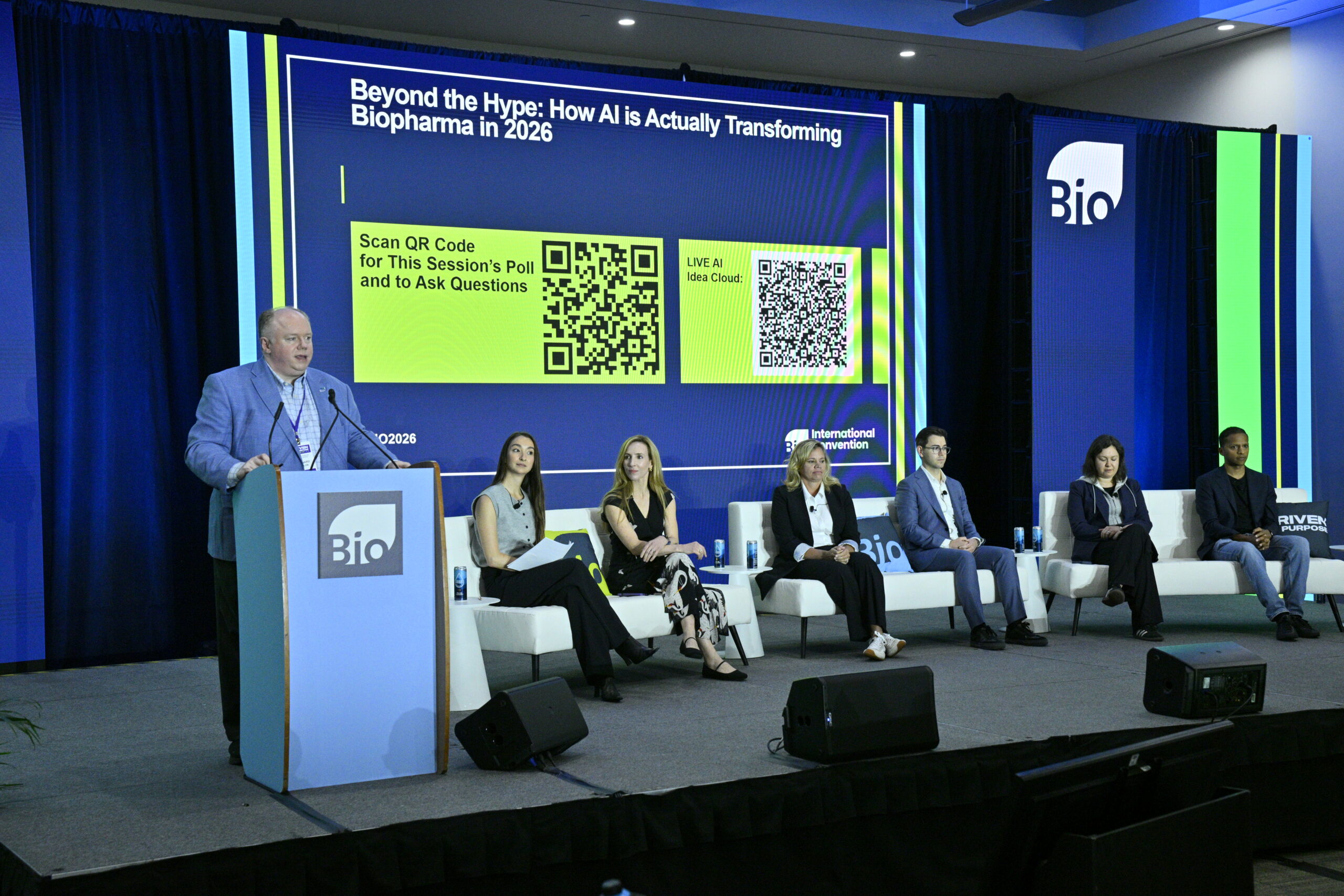
Artificial Intelligence is on the lips of everyone at the 2026 BIO International Convention.
And as the second-annual AI Summit began on June 22, everyone was talking about one headline in particular: the $2.5 billion deal between Insilico Medicine and SK Biopharmaceuticals. The deal leverages Insilico’s Pharma.AI platform with SK Biopharmaceuticals’ expertise.
With this ramp-up in technology and dealmaking, the AI Summit explored several key questions. Where is AI delivering? What does effective adoption look like? How do we ensure we have high-quality datasets to train effective scientific agents?
“We have to think about how we’re going to get smarter about the medicines that we’re inventing for patients, and how we can bring massive amounts of data that we have now to the research forefront,” said Fritz Bittenbender, Senior Vice President of Public Affairs and Access at Genentech and BIO Board Chair. “How can we use AI to actually sift through that data and find targets faster? How can we use AI to help us develop molecules that would take scientists years and years to develop what we can do in months or weeks now?”
Where is AI delivering today?
Many of the conversations focused on where AI is most effectively used today.
As Benchling found in their 2026 AI Report, the highest rate of effective usage has been in “knowledge extraction (76% adopting), protein structure and property models (71%), scientific reporting (66%), and target identification (58%).”
The turnaround time when using these tools is notable: “50% of biotechs report faster time-to-target today and 56% expect cost reductions within two years as automation and agentic workflows scale.”
In some cases, lab experiments are going from months to days, while agents are training on available data to perform even faster down the line.
“It’s not perfect yet,” warned Joshua Meier, Co-Founder of Chai Discovery. “But we’re in a very different regime now than we were even a year ago. I think that’s one of the reasons why we’re just starting to see even more progress, because when you can use the models to then go and generate more data, then you’ve got this really exciting flywheel.”
Good data is key to good AI agents – and there is plenty of it out there. Yet access remains difficult for many reasons.
“It’s difficult sometimes in a larger, sort of more conventional R&D organization to just generate a lot of data just because,” noted Mary Rozenman, Ph.D., CBO/CFO at Insitro.
Rozenman recalls the early days of AI, when Insitro’s founder, Daphne Koller, literally wrote the book on probabilistic graphical models. “One of the early concepts was that there is a tremendous amount of information content in data that captures human health and disease,” explained Rozenman. If researchers went in objectively, without a pre-existing hypothesis and with the right computational tools, they would likely uncover important insights.
“It still feels hard for people to trust-fall into their data,” observed Rosenman.
‘Most organizations are adopting AI incorrectly’
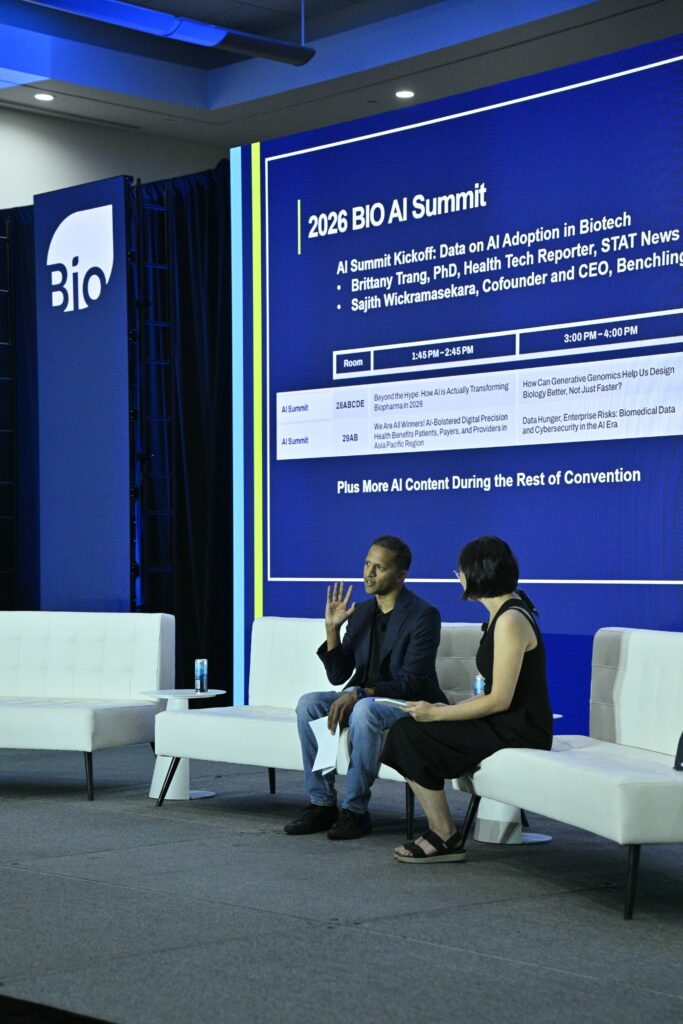 As many experts pointed out throughout the day, adoption overall is broad rather than deep.
“Senior executives have to lead from the front, and they have to not just be cheerleaders, but also be users of the technology,” said Sajith Wickramasekara, CEO and co-founder of Benchling.
“My core contention is that most organizations are adopting AI incorrectly,” admitted Wickramasekara. “They are sprinkling a little bit of it on their jobs as it is, and it requires more of a fundamental rethink.”
Wickramasekara pointed to Cutko knives and the door-to-door salespeople of yesterday. Say it’s 2003, and Jack and Jill are selling knives just as the internet age is taking off. Jack spends every day going door-to-door and only experiments with digital advertising in the evening and on the weekends. He gets one or two more leads, and he feels good. Jill, on the other hand, stops going door-to-door completely. Her sales dry up, but after a year, she is able to get back up to flat sales.
“But if you ask yourself, who’s better off a year later, two years later, the answer is, I think, pretty obvious – nobody sells knives door to door anymore,” Wickramasekara pointed out. “Every pre-AI company of any scale is kind of being Jack right now, and that they need to be Jill.”
How biotechs can incorporate AI
As the panelists discussed, AI can quickly solve time and cost problems in R&D, even if the initial price tag is steep.
“What’s wild about that is that not only are we sitting faced with these once-in-a-lifetime – or many lifetimes – technologies, not only are we sitting with this vast unmet patient need, but people are doing the same thing over and over again,” said Rozenman.
“It totally makes sense why people don’t want to embrace clinical risk upfront,” she continued. “We’re all taught to reduce the risk, but at this moment with this incredible set of technologies and the pace of innovation, the models are just getting better and better and better. We should be challenging ourselves as an industry to do better and identify a way to get therapeutic programs not only first in class, but also with a higher probability of success.”
“At this moment, we all owe ourselves and each other and patients that kind of bold perspective.”
Her words were met with spontaneous applause.
The post BIO 2026: Where AI is delivering – and where biotech must go next appeared first on Bio.News.
Apa Reaksi Anda?
 Suka
0
Suka
0
 Kurang Suka
0
Kurang Suka
0
 Setuju
0
Setuju
0
 Tidak Setuju
0
Tidak Setuju
0
 Bagus
0
Bagus
0
 Berguna
0
Berguna
0
 Hebat
0
Hebat
0