






































































Blocking Protein Slows Pancreatic Tumor Growth and Reduces Immune Suppression in Mice
Researchers headed by a team at Fox Chase Cancer Center have identified a protein called anoctamin 6 (ANO6) as potential therapeutic target for pancreatic ductal cell adenocarcinoma (PDAC), the most common form of pancreatic cancer. The team’s research discovered that ANO6 helps pancreatic cancer cells obtain nutrients from surrounding cells while suppressing the immune system’s ability to fight tumors. In particular, ANO6 enables cancer-associated fibroblasts (CAFs)—cells that make up much of the dense tissue surrounding pancreatic tumors—to transfer cholesterol and other lipids to cancer cells.
In preclinical tests the scientists demonstrated that blocking ANO6 slowed tumor growth and reduced immune suppression. “These findings help explain how pancreatic cancer cells obtain essential nutrients despite the unusual structure of the pancreatic tumor microenvironment,” said Igor Astsaturov, MD, PhD, a professor at Fox Chase. “Cancer-associated fibroblasts are not passive bystanders. They actively support tumor growth by transferring lipids to cancer cells.”
Astsaturov is co-senior author of the researchers’ published paper in Nature Cancer, titled “ANO6-mediated trogocytosis of cancer-associated fibroblasts promotes pancreatic cancer cell growth and immune suppression,” in which they reported “Blockade of ANO6 antagonizes tumor growth, partly by disrupting cholesterol delivery to cancer cells, and attenuates immune suppression, identifying ANO6 as a candidate therapeutic target in PDAC.”
Pancreatic ductal adenocarcinoma is surrounded by dense connective tissue and has relatively few functional blood vessels as these collapse due to the expansion of CAFs and their self-generated collagenous fibers acting as a functional unit. How cancer cells obtain nutrients such as cholesterol in this environment isn’t well understood. “How PDAC cells obtain membranous lipids such as cholesterol has, therefore, remained unclear and resolving this could reveal a therapeutic strategy,” the authors wrote.
“We found that CAFs can act as a source of these nutrients,” said co-senior author Edna Cukierman, PhD, professor and co-leader of the Cancer Signaling and Microenvironment Program at Fox Chase. “Using laboratory and animal models, we discovered that CAF units acquire cholesterol from the bloodstream and transfer it to nearby pancreatic cancer cells through a process called trogocytosis.”
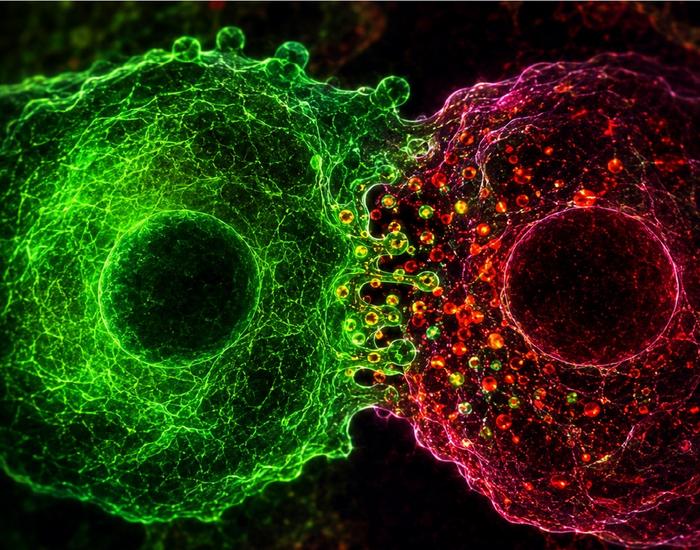
The study showed that during trogocytosis, cancer cells take small pieces of the CAF cell membranes, allowing them to acquire cholesterol and other lipids needed for survival and growth. In their paper the authors further explained, “… we show that CAFs transfer exogenous cholesterol and other nutrients through contact-dependent transfer of plasma membrane (PM) fragments, a process known as trogocytosis (trogo, ‘to gnaw’), whereby PDAC cells nibble CAF membranes.”
The process depends on ANO6, which helps prepare the CAF membrane for transfer. When researchers reduced or eliminated ANO6 in CAFs, the cells were less able to support pancreatic cancer cell survival as effectively. In mouse models, tumors supported by ANO6-positive CAFs grew substantially faster than those without functional ANO6.
The study also showed that the same process can interfere with the immune response. CAFs form direct contacts with cytotoxic T lymphocytes (CTLs), immune cells that can recognize and kill cancer cells. During these interactions, the T cells can acquire CAF membrane material, including cholesterol. Excess cholesterol in the tumor environment can contribute to T-cell exhaustion, making the immune cells less effective.
“CAFs also inhibit T cell activity in pancreatic tumors, a major barrier to immunotherapy in this cancer type,” the investigators noted. “We link this immunosuppression to trogocytosis of the CAF membrane by cytotoxic T lymphocytes (CTLs), which causes CTL exhaustion, and show that ANO6 inhibition in CAFs attenuates it.”
Astsaturov further commented, “With Serge Fuchs, professor at the University of Pennsylvania and co-author on the paper, we were surprised to find that the same cellular mechanism can benefit the tumor in two ways—by supplying cancer cells with lipids while also weakening cancer-fighting T cells. Targeting ANO6 could potentially disrupt both of these tumor-supporting functions at the same time.”
The team’s studies in mouse models showed that blocking ANO6 reduced cholesterol accumulation in tumor-infiltrating T cells and improved markers of T-cell activity. Laboratory experiments also showed that T cells exposed to CAFs with reduced ANO6 had greater cancer-killing activity. Cukierman commented “Excitingly, reducing ANO6 expression also disrupted the stromal synapse-mimicry circuit we previously identified, which coordinates tumor nutritional support, CAF-unit metabolism, and immune suppression. These findings position ANO6 as the missing mechanistic link that unifies nearly a decade of discoveries by our team.”
The researchers tested whether disrupting ANO6 could slow pancreatic cancer growth. In mouse models, treatment with the niclosamide or clofazimine—drugs that inhibited ANO6-dependent activity in the study—significantly reduced tumor weight. Niclosamide also reduced the delivery of cholesterol to pancreatic cancer cells.
The researchers noted that trogocytosis is one of several ways pancreatic cancer cells may obtain lipids, and that further research is needed to determine whether selectively targeting ANO6 could be an effective treatment strategy. The ANO6-targeting drugs used in the study may also be deployed to treat other recalcitrant cancers beyond pancreatic adenocarcinoma. And as the team further noted, “Both agents may inhibit targets unrelated to ANO6 and there remains a possibility that their antitumor activity is not exerted solely through trogocytosis.” Still, they stated, “With that caveat, these well-tolerated and inexpensive compounds provide a tractable pharmacological entry point for testing ANO6 blockade and support the development of selective ANO6 inhibitors for CAF-rich desmoplastic tumors such as pancreatic cancer.”
Astsaturov added, “We believe our findings identify ANO6 as a potential therapeutic target that could simultaneously disrupt the nutrient supply supporting pancreatic cancer cells and reduce the immune-suppressive effects of the tumor microenvironment.”
The post Blocking Protein Slows Pancreatic Tumor Growth and Reduces Immune Suppression in Mice appeared first on GEN - Genetic Engineering and Biotechnology News.
Apa Reaksi Anda?
 Suka
0
 Kurang Suka
0
 Setuju
0
 Tidak Setuju
0
 Bagus
0
 Berguna
0
 Hebat
0