




































































No Nonsense: David Liu Lauds Progress in Disease-Agnostic Gene Editing at ESGCT
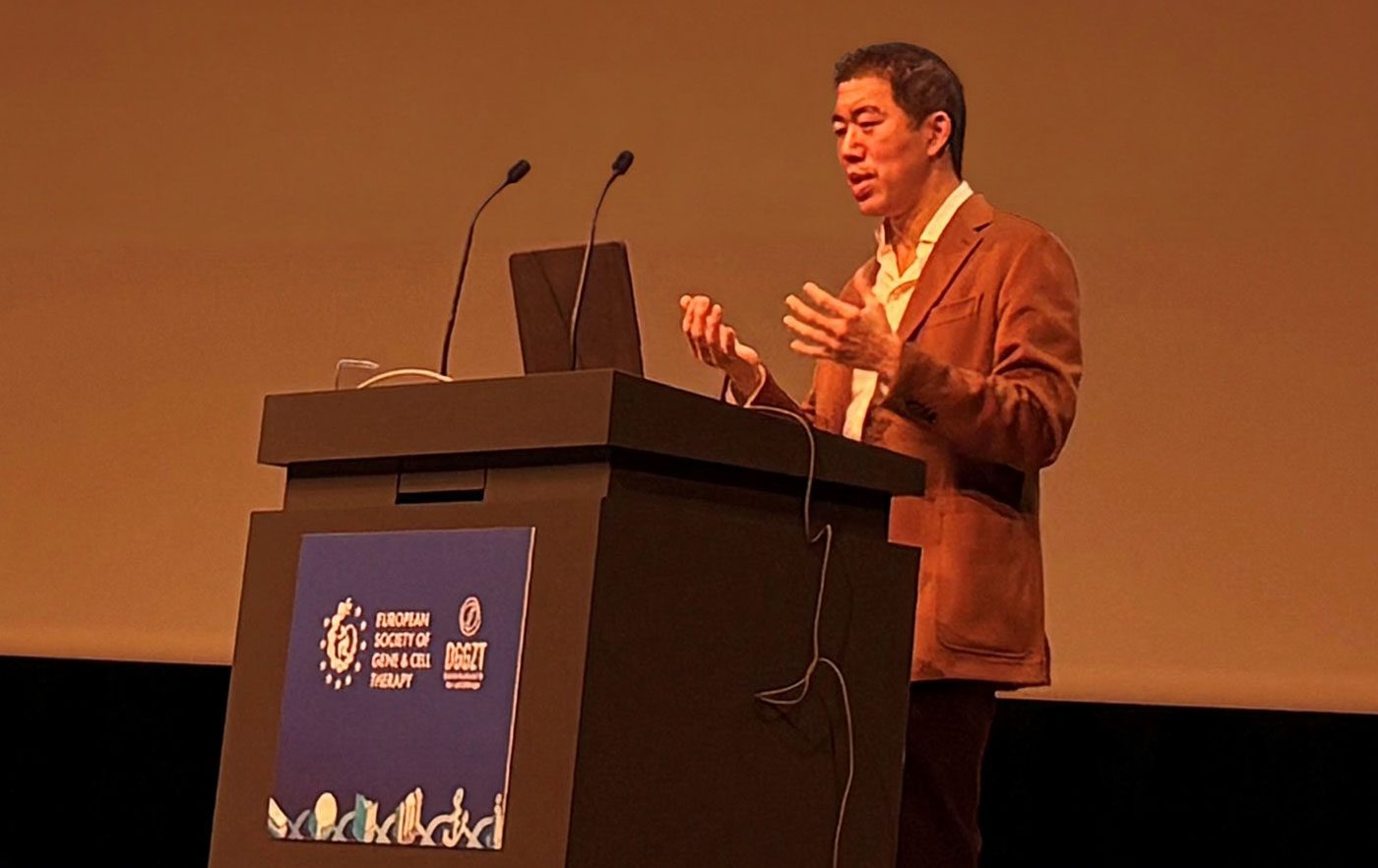
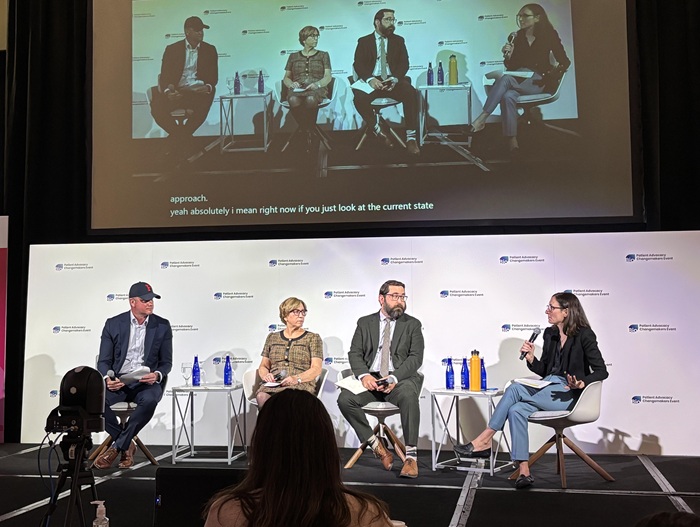
HAMBURG—The distinguished researcher who had the dubious honor of speaking before David Liu, PhD, in a plenary session at the European Society of Gene & Cell Therapy (ESGCT)—2018 Kavli Award winner Virginijus Siksnys, PhD—opened his talk with a bashful admission: “I’m just the warm up for David,” the Lithuanian chuckled.

Liu ensured that his return visit to ESGCT (having spoken at the congress in Barcelona in 2019) would be one of the highlights of the conference. The “meta lesson” of the past few years in therapeutic genome editing, Liu began, is that different scientific approaches and applications can synergize with regulatory, manufacturing, and economic advances “to achieve the mission we’re on.”
That mission is already confronting the immense challenge of expanding the early clinical promise of genome editing beyond the vanishingly long tail of genetic diseases. There are more than 200,000 known mutations responsible for some 8,000 known genetic diseases, affecting roughly 400 million families.
Liu’s journey into precision genome editing kicked off ten years ago with the publication of the first landmark base editing report. Prime editing (PE) was described three years later. The two technologies, both building off the CRISPR-Cas chassis, provide a vast repertoire of potential gene edits encompassing single-base substitutions and are being commercially driven by two biotech companies co-founded by Liu—Beam Therapeutics and Prime Medicine.
AI and PE
Liu gave two examples of how his lab is integrating artificial intelligence (AI) into the development of enhanced prime editing technology.
In the first example, published a few months ago in Nature Biotechnology, Liu’s lab used an AI tool called ProteinMPNN to improve the overall attributes of prime editors. In 2023, Liu’s lab used phage-assisted continuous evolution (PACE) to evolve prime editors in the lab. Although these evolved PE6 prime editors had higher activity, they tended to exhibit lower stability and expression levels.
ProteinMPNN, Liu said, excels at the inverse protein folding problem: generating sequences that can fold stably into a given structure. By allowing ProteinMPNN to redesign as many as 25 percent of the reverse transcriptase amino acids, the researchers were able to remedy stability deficits. The new PE8 variants show stronger expression and editing efficiencies in various cell types.
Another recent paper describes the development of a free machine learning tool called OptiPrime to predict prime editing outcomes. “We can’t call it Optimus Prime or Hasbro would sue us,” Liu joked.
Each pegRNA contains multiple regions that are subject to variability that can significantly impact PE efficiency. OptiPrime helps simplify the search through potentially hundreds of potential pegRNA variants that can all in principle engineer the same edit. Researchers can use the OptiPri.me website to generate a rank-ordered list of the top pegRNA candidates. The relevant information can be copied and pasted into the online order forms for a researcher’s favorite gene synthesis service.
Ten years after
By any measure, the pace of uptake and clinical potential of base and prime editing has been remarkable. Liu counted nine examples—representing he estimated one person-century of work—of precision genome editing rescuing disease phenotypes in animal models, including progeria, sickle cell disease, cystic fibrosis, phenylketonuria, and spinal muscular atrophy.
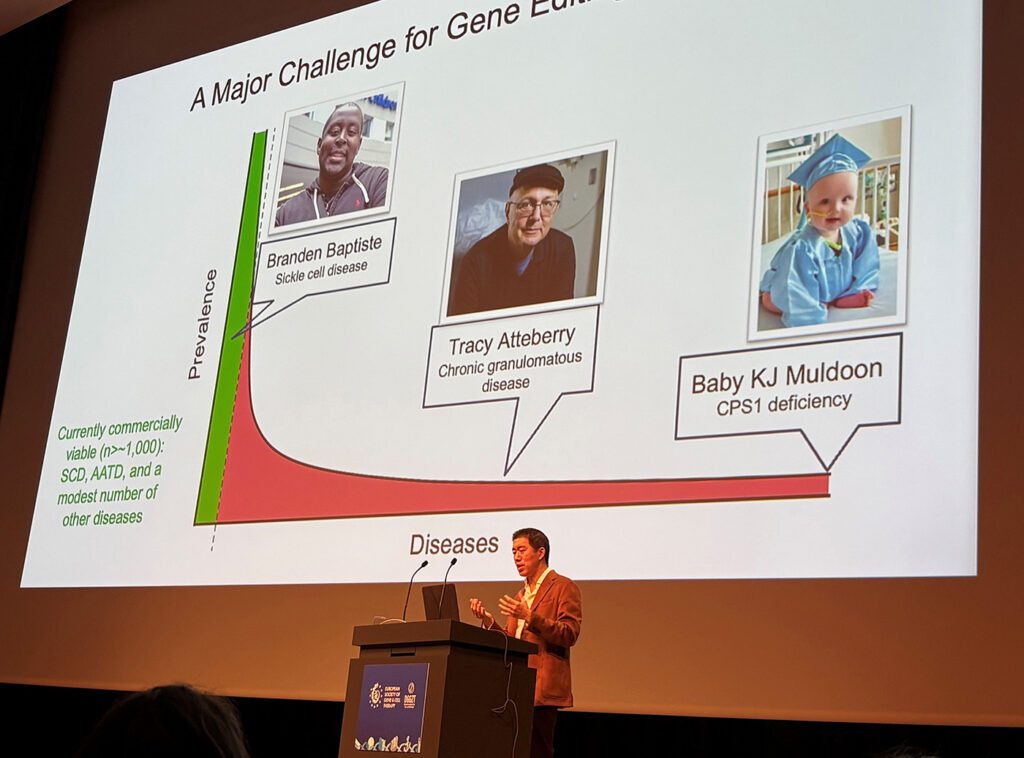
Several programs have progressed to IND-enabled studies and encouraging clinical results. In March 2025, Beam Therapeutics reported the first clinical correction of a human pathogenic mutation, a subject with alpha-1 antitrypsin deficiency (BEAM-302). Around the same time, the Baby KJ story, which revolved around bespoke base editing, captured the world’s attention, revealing that even babies aren’t prisoners to the mutations in their DNA.
Liu also pointed to clinical progress in prime editing. In April 2025, the first ex vivo prime editing patient—57-year-old Tracy Atteberry—was dosed (reported at the end of 2025 by Jennifer Gori, PhD, and colleagues). The 57-year-old Atteberry, from Nebraska, received prime-edited stem cells engineered to repair the two-base gene deletion. And in October, the first patient was dosed in an in vivo prime editing trial for Wilson disease (PM577a).
Liu said he was feeling optimistic because regulators in the U.S., U.K. and elsewhere in general “are not standing in the way.” There seems to be “a liberalization of policies around initiation and BLAs for drug approval.” Indeed, the day before Liu’s lecture, the U.S. Food and Drug Administration issued a well-received draft guidance, “Individualized Human Genome Editing Products: Considerations for BLA Submission and Postapproval Management.”
Disease agnostic approach
Liu closed by focusing on his group’s work in developing a multi-disease therapeutic approach using only a single treatment, which would benefit more patients than just those with a very rare mutation. Around 30 percent of genetic diseases feature at least one premature stop codon. As was reported last year, Liu’s team has pursued the idea of using suppressor tRNAs, which can read through the stop (or nonsense) codon, thereby restoring production of a full-length protein.
“A tRNA approach enables far fewer drugs to target a larger number of mutations/diseases,” Liu said.
There are 418 tRNA genes in the human genome, signaling considerable redundancy in translation as there are only 61 coding triplets. “You don’t need 418 tRNA genes,” he said. Many humans are lacking at least one of these tRNA genes, showing that humans can tolerate tRNA mutations. Liu’s idea was to “convert a dispensable tRNA into a permanent tRNA suppressor,” a method called prime editing-mediated readthrough of premature termination codons (PERT), which could be used as a one-time treatment for multiple genetic diseases that shared the same premature stop codon.
Led by postdoc Sarah Pierce, PhD, Liu’s lab used prime editing to convert each of the 418 human tRNAs into a suppressor tRNA, engineering each anticodon to the three triplets (CUA, UCA, and UUA) that recognize the three stop codons. As described in the 2025 paper, Liu’s team chose to focus on a leu tRNA, which exhibited the highest suppression activity. This was converted into an optimized suppressor.
“We’re not over-expressing this optimized suppressor tRNA,” Liu said. By only making about 40% of the tRNA that was replaced, Liu said he was “optimistic we can achieve suppression without over expression.” The most promising data so far comes from the use of PERT to treat a mouse model of Hurler syndrome. PERT treatment led to the expression of about seven percent of the wild-type enzyme activity, which Liu suggested “can rescue the disease.”
Although it is early days, Liu closed by saying he was “very hopeful that various therapeutic approaches… will help increase the applicability of gene editing to more and more patients.” However, “until regulatory streamlining and clinical derisking continues to drive the risk and cost lower and lower, the vast majority of genetic disease remain too rare to be pursued by industry.”
In one new effort to tackle rare diseases, researchers at the Broad Institute, Boston Children’s Hospital, and The Jackson Laboratory have partnered to establish a non-profit collaboration called the Center for Therapeutic Genetics (CTG) that, Liu said, “we hope is mimicked everywhere… to connect patients with rare diseases.”
The project has received initial commercial support from several companies, including Apertura and Viralgen, as well as Liu’s gene editing companies, Beam Therapeutics and Prime Medicine.
The post No Nonsense: David Liu Lauds Progress in Disease-Agnostic Gene Editing at ESGCT appeared first on GEN - Genetic Engineering and Biotechnology News.
Apa Reaksi Anda?
 Suka
0
 Kurang Suka
0
 Setuju
0
 Tidak Setuju
0
 Bagus
0
 Berguna
0
 Hebat
0