

































































Endurance sport’s hidden oral health challenge
After crossing Iceland by bike, kayak and on foot, Ben Atkins explores the oral health risks of endurance sport.
When you think about the physical demands of endurance sport, teeth are unlikely to be high on the list. With months of training to complete, calories to replace, kit to test, hydration to manage and injuries to avoid, oral health can easily become an afterthought – and perhaps surprisingly, that proved true even for an experienced dentist.
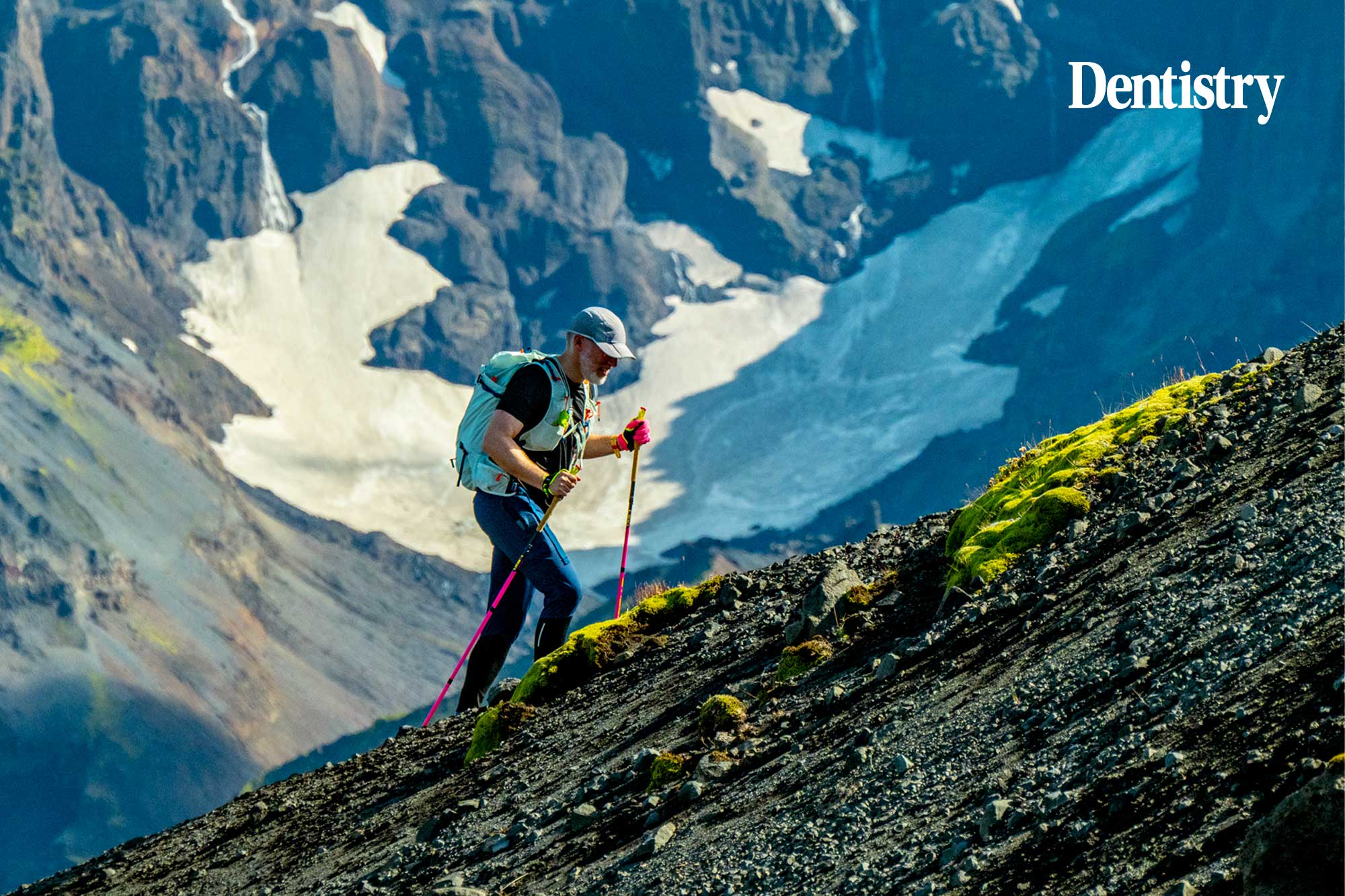
Dr Ben Atkins, a Manchester-based general dental practitioner and former president and long-standing trustee of the Oral Health Foundation, recently completed the Rat Race Iceland Coast to Coast. The challenge involved around 110km a day of off-road mountain biking over five to six days, approximately two hours of kayaking and a 44km ultramarathon-style finish.
He had spent around two and a half years rebuilding his fitness after serious back problems affecting three discs stopped him running and, for a period, left him without feeling in one foot. His preparation covered training, nutrition, hydration and equipment. His kit included a Philips Sonicare DiamondClean 9900 Prestige sonic toothbrush, toothpaste and interdental cleaning aids. Yet there was one risk he says he had underestimated: ‘I overlooked it. And this is my world.’
The endurance blind spot
For Ben, Iceland was about the experience rather than chasing a finishing time. ‘I wanted to absorb every detail and not hare through every stage,’ he says. ‘It was much more about the journey.’
The journey took him through black volcanic landscapes, river crossings, snow and green valleys, often in complete isolation. He had relatively little experience of technical mountain biking beforehand and, by the end, his cycling shoes had deteriorated so badly that they had to be cable-tied to his feet.
For six days, the group saw nobody outside the expedition. Against this backdrop, he began to appreciate an aspect of endurance sport that research suggests deserves greater attention.
A study of 352 elite and professional UK athletes found untreated caries in 49.1%, erosive tooth wear in 41.4% and gingival bleeding or calculus in 77%; 21.6% recorded probing depths of at least 4mm. Overall, 32% reported an oral health-related impact on sporting performance (Gallagher et al, 2018).
A related study found that 94.2% brushed at least twice a day, yet only 40% had visited a dentist in the previous six months and 80% used sports drinks during training or competition (Gallagher et al, 2019).
A 2026 review by Needleman, Gallagher and Ashley in the British Dental Journal concluded that oral disease remains common among elite athletes. It suggested that, because carbohydrates required to fuel training and competition cannot simply be removed, oral-health support is more realistically approached as risk mitigation.
When a healthy mouth becomes high risk
Endurance athletes may consume 90g of carbohydrate an hour or more for sustained periods, potentially keeping plaque pH depressed while high airflow and possibly stress can reduce saliva availability.
In Iceland, Ben experienced that combination himself. Food between stages was healthy and well planned, but once he was on the route he needed enough portable energy to sustain long days on the bike. By his estimate, he was burning around 6,500 calories a day.
‘You couldn’t avoid it. You needed that volume of food,’ he says. ‘The only way to get it in is cake.’
What concerned him most was not simply the amount of sugar, but the frequency of exposure. ‘A lot of people were on isotonic drinks, and they have sugar in them, so you have a sugar solution in your mouth for 12 hours, which is not something we do at home. I do worry about how that affected my mouth.’
Dry mouth was the greater surprise. ‘The dry mouth was a challenge, without question. I wasn’t even thinking about it,’ he says. ‘I know about sugar, but it was the dehydration that caught me out.’ His conclusion was simple: ‘You suddenly become a high-risk patient.’ Even a week and a half after returning home, Ben described his mouth as still feeling ‘shot’.
Prevention before performance
The experience has changed how Ben thinks about conversations with patients preparing for endurance events. One member of the Iceland group needed root canal treatment only two days before travelling, after developing a facial swelling.
‘The last thing you want is toothache in the middle of Iceland,’ Ben says. ‘You have spent a lot of money and a huge amount of time training, so get a good examination performed before you embark on a challenge and review anything that could go wrong.’
Rather than simply telling athletes to avoid gels or sports drinks that may be necessary for performance, he believes prevention needs to fit around how they actually train. This may mean checking oral health well before a major event, looking at the timing and frequency of carbohydrate exposure, following sugary gels or drinks with water where practical, and reviewing the patient again after an intensive period of training or competition (Needleman, Gallagher and Ashley, 2026).
‘We often think prevention is what we do when we see bleeding gums, but that is treatment,’ Ben explains. ‘Even if you have perfect oral health, you are about to assault your mouth.’
Keeping prevention on track
Ben continued using his Philips Sonicare throughout the trip and, as far as he could tell, was the only participant using an electric toothbrush. His normal routine became more thorough rather than less, with brushing increasing to three times a day and often taking place as soon as he came off the bike.
The brush’s AI-supported coverage map, displayed directly on the handle, showed which areas of his mouth he had covered and helped him identify places he had missed. However, the benefit he remembers most was more personal than technological.
‘It gave me five minutes away from everybody,’ he says. ‘Brushing your teeth, it’s that two minutes away. Let’s just reset.’
At the end of long days on the bike, the familiar routine gave him a few minutes to switch off before eating, showering, repacking his kit and preparing for the following morning. ‘By the time I’d brushed my teeth, I was like, okay, we’re okay again now. Now I can go.’
A different question for active patients
For Ben, asking a patient what they eat may not reveal the whole picture. Someone may eat well, brush twice a day and appear highly motivated about their oral health, yet during training or competition spend hours repeatedly exposing their mouth to carbohydrates while also experiencing dehydration.
‘We should speak to our patients about this,’ says Ben. ‘We should ask:
‘Are you training for something?
‘What are you doing during a sporting challenge?
‘What are your children drinking during a match?’
For dental teams, asking how patients fuel their sport could uncover a very different pattern of oral-health risk. Endurance sport has become increasingly sophisticated in the way athletes monitor training, nutrition, hydration, sleep and recovery, yet oral health can still fall between the gaps. If a dentist can overlook that risk while preparing to cross Iceland, it is worth asking how many active patients may be overlooking it too.
For references, email siobhan.hiscott@fmc.co.uk.
Create a free account for unlimited access — plus the Dentistry Bulletin delivered to your inbox.
Apa Reaksi Anda?
 Suka
0
 Kurang Suka
0
 Setuju
0
 Tidak Setuju
0
 Bagus
0
 Berguna
0
 Hebat
0