















































Health Innovation for All conference reimagines equitable care

HN Summary
• Hamilton Health Sciences’ third annual Health Innovation for All conference drew nearly 200 participants to explore ways to make care more equitable.
• Presenters showcased a social prescribing program that connects families with YMCA activities and infrared technology that makes hard-to-find veins easier to see during blood draws.
• The conference also highlighted remote monitoring for the first two weeks after surgery and ways hospitals can use data to identify gaps in care.
From cutting-edge technologies to community-driven solutions, Hamilton Health Sciences’ (HHS) third annual Health Innovation for All conference welcomed close to 200 leaders, clinicians, researchers, innovators, community partners, patients and learners from across Hamilton and Ontario to explore how innovation can play a key role in improving health-care equity.
HHS’ chief innovation officer Dr. Ted Scott and chief health equity officer Rochelle Reid welcomed participants to the Oct. 29 conference, held at the Hamilton Convention Centre.
“There’s a key aspect of innovation that we believe needs to be central, and that’s health equity,” said Scott. “When we’re creating solutions for our patients, families and communities, we need to ensure these innovations are accessible to all.”
A commitment to health equity goes beyond creating new innovations and technologies, added Reid. “Innovation has the power to help us see barriers that were previously invisible, identify gaps in access and outcomes, and design solutions that improve experiences for the people facing the greatest challenges.”
Making barriers visible
Health equity presentations explored how data can uncover gaps in care and help turn insights into action.
A From Insights to Action session featured a video presentation on HHS’ social prescribing program with Reid; HHS registered dietitian Elizabeth Chrystian; HHS clinical and health psychologist Dr. Sheri Nsamenang; YMCA of Hamilton Burlington Brantford vice president Genevieve Hladysh; and community member Cherrise Pinder, whose family was connected to the YMCA through HHS’ Ron Joyce Children’s Health Centre.
“It meant a great deal for us,” Pinder says in the video. A mother of three, her family accessed YMCA programming including the fitness area, swimming, basketball and indoor soccer to support their health and wellness needs.
Jennifer Lounsbury, HHS’ chief nursing information officer, presented on Technology and the Human Experience to share how technology can help more people access equitable care by making it easier to identify and respond to their social needs.
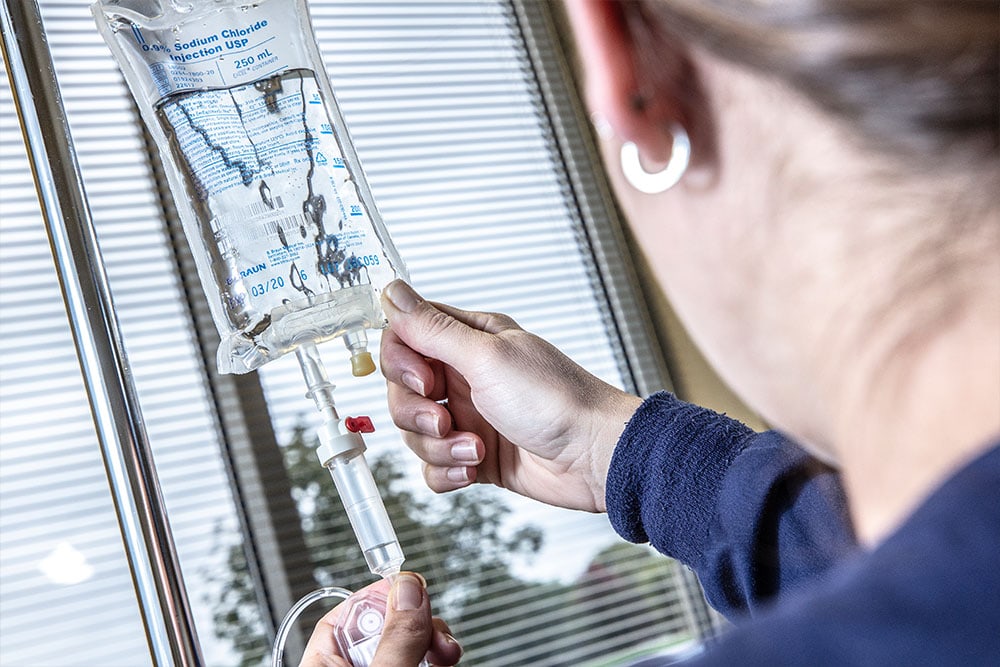
An Innovation at the Frontline presentation featured a demonstration of the VeinViewer Vision 2, a piece of equipment that uses infrared light to illuminate patients’ veins under the skin so they appear a glowing, electric green colour. This makes it much easier to see the veins, so a needle for drawing blood can be inserted in just one attempt.
Darker skin tones can make veins hard to find. Some people also have naturally small, thin veins, making them difficult to see. Session presenters were Denise Johnson, director of quality standards and corporate quality; Valerie Jansen, clinical leader with HHS’ McMaster Children’s Hospital’s pediatric emergency department; and Charmaine Neu, a physiotherapist at HHS’ Juravinski Hospital and Cancer Centre (JHCC).
Health care of tomorrow
Presentations also featured ways that innovative care models are transforming how patients recover and access support after leaving the hospital.
The first 14 days: A patient-eye view of recovery featured a panel discussion on the PROTECT Lab’s Continuus Health program. Based at JHCC, this program provides virtual care and remote home monitoring to support patients as they recover from surgery safely at home for two weeks after being discharged from hospital. The PROTECT Lab is a joint initiative of HHS, the Population Health Research Institute (PHRI) and HHS’ key academic partner, McMaster University. The world-renowned PHRI is a joint research institute of HHS and McMaster.
Panel members included Samantha Ogilvie, a patient who received care from the Continuus Health program while recovering at home from heart surgery.
“It felt like I had my own personal nursing team with me during my recovery,” said Ogilvie, who had high praise for the program and found the at-home monitoring equipment easy to use.
Joining Ogilvie on the panel were Kanae Nagatani, the program’s clinical leader; Heidi Vuylsteke, a registered nurse who recruits patients for the program and also monitors them from the lab; and Dr. Sandra Ofori, a cardiologist, PHRI researcher and co-lead of the lab’s postoperative virtual care research program. Session moderator was Dr. Michael McGillion, who also co-leads the postoperative virtual care research program. McGillion is a PHRI scientist, acting vice-dean in McMaster’s Faculty of Health Sciences and executive director of the McMaster School of Nursing.
Dr. Shiran Issacksz, the University Health Network’s (UHN) clinical vice president of Altum Health, presented on UHN Connected Care: Transform Experience, Transform Care. Issacksz shared how UHN redesigned care delivery so patients experience coordinated care across hospital, home care, primary care and community services.
From data to better care
Canada’s health systems generate enormous amounts of data and knowledge, but turning those insights into better patient outcomes remains a challenge. Presentations explored how health-care teams can use data and real-world experience to continually learn, adapt and improve care, helping deliver better outcomes and more equitable care for patients.
A panel discussion, Conversations from Learning Health System Leaders, was moderated by Scott and featured Dr. Andrea Eisen, an HHS medical oncologist, renowned researcher, and Buffett Taylor Chair in Breast Cancer Research; Dr. Marissa Bird, learning health system scientist with the Institute for Better Health and practice-based research lead for Trillium Health Partners; and Dr. Geetha Mukerji, endocrinologist and clinician in quality and innovation and University of Toronto and Women’s College Hospital Institute of Health Systems and Virtual Care.
Dr. Laura Desveaux, director of the Learning Health System Leadership Centre and a scientist with the Institute for Better Health, Trillium Health Partners, also presented on, From Data to Learning: Why Canada’s Health Systems Generate Knowledge but Struggle to Use It.
Keynote speakers: Ideas worth sharing
Opening keynote speaker Dr. Muhammad Mamdani shared insights on health innovation in the AI era. Mamdani is the clinical lead of AI at Ontario Health and director of University of Toronto’s Temerty Faculty of Medicine Centre for Artificial Intelligence Research and Education in Medicine.
Closing keynote speaker Dr. Andrew Boozary presented on The Promise of Universality: Building a More Equitable and Resilient Health System. Boozary is a primary care physician, policy practitioner, researcher, and founding executive director of the Gattuso Centre for Social Medicine at UHN.
“The conversations shared throughout the day demonstrated that innovation takes many forms, from breakthrough technologies to community partnerships and frontline problem-solving,” said Scott.
“Together, our presenters underscored our commitment to building a more equitable, connected and patient-centred health system at HHS and beyond.”
The post Health Innovation for All conference reimagines equitable care appeared first on Hospital News.
Apa Reaksi Anda?
 Suka
0
 Kurang Suka
0
 Setuju
0
 Tidak Setuju
0
 Bagus
0
 Berguna
0
 Hebat
0