









































%20and%20Batch%20Production%20Records%20(BPR).png)













We aim to be a truly integrated partner across modalities
Aurigene has announced plans to invest around $100 million. What are the key areas where this investment will be deployed, and where do you expect it to have the greatest impact on the company’s growth and capabilities?
The investment is aimed at the areas where we see the most customer demand and where the industry has the least capacity:
- Peptide research and manufacturing
- Capacity expansion for our core platforms
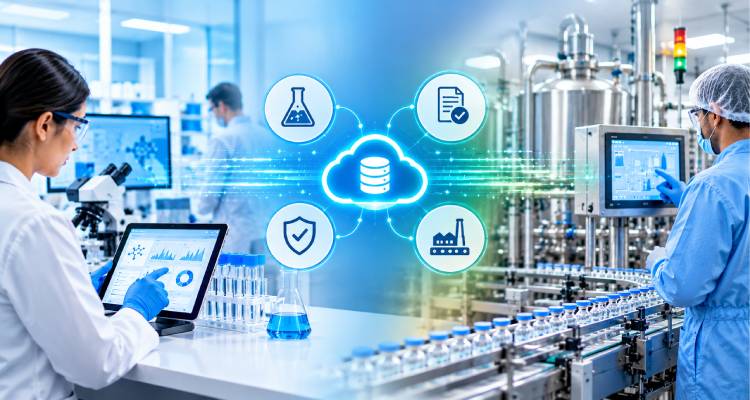
- Digital and AI platforms
- Biologics infrastructure
The impact will be greatest where these areas connect, for example peptides and biologics that move from our discovery labs into development and manufacturing without a tech-transfer gap. The aim is to take on larger, more complex programmes and support them through to commercial supply.
Aurigene, together with its parent company Dr Reddy’s, recently signed a long-term agreement with a leading global pharmaceutical company for technology transfer and commercial drug-product manufacturing and supply of a diversified portfolio. How significant is this agreement for Aurigene, and are you seeing similar interest from other pharmaceutical and biotech companies?
This is one of the most important agreements in Aurigene’s journey. It is a 10-year master agreement covering technology transfer and commercial manufacturing of products across sterile injectables, biologics and topicals. The products will be made across five Aurigene / Dr Reddy’s sites in India, with revenue expected from calendar year 2028 . It gives us long-term visibility, and it shows that a global innovator trusts our drug-product capabilities, particularly in sterile injectables and biologics.
We are seeing growing interest of the same kind. Large pharma companies are cutting down their external manufacturing networks and moving from product-by-product outsourcing to fewer, strategic partners. That trend suits an integrated player like us. We already have multi-year commercial contracts with three of the top five innovator pharma companies. We are in active discussions with several global pharma and biotech companies. We will share more when those agreements are signed.
How is Aurigene leveraging AI and other emerging technologies across the drug discovery process—from target identification and validation to molecule design, optimisation and candidate selection?
AI is built into how we run discovery. Aurigene.AI combines generative design, predictive modelling and computational chemistry, and it is directly integrated with our wet chemistry and biology labs. The models suggest molecules; our chemists make and test them quickly.
This lets us run our integrated drug discovery (IDD) programmes more efficiently: we need fewer cycles, make better choices about which compounds to synthesise, and reach candidates faster. All programme data is used only for that programme and that customer. A good example is our collaboration with Alveus Therapeutics, a biotech company developing next-generation therapies for obesity and metabolic disease. We combined Aurigene.AI with our medicinal chemistry and integrated biology platforms to support their discovery programmes. Together, we nominated ALV-200, a highly selective AMYR3 peptide candidate, as the first development candidate. Other discovery programmes under the collaboration are still ongoing. Across our integrated discovery work, we have delivered
around 75 projects, and six are now in the clinic.
What are the biggest challenges currently facing the drug discovery and development ecosystem, from target identification and validation to clinical development, and how is Aurigene addressing these challenges?
First, capital efficiency. Biotech funding has become more selective, and innovators have to show more data with less money and in less time. Every experiment and every month has to count. This is where India has a real advantage. We have a large pool of experienced chemists and biologists, and the cost of running discovery and development here is competitive. At Aurigene, we combine that talent with Aurigene.AI and our integrated wet
labs. Partners get more work done for every dollar they spend, and they reach decision points sooner.
Second, supply-chain risk. Recent years have shown the danger of relying too much on a few countries or single suppliers. Innovators are now reviewing where their molecules are developed and made, and they want partners they can trust over the long term. India is increasingly the natural choice. We add to that with R&D in India and the UK and manufacturing in India, the UK and Mexico, so we can offer customers geographic flexibility
and supply security.
Third, quality and trust at scale. Indian CDMOs have often had to prove that they can deliver innovator-grade quality, not only cost advantage. Our track record answers that. We have 16 USFDA-inspected facilities and have taken 20 NCEs to commercialisation.
Across all three, our answer is integration. Discovery, development and manufacturing sit under one roof, so innovators avoid the delays and risks of moving a programme between vendors. For our partners, that means lower cost, less risk and faster timelines, delivered from Aurigene to global standards.
Which therapeutic areas have the strongest demand?
CNS, oncology, immunology and metabolic disorders remain our strongest areas. Metabolic disease, especially obesity, has grown sharply, and it is pushing demand for both peptides and small molecules. Our discovery collaboration with Alveus Therapeutics is a good example. Working together, we nominated ALV-200, a selective AMYR3 peptide candidate for metabolic disorders. We also see strong growth in targeted therapies and in modalities
such as bispecifics, peptide conjugates and complex injectables. In these areas, customers need a partner that can handle both the science and the scale-up Q3. Use of AI and emerging technologies AI is built into how we run discovery. Aurigene.AI combines generative design, predictive modelling and computational chemistry, and it is directly integrated with our wet chemistry and biology labs. The models suggest molecules; our chemists make and test them quickly.
This lets us run our integrated drug discovery (IDD) programmes more efficiently: we need fewer cycles, make better choices about which compounds to synthesise, and reach candidates faster. All programme data is used only for that programme and that customer.
A good example is our collaboration with Alveus Therapeutics, a biotech company developing next-generation therapies for obesity and metabolic disease. We combined Aurigene.AI with our medicinal chemistry and integrated biology platforms to support their discovery programmes. Together, we nominated ALV-200, a highly selective AMYR3 peptide candidate, as the first development candidate. Other discovery programmes under the collaboration are still ongoing. Across our integrated discovery work, we have delivered around 75 projects, and six are now in the clinic.
What will be your key priorities over the next three to five years?
We aim to be a truly integrated partner across modalities, taking a programme from discovery through development to commercial supply. We have taken 20 NCEs through to commercialisation and have 4 R&D centres with 16 USFDA-inspected facilities. We work across small molecules, peptides and biologics, and our next priority is to scale this integration. Our global presence is a big part of this, especially in today’s complex and fast-
changing geopolitical environment. We have R&D centres in India and the UK, and manufacturing in India, the UK and Mexico. This gives our partners geographic flexibility and supply security.
Over the next three to five years, we will focus on:
- Converting our relationships with large pharma into long-term, multi-product/platforms partnerships
- Building a full stack peptide CRDMO
- Scaling AI-led integrated drug discovery
- Expanding into newer modalities such as ADC, biologics and complex drug products
Sanjiv.das@expressindia.com
sanjivdas1@gmail.com
The post We aim to be a truly integrated partner across modalities appeared first on Express Pharma.
Apa Reaksi Anda?
 Suka
0
Suka
0
 Kurang Suka
0
Kurang Suka
0
 Setuju
0
Setuju
0
 Tidak Setuju
0
Tidak Setuju
0
 Bagus
0
Bagus
0
 Berguna
0
Berguna
0
 Hebat
0
Hebat
0