




































How to Run an Elimination Diet for Your Dog (and Why Most Fail)

There is no blood test that reliably diagnoses food allergy in dogs. There is one method that works, and it is slow, strict and cheap: take the suspected trigger away and see what happens. The reason so many attempts fail has nothing to do with the food. It is the dental stick on day nine.
First, is it worth doing?
Food allergy affects somewhere between one and seven per cent of dogs. It usually shows early, within the first year in 30 to 50 per cent of cases and by the age of three in most. The signs are mainly on the skin, so a dog with a perfect stool can still have a food allergy.
 Itching around the face, belly and flanks
 Ear scratching and infections that keep returning
 Paw licking, scooting and an itchy bottom
Some dogs also show gas, intermittent loose stool, or vomiting close to mealtimes.
Before you start, your vet should rule out the more common causes of the same symptoms: fleas and other parasites, environmental allergies, and secondary yeast or bacterial infections. Starting an elimination diet without that step is how people spend three months proving nothing.
Choosing the protein
The principle is simple. A dog is very unlikely to be allergic to something it has never eaten. So the diet is built on one protein your dog has never had and one carbohydrate your dog has never had, and nothing else.
That makes the first job a list. Write down every food, treat and chew your dog has eaten in their life, as far as you can. Then look at what is left. For most UK dogs, beef, chicken, lamb, turkey, pork, fish, wheat, rice and potato have all been on the menu at some point, which is why the proteins used for elimination diets are the unusual ones: kangaroo, ostrich, goat, quail, horse, rabbit.
The alternative route is a hydrolysed diet, where the protein is broken into fragments too small for the immune system to recognise. These are prescription foods and worth discussing with your vet, particularly if the list of never-eaten proteins is short.
of food-allergic dogs in a meta-analysis reacted to beef, dairy or wheat, and about a quarter to chicken (meat or egg), soya or lamb. The common proteins are common triggers precisely because so many dogs have eaten so much of them.
Home-cooked or commercial?
The textbook version is home-cooked: one meat, one carbohydrate, boiled. It is the purest form of the test, and it is also the one owners give up on, because it takes daily effort and, fed for more than a couple of weeks, it is not nutritionally complete. Dogs are whole-body eaters; meat and rice alone is short of the minerals, vitamins and fatty acids they need.
A commercial complete food with a single novel protein and a single carbohydrate does the same job, is balanced, and survives contact with a busy week. Read the ingredients list, not the front of the bag: "single protein" should mean one animal source anywhere in the recipe, including the fat and the flavouring.
How long it takes
weeks for a clear answer, and up to twelve in some dogs. Skin takes far longer than the gut to calm down, so judge at week three at the earliest and week six ideally, not after ten days.
The test is completed by re-challenging: once the symptoms have gone, feed the old food again. If they return within days to a couple of weeks, the diagnosis is made. If they do not, the food was not the problem, which is also useful to know.
What "nothing else" means
This is where it fails. Even a tiny amount of the trigger can restart the reaction, and every restart resets the clock. So for the whole period:
| Out | Why |
|---|---|
| Treats, training treats, biscuits | Almost all contain a common protein or wheat. |
| Dental sticks and chews, pig's ears, rawhide | Animal origin, often beef or pork, and hard to digest. |
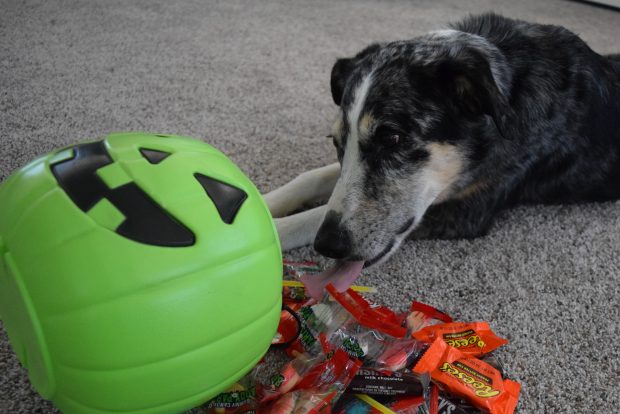
| Table scraps, the toast crust, the last bit of cheese | The most common breach, usually by someone who "just gave him a little bit". |
| Flavoured medication, wormers and supplements | Check with your vet; many use beef or chicken flavouring. |
| Toothpaste, pill pockets, peanut butter in the Kong | Same reason. |
| Other dogs' bowls and the cat's food | Feed separately. |
Everyone in the household, and the dog walker, and the grandparents, has to be told. If you need to reward during training, use pieces of the elimination food itself.
What to do with the result
If the diet worked and the re-challenge confirmed it, you have three options. Stay on the elimination food long term, which is simplest. Or, with your vet, reintroduce single ingredients one at a time, two weeks each, to find exactly which protein is the problem and widen the menu. Or a mixture of the two.
If the diet did not work after twelve weeks of genuine strictness, the problem is probably not food, and your vet will look at the environmental and skin-barrier causes instead. A small number of dogs do not respond to any elimination diet for immune reasons that are not yet understood, so a failed trial is information, not a failure.
- your dog is a puppy, pregnant, or has another health condition; elimination foods are formulated for adults and may need supplementing
- the skin is broken, infected or very sore; that needs treating alongside the diet, not instead of it
- there is weight loss, vomiting or persistent diarrhoea alongside the itching
Where our food fits, and where it does not
Our kangaroo, ostrich and goat recipes are single-protein complete foods, which is what an elimination diet needs. They are suitable if, and only if, your dog has never eaten that protein before. If your dog has had kangaroo treats, kangaroo is no longer novel for them and you should pick something else. That is also why we would rather you did not feed novel proteins to a healthy dog "just in case": it does not prevent allergy, and it uses up the options you may need later.
Tell us what your dog has eaten and we will say which recipe, if any, would give you the cleanest trial.
Ask which protein is still new for your dog
Written with the Happy Dog veterinary team. Based on "Sensitive stomach in dogs and cats: causes and nutrition" by Pascale Huber, veterinarian, "The search for the right diet: a real challenge in food allergy" by Cornelia Günther, veterinarian, and "Gastrointestinal disease in the dog: feeding tips" by Pascale Huber. Reviewed for Happy Dog UK, September 2026. General information, not a substitute for veterinary advice.
- Classen J, Klinger CJ, Mueller RS: Allergien bei Hund, Katze und Pferd. Allergologie 39, 2016.
- Verlinden A, Hesta M, Millet S, Janssens GPJ: Food allergy in dogs and cats: a review. Crit Rev Food Sci Nutr 46:259–273 (2006).
- Rade C: Futtermittelallergien bei Hund und Katze: Ein Update der diätetischen Möglichkeiten. Kleintiermedizin 5-2011.
- Kohn B, Schwarz G: Praktikum der Hundeklinik, 12th ed. Thieme 2017.
- Dillitzer N: Tierärztliche Ernährungsberatung, 2nd ed. Elsevier 2012.
Apa Reaksi Anda?
 Suka
0
Suka
0
 Kurang Suka
0
Kurang Suka
0
 Setuju
0
Setuju
0
 Tidak Setuju
0
Tidak Setuju
0
 Bagus
0
Bagus
0
 Berguna
0
Berguna
0
 Hebat
0
Hebat
0